 Infozion Technologies LLPInfozion Technologies LLP




ERP vs CRM – What’s the Difference? A Complete 2025 Deep-Dive Guide
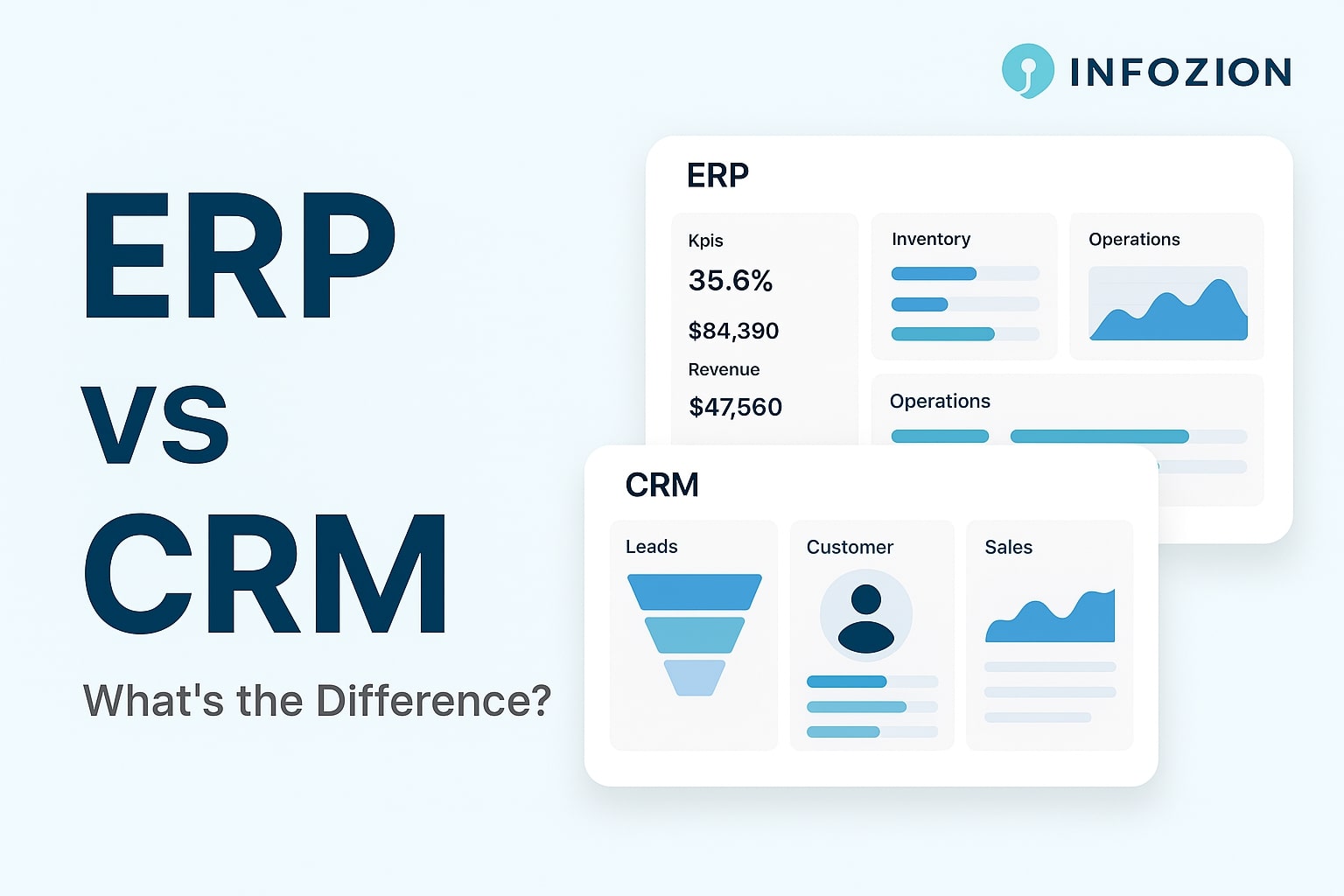
ERP vs CRM – What’s the Difference? A Complete 2025 Deep-Dive Guide
Introduction
Businesses today rely heavily on software to manage their daily operations, sales activities, customer communication, and financial processes. As companies grow, two systems become extremely important: ERP and CRM. Many business owners often compare both and try to understand ERP vs CRM clearly, because choosing the right system affects the entire workflow. In reality, ERP and CRM serve very different purposes. CRM helps a business get customers, while ERP helps the business run smoothly from the inside.
In this detailed 2025 guide, we will break down the difference between ERP and CRM in the simplest possible way. You’ll understand what each system does, how they work, how they impact your business, and which one you should choose. Whether you are a new business owner, a manager, or a student learning technology, this guide will help you make complete sense of these two powerful systems.
What Are ERP and CRM? (Beginner-Friendly Explanation)
What Is ERP?
ERP stands for Enterprise Resource Planning. It is a complete business management software that connects all major departments of a company—such as finance, human resources, inventory, purchasing, sales, and operations. Instead of using separate tools for each department, ERP brings everything into a single connected platform. This ensures that the entire company works using the same updated information.
If you want to understand ERP basics clearly, you can read the foundation guide here:
https://www.infozion.in/what-is-erp/
What Is CRM?
CRM stands for Customer Relationship Management. Its primary goal is to help a business manage leads, customers, follow-ups, calls, messages, meetings, and sales opportunities. CRM is mainly used by sales teams, marketing teams, and customer support teams to improve communication and increase revenue.
While ERP works across the whole company, CRM focuses mainly on improving customer relationships and boosting sales.
How ERP Works Compared to CRM
How ERP Works (Simple Example)
Imagine a customer places an order. ERP will automatically update inventory, notify the finance team about payment, send details to the delivery team, and update the sales dashboard—all instantly. ERP removes manual work and connects the entire business in real time. This automation helps companies avoid mistakes, delays, and confusion.
To see how ERP systems actually function, you can read the detailed overview here:
How CRM Works (Simple Example)
Now imagine your sales team is trying to convert a new lead. CRM will track the lead’s name, phone number, email, follow-up history, meeting notes, proposals, and deal stage. Every update is visible to sales managers, so no lead gets ignored or forgotten. CRM also sends reminders for follow-ups and helps sales teams close deals faster.
Key Differences Between ERP and CRM (Explained in Depth)
1. Focus Area
ERP focuses on the internal operations of a business. It keeps the company organized by managing stock, employees, money flow, and daily tasks. CRM focuses on customers—how to acquire them, follow up with them, communicate with them, and retain them. ERP = internal operations, CRM = customer relationships.
2. Main Purpose
The purpose of ERP is to increase efficiency, reduce errors, automate processes, and ensure the business runs smoothly. CRM’s purpose is to grow revenue by improving customer communication, managing leads, and increasing sales.
3. Who Uses It?
ERP is used by almost every department: HR, finance, operations, purchase, manufacturing, and inventory teams. CRM is used mainly by sales, marketing, and support teams. ERP supports internal workflow; CRM supports external customer interaction.
4. Type of Data Managed
ERP handles internal operational data such as stock levels, employee attendance, financial statements, vendor purchases, and production details. CRM handles customer data such as leads, contact information, communication history, and deal status.
Side-by-Side ERP and CRM Comparison Table
Below is a simple but powerful table to help you clearly understand the difference between ERP and CRM:
| Feature | ERP | CRM |
|---|---|---|
| Focus | Entire business | Customers & sales |
| Used By | All departments | Sales, marketing, support |
| Goal | Efficiency & automation | Revenue & relationships |
| Data Type | Internal business data | Customer interaction data |
| Improves | Operations | Conversion rates & communication |
When Should a Business Choose ERP?
You should choose ERP if your business is facing issues such as poor inventory control, financial confusion, manual errors, slow processes, missing documents, or lack of departmental coordination. ERP is perfect for growing businesses that need structure and automation. Manufacturing companies, retail businesses, supermarkets, construction firms, and service providers all rely heavily on ERP for smooth day-to-day operations.
When Should a Business Choose CRM?
If your business relies on lead generation, client communication, and sales performance, CRM is essential. Real estate companies, coaching centers, travel agencies, marketing agencies, and software companies use CRM to track leads, follow up properly, and manage thousands of customer conversations in one place.
Do You Need Both ERP and CRM?
Many companies often ask: Should we buy ERP or CRM? The truth is, both systems serve different purposes. Growing companies commonly use both systems to get the best results. CRM helps bring customers in, while ERP helps manage everything after the customer places an order. When ERP and CRM are used together, the business becomes more organized, faster, and more profitable.
Real-Life Examples for Easy Understanding
CRM Example
A real estate company receives 200 leads every month. Without CRM, many leads get ignored because salespeople forget to follow up. With CRM, every lead is tracked properly, follow-ups are timely, meetings are recorded, and deals close faster.
ERP Example
A manufacturing company makes 1,000 products every week. Without ERP, stock mismatches, wrong purchase orders, missing raw materials, and delayed production become common. With ERP, production planning becomes smooth, stock accuracy improves, costs reduce, and the company grows faster.
Additional Resource for Understanding ERP and CRM
If you want a trusted external explanation, you can read the official comparison here:
Which One Is Better for Your Business?
Choose CRM if your goal is to increase revenue, improve customer communication, and track leads properly. Choose ERP if your goal is to manage the business efficiently, reduce errors, and automate operations. The best approach for fast-growing businesses is to use both ERP and CRM together. This brings complete balance between sales growth and operational efficiency.
Conclusion
ERP and CRM are two of the most important systems for any business in 2025. CRM helps you build strong customer relationships and increase sales, while ERP helps you manage daily operations, organize departments, and reduce errors. Understanding the difference between ERP and CRM allows you to make the right decision for your business.
If you want to understand ERP from the basics before comparing it with CRM, start here:
https://www.infozion.in/what-is-erp/