 Infozion Technologies LLPInfozion Technologies LLP




Top Freight Forwarding Companies in Gurgaon for eCommerce Businesses (2026 Guide)
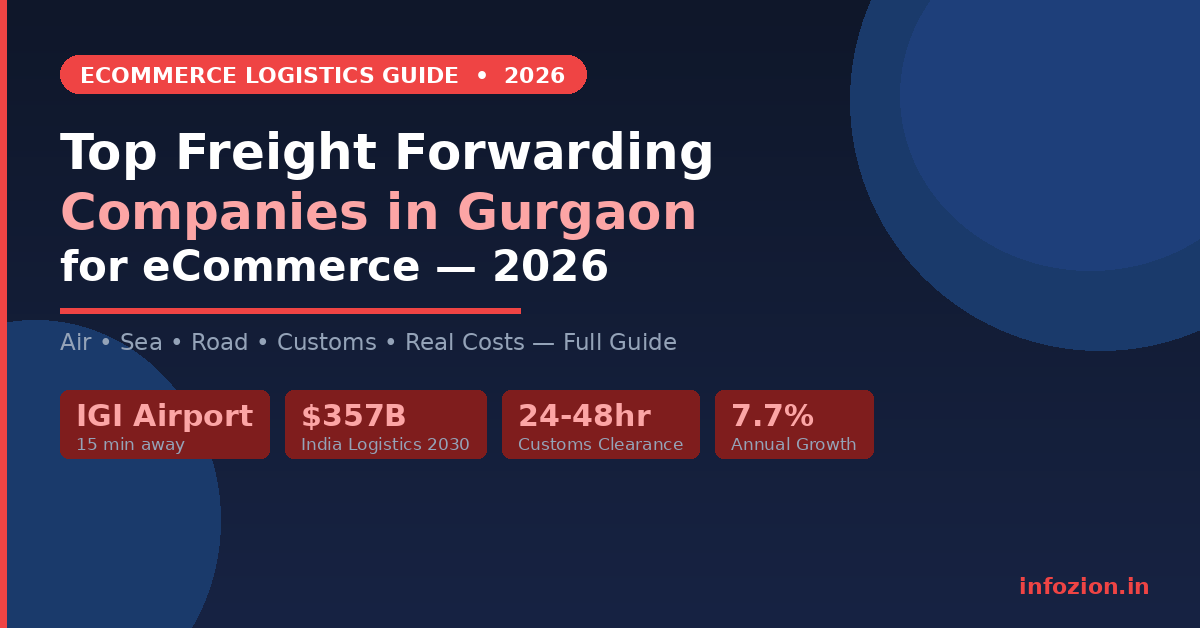
Top Freight Forwarding Companies in Gurgaon for eCommerce Businesses (2026 Guide)
Finding the right freight forwarding companies in Gurgaon is one of the most critical decisions an eCommerce business makes — and choosing the wrong partner can mean delayed shipments, unhappy customers, and losses you cannot recover.
Gurgaon — now officially Gurugram — sits at the heart of India’s most powerful logistics corridor. It connects Delhi’s Indira Gandhi International Airport, the Dedicated Freight Corridor, and major industrial belts across Haryana and Rajasthan. For eCommerce businesses shipping domestically or internationally, Gurgaon offers a strategic advantage that few Indian cities can match.
In this guide, we cover what freight forwarding actually means, what to look for in a Gurgaon-based freight partner, the top companies operating in the region, and how eCommerce businesses can reduce shipping costs and transit times in 2026.
What is Freight Forwarding, and Why Does it Matter for eCommerce?
A freight forwarder is a specialist intermediary who organizes the shipment of goods on behalf of businesses—handling documentation, customs clearance, carrier booking, insurance, and last-mile coordination across air, sea, road, and rail.
For eCommerce businesses, a freight forwarder is not just a shipping vendor. They are a strategic logistics partner who determines whether your products reach customers on time, at the right cost, and in the right condition.
What a freight forwarder does for eCommerce businesses:
- Books cargo space on airlines, vessels, and trucks at negotiated rates
- Handles export and import documentation—Bill of Lading, commercial invoices, packing lists
- Manages customs clearance at origin and destination
- Provides real-time shipment tracking and status updates
- Arranges cargo insurance for high-value consignments
- Coordinates last-mile delivery to end customers or warehouses
According to FICCI, India’s logistics sector is growing at 7.7% annually and is projected to reach $357 billion by 2030—driven largely by e-commerce growth across Tier 1, Tier 2, and Tier 3 cities.
Why Gurgaon is India’s Top eCommerce Logistics Hub
Gurgaon’s position as a premier freight forwarding hub is not accidental. Several structural advantages make it the preferred base for logistics operations serving North India and international trade.
Proximity to IGI Airport
Indira Gandhi International Airport — just 15-20 minutes from Gurgaon — handled over 1.1 million tonnes of air cargo in FY2024-25. Furthermore, it connects to over 60 international destinations, making Gurgaon-based freight forwarders ideally positioned for express international eCommerce shipments.
National Highway Connectivity
Gurgaon sits on NH-48 (Delhi-Mumbai Expressway) — one of India’s busiest freight corridors. Additionally, NH-8 connects it to Jaipur, Ahmedabad, and Mumbai, giving eCommerce businesses road freight access to Western and Central India.
Industrial and Warehousing Ecosystem
IMT Manesar, Udyog Vihar, and Sector 37 are major industrial zones with warehousing facilities, cold chain infrastructure, and distribution centers. Moreover, Gurgaon’s proximity to Faridabad and Noida manufacturing belts makes it a natural consolidation hub.
Technology-Forward Logistics Companies
Gurgaon hosts the Indian offices of several global logistics technology companies. Consequently, freight forwarders operating here tend to offer better tracking systems, API integrations with eCommerce platforms, and automated documentation compared to those in smaller cities.
What to Look for in a Freight Forwarding Company in Gurgaon
Not all freight forwarders in Gurgaon deliver the same quality. Here is a structured checklist for eCommerce businesses evaluating logistics partners:
1. Mode Coverage
Your freight forwarder should handle all modes — air freight for urgent, high-value shipments; sea freight for bulk, cost-sensitive consignments; and road freight for domestic last-mile delivery. A single-mode provider forces you to manage multiple vendors.
2. eCommerce-Specific Experience
General freight forwarders handle industrial cargo. However, eCommerce logistics requires different capabilities—returns management, COD reconciliation, multi-SKU shipments, and integration with platforms like Shopify, WooCommerce, and Amazon. Always verify that the forwarder has specific eCommerce clients in their portfolio.
3. Customs Clearance Capability
For international eCommerce, customs clearance speed directly impacts your customer’s experience. Look for forwarders who hold a Custom House Agent (CHA) license and have dedicated customs teams at IGI Airport and major seaports.
4. Technology and Tracking
In 2026, real-time shipment visibility is non-negotiable. Your freight forwarder must provide a tracking portal or API that integrates with your e-commerce platform—so you and your customers always know where shipments are.
5. Warehouse and Fulfillment Integration
The best freight forwarders in Gurgaon offer integrated warehousing — meaning your inventory sits in their facility and they manage picking, packing, and dispatch. This reduces transit time from order to shipment significantly.
6. Compliance and Certifications
Look for IATA accreditation for air freight, FIATA membership for international credibility, and ISO certifications for quality management. Additionally, verify GST registration, IEC (Import/Export Code), and CHA license validity.
Types of Freight Forwarding Services for eCommerce Businesses
Air Freight
Best for: High-value products, perishables, fashion, electronics, time-sensitive shipments.
Air freight from Gurgaon via IGI Airport connects to major global hubs in 24-72 hours. Furthermore, express courier services integrated with freight forwarders can deliver B2C eCommerce shipments internationally within 2-5 business days.
Approximate cost: ₹150-600 per kg depending on destination and service level.
Sea Freight
Best for: Bulk shipments, furniture, heavy machinery, non-perishable goods with longer lead times.
Sea freight from Gurgaon typically routes through JNPT Mumbai or Mundra Port. However, transit times of 15-45 days make it unsuitable for standard B2C eCommerce but excellent for B2B bulk restocking.
Approximate cost: ₹25,000-80,000 per FCL container depending on the destination.
Road Freight
Best for: Domestic eCommerce, pan-India distribution, last-mile delivery.
Gurgaon’s highway network makes it an ideal base for road freight covering Delhi NCR, Haryana, Rajasthan, Punjab, and UP within 24-48 hours.
Approximate cost: ₹8-25 per kg for domestic FTL/LTL shipments.
Express Courier Integration
Best for: D2C eCommerce brands shipping to end customers domestically and internationally.
Many Gurgaon freight forwarders have tie-ups with FedEx, DHL, UPS, Aramex, and Delhivery—offering negotiated rates for eCommerce brands with consistent shipment volumes.
Note: These are approximate industry rates for 2026. Actual rates depend on volume, destination, and commodity type. Contact your freight forwarder for a customised quote.
Key Questions to Ask Before Signing a Contract
Before committing to any freight forwarding company in Gurgaon, ask these questions directly:
- What is your average customs clearance time at IGI Airport? (Benchmark: under 24 hours for standard consignments)
- Do you have dedicated eCommerce clients? Can you share references?
- What tracking system do you use, and does it integrate with Shopify or WooCommerce?
- What is your process for lost or damaged shipments?
- Do you offer cargo insurance, and what does it cover?
- What are your payment terms — do you offer credit for established accounts?
- Do you have a returns management process for eCommerce?
A professional freight forwarding company will answer these confidently. Moreover, they should proactively offer you a service level agreement (SLA) with defined response times and escalation procedures.
Red Flags to Avoid in Freight Forwarding Partners
Choosing the wrong freight forwarder costs more than just money. It costs customer relationships. Watch out for:
No physical office in Gurgaon: Many brokers list a Gurgaon address without actually operating there. Always visit the office before signing.
No CHA license: Customs clearance without a valid CHA license is illegal and exposes your shipments to unnecessary delays and penalties.
Vague pricing: A serious freight forwarder provides itemized quotes—freight charges, customs duties, handling fees, documentation charges, and insurance separately. Bundled “all-inclusive” quotes without breakdowns hide profit margins at your expense.
No tracking technology: In 2026, any freight forwarder without a digital tracking portal is operating a decade behind. Consequently, your customers will have no visibility into their shipments.
Poor communication: Freight forwarding involves multiple parties across time zones. If your forwarder takes more than 4 hours to respond to a query during business hours, that is a preview of what a crisis will feel like.
How Technology is Changing Freight Forwarding for eCommerce
The best freight forwarding companies in Gurgaon in 2026 are no longer just logistics operators — they are technology companies with logistics expertise.
Key technology trends shaping freight forwarding:
- AI-powered route optimization—algorithms that find the fastest and most cost-effective shipping routes in real time
- Blockchain-based documentation — tamper-proof Bills of Lading and customs documents that reduce fraud and processing time
- API integration with eCommerce platforms — automatic shipment creation from Shopify, WooCommerce, or Amazon orders
- Predictive delivery tracking — machine learning models that predict delays before they happen and proactively notify customers
- Automated customs filing — EDI systems that submit customs documentation electronically, reducing clearance time from days to hours
Furthermore, logistics software platforms like Freightos, Flexport, and India-specific platforms like Shiprocket and Delhivery are enabling eCommerce businesses to compare freight rates, book shipments, and track consignments from a single dashboard.
Frequently Asked Questions
What is the best freight forwarding company in Gurgaon for eCommerce?
The best freight forwarding company in Gurgaon for e-commerce depends on your shipment profile—domestic vs international, air vs. sea, B2C vs. B2B. Look for companies with eCommerce-specific experience, IATA and FIATA accreditation, real-time tracking technology, and customs clearance capability at IGI Airport. Always request references from existing eCommerce clients before committing.
How much does freight forwarding cost in Gurgaon in 2026?
Air freight from Gurgaon typically costs ₹150-600 per kg for international shipments. Road freight for domestic eCommerce costs ₹8-25 per kg. Sea freight FCL containers cost ₹25,000-80,000 depending on destination and commodity. Costs vary significantly based on volume, urgency, and the specific freight forwarder’s negotiated carrier rates.
What is the difference between a freight forwarder and a courier company?
A courier company handles small, standardized parcels with fixed rates. A freight forwarder handles larger, more complex shipments—negotiating carrier rates, managing customs clearance, handling documentation, and coordinating multi-modal transport. For eCommerce businesses shipping in volume or internationally, a freight forwarder typically offers better rates and more comprehensive service than a courier.
Do I need a freight forwarder for domestic eCommerce shipping in India?
For purely domestic eCommerce, courier aggregators like Shiprocket, Delhivery, or Pickrr may be sufficient for small volumes. However, as your order volume scales, a freight forwarder with road freight capabilities and warehousing integration can reduce per-shipment costs significantly. Additionally, if you are shipping heavy or bulky items, freight forwarding becomes more cost-effective than courier services.
How long does customs clearance take at IGI Airport in Gurgaon?
Standard customs clearance at Indira Gandhi International Airport for eCommerce shipments typically takes 12-48 hours. However, with a CHA-licensed freight forwarder filing electronically via the ICEGATE system, clearance can be completed in under 8 hours for pre-certified importers. Delays usually occur due to documentation errors or random examination orders.
What certifications should a freight forwarding company in Gurgaon have?
Look for IATA accreditation (for air freight), FIATA membership (international credibility), a CHA license (customs clearance), IEC registration, and ISO 9001 quality certification. Additionally, membership in WCA (World Cargo Alliance) or GLAN indicates a strong international partner network for global eCommerce shipments.
Conclusion
Choosing the right freight forwarding companies in Gurgaon for your eCommerce business in 2026 is not just a logistics decision — it is a customer experience decision.
Every delayed shipment, every missed customs clearance, and every damaged consignment is a customer who will not return. The right freight partner becomes an invisible but critical part of your brand’s promise to deliver.
Start with a clear brief—your shipment volumes, destinations, product types, and budget. Then evaluate three to five forwarders using the checklist above. Request reference calls with their existing eCommerce clients. And never sign a contract without a clear SLA defining delivery timelines, damage liability, and escalation procedures.
Gurgaon’s logistics ecosystem is world-class. The right freight forwarding partner is out there — you just need to know how to find them.
How E-commerce AI is Transforming Business in 2025
Introduction: What is Ecommerce AI?
Have you ever shopped online and seen suggestions like “You might also like this” or “People also bought this”? That’s not magic — it’s Artificial Intelligence (AI) helping online stores show you what you want before you even know it. When AI works in eCommerce, it helps businesses understand their customers better and sell smarter.
In 2025, eCommerce AI is changing how businesses work, making things faster, easier, and more fun for both shops and shoppers.
How Does Ecommerce AI Work?
Imagine AI as a smart robot brain. It looks at what people do online—what they click on, what they buy, what they ignore—and learns from it. Then it helps online shops make better choices.
So, when you go shopping online, AI is working in the background to:
- Show you products you may like
- Answer your questions with a chatbot
- Help the store pack and ship your order quickly
- Tell the store owner what’s selling best
Let’s look at how all of this works in 2025!
Smarter Shopping Experiences
AI Knows What You Like
AI can remember your choices. If you often buy sneakers or love black T-shirts, AI will show you more of that. In 2025, this is even more advanced. AI now understands your taste, size, budget, and even when you’re most likely to shop!
Virtual Assistants Are Helping
Chatbots (which are AI-powered helpers) are everywhere now. When you type a question like “Where’s my order?” or “What size should I get?”, the chatbot replies right away, just like a helpful store worker.
Search with Your Voice or Picture
In 2025, you can search for things online by speaking or uploading a picture. So if you don’t know what a shirt is called but have a photo, AI can find it for you. That’s called visual search and it’s super cool!
Helping Businesses Behind the Scenes
AI Understands What’s Hot and What’s Not
AI watches what customers are buying and tells the business which products are popular. This helps shop owners know what to sell more of. It can also predict what customers might want next season.
Quick Decisions with Smart Data
Running a business means making decisions. With AI, store owners get reports that are super smart. These reports tell them things like:
- What’s selling fast
- What products are low in stock
- What days people buy the most
With all this info, shop owners can plan better.
AI Makes Everything Faster
Speedy Customer Service
In the past, customers had to wait for replies. In 2025, AI chatbots answer most questions instantly—24/7. This makes customers happy and helps businesses too.
Faster Deliveries
AI helps warehouses pack things faster and delivery trucks find the best routes. So, when you click “Buy Now,” you get your order quicker!
Personalized Ads Just for You
Ever notice how ads online seem to know what you were thinking about? That’s AI again! It sends you ads for things you’re likely to buy.
In 2025, these ads are smarter. If you liked a red backpack last week, it might show you matching red shoes today. This makes shopping more fun and helps businesses sell more.
AI is Saving Money for Businesses
Using AI means businesses need fewer workers to do basic tasks like customer service or checking inventory. It also helps avoid mistakes. This saves money and lets shop owners focus on bigger things—like growing their brand.
AI also helps reduce returns. If a customer picks the right size or color the first time (thanks to AI), they’re less likely to send it back. This saves money too!
Making Shopping Safe and Trustworthy
In 2025, AI helps keep shopping safe. It can catch fraud quickly—like if someone tries to use a stolen card or place a strange order. This protects both customers and stores.
The Future is Now
AI isn’t just some science fiction story—it’s here and working every day in online stores. And it’s not only helping big companies. Small businesses are using AI tools too!
For example, Amazon uses AI for fast deliveries, smart recommendations, and voice shopping through Alexa. Now, even smaller online stores are using similar tools to give their customers better service.
If you’re running an eCommerce business, now is the best time to explore AI.
Conclusion: Why Ecommerce AI Matters in 2025
Ecommerce AI is like a super helper. It learns what people like, answers their questions fast, helps businesses work smarter, and makes shopping fun. In 2025, it’s making a huge difference.
If you want to grow your online business or shop smarter, AI is the tool you need. Whether it’s chatbots, product suggestions, or delivery speed—AI is changing everything for the better.
Want to know how to use AI in your online store?
Visit Infozion Technologies and let us help you build a smarter ecommerce experience!
Leveraging the Power of AI for E‑commerce Platforms
AI for E-commerce Platforms have become a game-changer in the way online stores function. Have you ever noticed how online stores seem to know exactly what you want? Whether it’s a product you looked at before, a chatbot helping you instantly, or even being able to search by image — it’s all made possible with Artificial Intelligence (AI).
AI is becoming a big part of e-commerce. It helps online shops work faster, understand customers better, and sell smarter. In this blog, we’ll explain how AI is changing the world of e-commerce in a simple way — so even a 5th grader can understand!
What is AI for E-commerce Platforms?
Artificial Intelligence (AI) means teaching computers to think and learn like humans. AI can:
-
Understand what people say
-
Make smart decisions
-
Recommend things
-
Answer questions
-
Help with tasks
When you shop online, AI is working in the background to suggest products, talk to you via chatbots, and help you find what you need quickly.
Why AI is Important for E-commerce Platforms
Smarter Shopping Experiences
AI tracks what customers like, search for, or buy. It then shows them products they are most likely to be interested in. It’s like a personal shopping guide on your screen.
Faster Customer Service
AI chatbots can help customers 24/7. They answer questions, guide people through checkout, and provide delivery updates — all without needing a human.
Personalized Product Suggestions
AI gives suggestions based on a customer’s activity. This helps them discover things they didn’t even know they wanted — increasing chances of purchase.
How AI for E-commerce Platforms Is Used
Product Recommendations
AI learns from your activity and compares it with others. It then recommends products you might like.
Example
If you bought a cricket bat, it may recommend gloves, balls, or a kit bag. This keeps customers engaged and boosts sales.
Visual Search
AI allows customers to upload a photo to search for similar items. This is helpful when you don’t know the name of a product.
Big brands like Amazon and ASOS use this to improve customer experience.
AI Chatbots
AI-powered chatbots help users:
-
Ask questions
-
Find products
-
Track orders
-
Get help instantly
They’re always online, making support easier and faster for businesses.
Voice Search
Many people use Alexa, Siri, or Google Assistant. E-commerce websites now allow voice search, where customers can speak to find what they need.
This makes shopping easier for kids, elderly users, or people who find typing hard.
Inventory Management
AI helps businesses track what’s selling and what’s not. It predicts demand and even places restocking orders automatically.
This prevents stock issues, saves money, and keeps customers happy.
Benefits of Using AI for E-commerce Platforms
Increased Sales
With better suggestions and faster service, customers are more likely to buy. AI boosts conversion rates and grows revenue.
Saves Time and Money
AI handles customer queries, stock tracking, and suggestions — freeing up human time and reducing workload.
Smarter Marketing
AI can send targeted emails, offers, and product suggestions to the right people at the right time.
Fewer Errors
AI reduces human mistakes. It processes data and orders more accurately.
Better Shopping Experience
When users enjoy browsing and get help quickly, they return more often. This builds loyalty and brand trust.
Real-Life Example of AI in E-commerce Platforms
Imagine a clothing store that sells online. With AI, it can:
-
Suggest matching clothes
-
Help customers find their size
-
Answer style-related questions
-
Offer visual and voice search
-
Track what’s trending and restock automatically
This makes the business smarter and more customer-friendly — just like what Infozion Technologies helps companies achieve through tech-driven e-commerce solutions.
The Future of AI for E-commerce Platforms
The future is exciting with AI evolving every day. Here’s what we can expect soon:
-
Advanced virtual try-ons for clothes or glasses
-
Full voice-based shopping experiences
-
Better fraud detection and safe payments
-
AI-generated content and product listings
-
Hyper-personalized homepages and dashboards
Want to know why experts believe AI is the future of e-commerce? Read more in this Bloomreach article.
Quick Recap
Here’s a quick table to remember how AI helps e-commerce:
| AI Feature | How It Helps |
|---|---|
| Product Suggestions | Helps users discover products they’ll like |
| Chatbots | Always-on support for customers |
| Visual & Voice Search | Makes finding items easier and faster |
| Smart Inventory | Tracks and manages product stock |
| Marketing Automation | Sends targeted messages and offers |
Final Thoughts
AI for E-commerce Platforms isn’t just a trend — it’s a smart way to run modern online stores. It helps businesses:
-
Sell more
-
Save time
-
Provide better customer experiences
If you’re planning to build or improve your e-commerce site, now’s the time to embrace AI. From personalized shopping to automated customer support — it’s a game-changer.
Need help creating your AI-powered store? Visit Infozion Technologies to see how we bring smart ideas to life.