 Infozion Technologies LLPInfozion Technologies LLP




ERP Implementation Cost in India: Complete Pricing Guide 2026
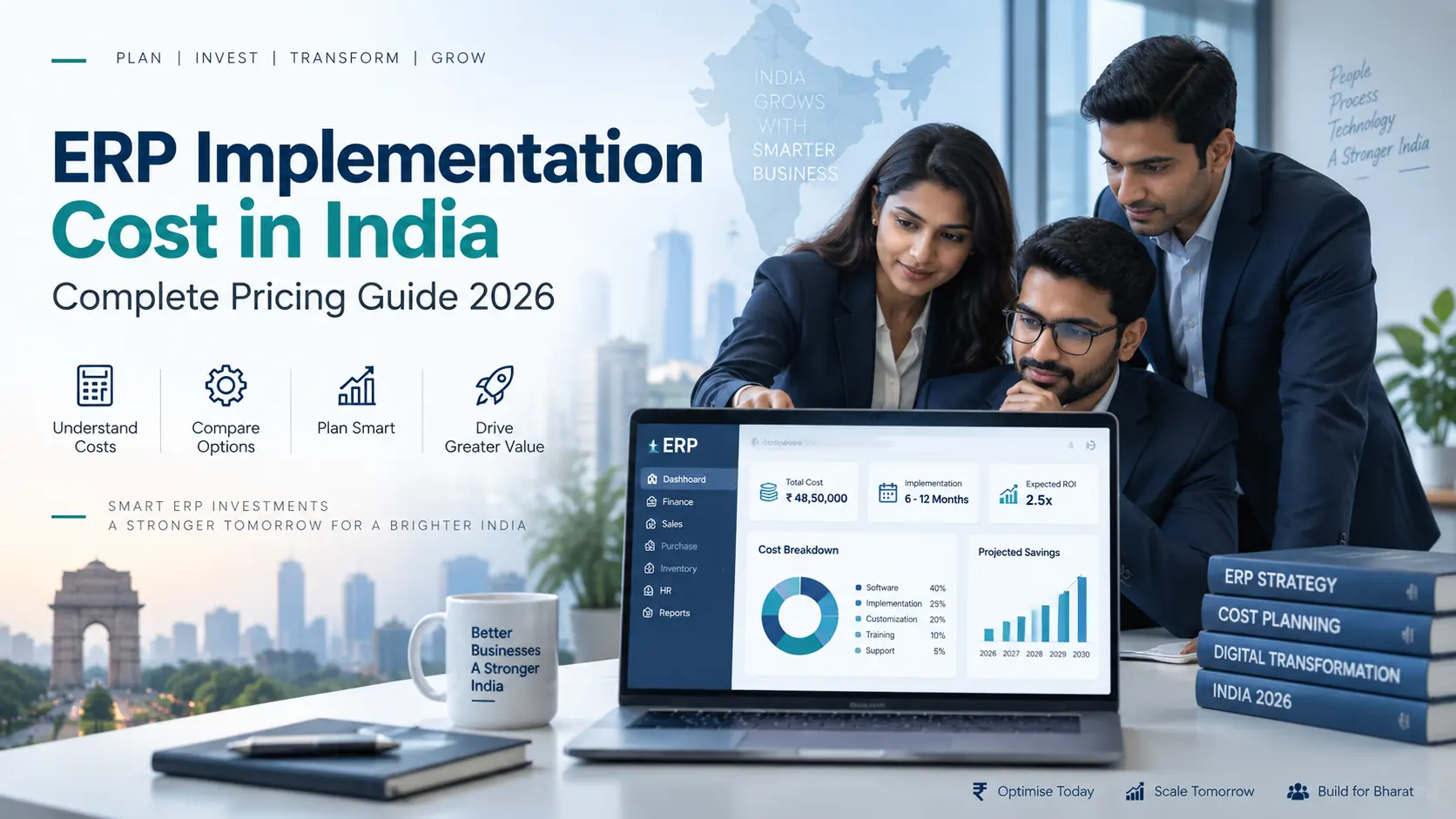
ERP Implementation Cost in India: Complete Pricing Guide 2026
If you are planning ERP for your business, one question probably comes before everything else: how much is it actually going to cost?
The ERP implementation cost in India can range from a relatively modest investment for a small, standardised deployment to a much larger budget for a multi-location company requiring custom workflows, integrations, manufacturing modules, automation or complex data migration.
That wide range is exactly why asking only, “What is the price of ERP?” can be misleading.
The software licence is only one part of the investment. Your real ERP budget can include business process analysis, configuration, custom development, integrations, data migration, testing, employee training, deployment and ongoing maintenance.
This 2026 guide breaks those costs down in practical terms so that you can build a realistic ERP budget before speaking to vendors.
How Much Does ERP Implementation Cost in India?
For budgeting purposes, Indian businesses can think about ERP implementation in four broad levels:
| ERP Scope | Indicative Planning Budget | Typical Requirement |
| Basic ERP deployment | ₹2 lakh–₹5 lakh | Few modules, limited users, standard workflows |
| Growing SME implementation | ₹5 lakh–₹12 lakh | Multiple departments, reporting, integrations |
| Advanced/custom ERP | ₹12 lakh–₹25 lakh+ | Custom workflows, automation, multi-location operations |
| Large enterprise ERP | Custom budgeting | Multiple entities, complex integrations, high user count |
These figures should be treated as planning ranges rather than fixed quotations. Two businesses with the same number of employees can have completely different implementation costs because their workflows, integrations and data complexity may be very different.
Publicly available Infozion industry-specific ERP pages also illustrate this variation: current examples show custom ERP ranges around ₹5–₹20 lakh depending on industry and scope.
The easiest way to understand ERP implementation pricing is therefore to calculate the individual components instead of looking for one universal package price.
What Is the ERP Implementation Cost in India in 2026?
There is no single correct answer.
A company implementing accounting, inventory and sales for one location will naturally spend far less than a manufacturer connecting procurement, production planning, BOM, quality control, warehouse operations, finance and management reporting across multiple plants.
Your total budget usually depends on:
- Number of ERP users
- Number of departments
- Modules required
- Business process complexity
- Standard configuration versus custom development
- Existing data quality
- Third-party integrations
- Number of offices, factories or warehouses
- Cloud versus on-premise deployment
- User training requirements
- Post-launch maintenance
That is why realistic ERP implementation charges should be based on scope, not simply company size.
Understanding the Complete ERP Cost Structure
A useful ERP budget should answer a simple question:
What will we spend before, during and after go-live?
The following components usually make up the real ERP total cost of ownership.
1. ERP Software or Licensing
The first cost is access to the ERP platform itself.
Depending on the system, pricing may be:
- Monthly per user
- Annual per user
- Per module
- One-time licence
- Open-source with implementation costs
- Fully custom software development
A cloud ERP may have a lower starting cost but recurring subscription fees. A custom ERP may require a higher initial investment but use a different long-term commercial model.
Never compare systems only on their first-year licence price.
2. Business Requirement Analysis
Before configuration or development begins, the implementation team needs to understand how your business actually works.
This may include:
- Sales process
- Procurement
- Inventory movement
- Accounting
- Production
- HR
- Approval workflows
- Customer management
- Reporting
- Branch operations
Good requirement analysis reduces expensive changes later.
Businesses that want to understand the complete journey before budgeting should first review the ERP implementation phases and understand what happens from discovery through go-live.
3. ERP Configuration
Standard ERP platforms contain many built-in capabilities.
Configuration involves adapting these features to your company without rebuilding the software.
Examples include:
- Tax settings
- User permissions
- Approval levels
- Warehouses
- Product categories
- Sales stages
- Invoice formats
- Purchase workflows
- Accounting structure
Standard configuration usually costs less than custom development.
4. Customisation and Development
This is where ERP budgets can change significantly.
Businesses often require functionality that is not available in the default platform.
Examples include:
- Custom dashboards
- Automated approval rules
- Unique business workflows
- Customer or vendor portals
- Custom mobile applications
- Advanced reports
- Industry-specific processes
- Special pricing logic
- Custom document generation
The custom ERP development cost increases with complexity because every custom feature must be designed, developed, tested and maintained.
Before approving customisation, ask one important question:
Is this feature genuinely necessary, or can the business use the standard ERP process?
That question alone can prevent unnecessary development costs.
5. Data Migration
Most businesses already have years of information stored somewhere.
It might be in:
- Excel
- Tally
- Accounting software
- CRM software
- Legacy ERP systems
- Google Sheets
- Internal databases
Moving that information into the new ERP requires cleaning, mapping, validation and testing.
Poor-quality legacy data takes longer to migrate and can increase implementation effort substantially.
Clean your data before ERP implementation wherever possible.
6. Third-Party Integrations
Modern businesses rarely operate ERP in isolation.
Your ERP may need to communicate with:
- CRM platforms
- E-commerce websites
- Payment gateways
- Banking systems
- Logistics platforms
- Tally or accounting software
- Email systems
- Payroll software
- Mobile applications
- Government or industry platforms
Every integration adds development, testing and maintenance requirements.
A simple API connection may be relatively straightforward. A custom integration involving bidirectional real-time data, multiple approval rules and error handling can be considerably more complex.
7. Testing and User Acceptance Testing
ERP testing is not optional.
Before launch, teams need to test real scenarios such as:
- Creating customers
- Raising purchase orders
- Receiving inventory
- Processing sales
- Generating invoices
- Approving transactions
- Producing reports
- Handling cancellations
- Correcting errors
End users should also participate in User Acceptance Testing (UAT).
Finding a problem before launch is almost always cheaper than discovering it after the system is already being used across the organisation.
8. Employee Training and Change Management
A technically perfect ERP can still fail if employees do not know how to use it.
Training needs to cover actual job roles instead of generic software demonstrations.
For example:
A warehouse employee needs inventory workflows.
A salesperson needs CRM, quotations and orders.
A finance employee needs invoicing, payments and reports.
Managers need dashboards and approvals.
The competitor research reviewed for this guide places substantial emphasis on change management, role-based training and post-go-live adoption rather than treating training as a final checkbox.
This cost should therefore be planned from the beginning.
9. Post-Go-Live Maintenance
ERP implementation does not finish on launch day.
After go-live, businesses may need:
- Bug fixes
- User assistance
- Performance monitoring
- Additional reports
- Workflow improvements
- Version upgrades
- New modules
- New integrations
- Security updates
When comparing vendors, ask what is included after deployment and what will be billed separately.
ERP Software Cost in India by Business Size
Business size helps estimate a budget, but operational complexity matters more.
Small Businesses
A small company using standard sales, purchase, inventory and accounting workflows may be able to start with a focused implementation.
A practical ERP cost for small business in India may begin in the lower-lakh range when customisation is limited.
Costs increase when the business requires industry-specific workflows, external integrations or historical data migration.
A phased rollout is often the better approach.
Start with the processes causing the biggest operational problems. Add secondary modules later.
Small and Mid-Sized Enterprises
A growing company may need:
- CRM
- Sales
- Purchase
- Inventory
- Accounting
- HR
- Management reporting
- Multiple user roles
- Automation
- Third-party integrations
At this level, planning and system architecture become much more important.
Instead of choosing the cheapest implementation, businesses should compare what is actually included in the quoted scope.
Manufacturing Companies
Manufacturing ERP can become more complex because it may involve:
- Material Requirements Planning
- Bill of Materials
- Production planning
- Raw material inventory
- Finished goods
- Quality control
- Machine maintenance
- Procurement
- Batch tracking
- Production costing
Businesses evaluating manufacturing automation should review the manufacturing ERP software requirements carefully before estimating the budget.
Infozion’s current manufacturing ERP page publicly shows a one-time pricing range of approximately ₹6 lakh–₹20 lakh, demonstrating how industry-specific ERP scope affects cost.
Healthcare Organisations
Hospitals and clinics can require workflows covering:
- Patient management
- Appointments
- Billing
- Pharmacy
- Inventory
- Departments
- Staff management
- Reporting
- Compliance
- Patient portals
Because these workflows differ substantially from general trading businesses, healthcare projects require industry-specific requirement analysis.
Businesses in this sector can explore healthcare ERP software to understand what modules may be required before requesting a quotation.
Infozion’s healthcare ERP page currently presents an indicative custom solution range of roughly ₹5 lakh–₹15 lakh.
Freight Forwarding and Logistics Companies
Logistics ERP may require:
- Quotations
- Booking
- Shipment tracking
- Invoicing
- Documentation
- Customs workflows
- Customer portals
- Multi-branch management
- Air, sea and road freight operations
Because these requirements go beyond general accounting software, scope has a major impact on pricing.
For businesses in this sector, Infozion’s freight forwarding ERP software content provides more detailed industry-specific functionality and currently shows approximate project ranges from ₹5 lakh to ₹20 lakh depending on scope.
This is why ERP implementation cost in India should always be evaluated against the workflows being automated rather than a generic software price.
ERP Cost by Deployment Model
Cloud ERP
Cloud ERP generally reduces the need to purchase and maintain physical infrastructure.
Typical costs may include:
- Subscription
- Implementation
- Configuration
- Customisation
- Training
- Integrations
- Ongoing subscription
Cloud deployment is attractive for companies that want faster scaling and less internal infrastructure management.
On-Premise ERP
An on-premise system runs on infrastructure managed by the business.
Additional costs can include:
- Servers
- Database licences
- IT administration
- Security
- Backup infrastructure
- Hardware maintenance
The organisation receives greater infrastructure control, but that control also brings additional responsibility.
Open-Source ERP
Open-source software can reduce or remove some licence fees, but it does not mean implementation is free.
You may still need to pay for:
- Setup
- Hosting
- Configuration
- Custom modules
- Migration
- Integrations
- Training
- Maintenance
Odoo is one common example.
If Odoo is being considered specifically, review the separate Odoo ERP implementation cost guide rather than applying generic ERP pricing assumptions.
Fully Custom ERP
A custom ERP is designed around the company’s own workflows.
This approach may make sense when the business has processes that cannot be handled efficiently through standard ERP configuration.
Examples include:
- Complex manufacturing
- Special logistics workflows
- Unique pricing calculations
- Multi-stage approvals
- Custom portals
- Proprietary operations
The advantage is flexibility.
The trade-off is higher design, development, testing and maintenance effort.
What Factors Increase ERP Implementation Cost?
Several factors can quickly expand the project scope.
Too Many Modules at Once
Implementing every possible module in phase one creates unnecessary complexity.
Focus on high-priority processes first.
Excessive Customisation
Every customised workflow must be built and tested.
Use standard ERP functionality wherever it can reasonably support the process.
Poor Data Quality
Duplicate customers, incomplete product records and inconsistent accounting data increase migration effort.
Too Many Integrations
Every external application introduces another point that must be developed, tested and maintained.
Unclear Requirements
Changing requirements midway through implementation leads to rework.
Good discovery prevents this.
Multiple Locations
Warehouses, offices, factories, branches and legal entities can add substantial configuration and testing requirements.
Complex Permissions
Companies handling sensitive finance, HR, management or operational data may require detailed role-based access controls.
Hidden ERP Costs Businesses Should Budget For
A realistic budget should also consider costs that do not always appear prominently in initial proposals.
These can include:
- Data cleaning
- Additional integrations
- Extra reports
- New requirements after testing
- Employee training time
- Internal project management
- Temporary productivity reduction during transition
- Cloud hosting
- Backup and security
- Post-launch changes
- Version upgrades
A quotation that looks cheaper may simply exclude more items.
Therefore, compare ERP proposals line by line rather than comparing only the final amount.
A Simple Formula for Estimating Your ERP Budget
You can use this basic framework:
ERP Budget = Software + Discovery + Configuration + Customisation + Migration + Integration + Testing + Training + Deployment + Ongoing Maintenance + Contingency
For example, suppose a growing company needs:
- CRM
- Sales
- Purchase
- Inventory
- Accounting
- Two integrations
- Historical data migration
- Management dashboard
- Employee training
The business should request separate estimates for each component.
This makes ERP implementation pricing much easier to understand and makes vendor proposals easier to compare.
How to Reduce ERP Implementation Cost Without Cutting Important Work
Reducing cost does not mean choosing the cheapest vendor.
The goal is removing unnecessary complexity.
Prioritise Requirements
Separate requirements into:
- Must have
- Should have
- Nice to have
- Future phase
Implement the first category before investing heavily in optional features.
Use Standard Features First
Configuration is normally more efficient than custom development.
Only customise when a genuine business requirement cannot be handled properly with the standard system.
Clean Data Before Migration
Do not pay ERP consultants to clean information your internal team can prepare beforehand.
Remove duplicate records, obsolete products and incomplete entries.
Implement in Phases
Phase one could contain core operations.
Phase two can add automation and advanced reporting.
Phase three can introduce additional departments or integrations.
This reduces risk and makes the project easier for employees to absorb.
Follow a Defined Implementation Process
A structured Odoo ERP implementation process or equivalent ERP methodology keeps requirements, migration, testing and training organised.
Infozion also has a detailed Odoo ERP implementation checklist covering requirement analysis, module selection, migration, configuration, testing, training and post-launch improvement.
Why the Cheapest ERP Quote Can Become Expensive Later
Imagine Vendor A quotes ₹4 lakh.
Vendor B quotes ₹7 lakh.
At first glance Vendor A appears cheaper.
But Vendor A excludes:
- Data migration
- Training
- Three reports
- API integration
- Post-launch assistance
Once those requirements are added, the real project may cost substantially more.
This is why businesses should ask vendors to provide a scope document containing:
- Modules
- Users
- Features
- Customisation
- Integrations
- Migration
- Training
- Testing
- Hosting
- Timeline
- Post-launch terms
- Exclusions
Compare scope first.
Compare price second.
What Is the Typical ERP Implementation Timeline?
Implementation duration varies as much as cost.
A limited deployment may take several weeks, while a heavily customised multi-department or multi-location ERP can take months.
The timeline usually includes:
| Stage | Main Work |
| Discovery | Requirements and process mapping |
| Planning | Scope, responsibilities and milestones |
| Configuration | ERP setup and workflows |
| Development | Required custom functionality |
| Migration | Existing business data |
| Integration | Connection with external systems |
| Testing | Technical testing and UAT |
| Training | User preparation |
| Go-Live | Production deployment |
| Stabilisation | Monitoring and improvements |
Infozion’s existing ERP implementation phases guide can support this section and should be internally linked from the paragraph above.
How to Calculate ERP ROI
ERP should not be evaluated only as an expense.
Its value may come from reducing operational inefficiencies.
Possible benefits include:
- Less duplicate data entry
- Faster order processing
- Improved inventory visibility
- Fewer manual errors
- Better financial reporting
- Faster approvals
- More accurate planning
- Reduced spreadsheet dependence
- Better management visibility
A simple ROI model is:
Annual ERP Benefit = Labour Savings + Error Reduction + Inventory Savings + Productivity Gains + Avoided Software Costs
Then:
ERP ROI = (Annual Benefit − Annual ERP Cost) ÷ ERP Cost × 100
Use your company’s real numbers rather than generic industry percentages.
This makes the business case more credible.
ERP Price vs ERP Total Cost of Ownership
A low initial price does not necessarily mean a low long-term cost.
When calculating ERP total cost of ownership, consider at least three to five years where practical.
Include:
- Initial implementation
- Subscription or licensing
- Hosting
- Maintenance
- Integrations
- Upgrades
- Additional users
- Custom development
- Internal administration
- Training
This gives management a more useful number than first-year cost alone.
Questions to Ask an ERP Vendor Before Requesting a Quote
Before comparing ERP implementation services in India, ask each vendor the same questions.
- What is included in the quoted amount?
- Which modules are included?
- How many users are covered?
- Is data migration included?
- How much historical data will be migrated?
- Are integrations included?
- What customisation is included?
- Is user training included?
- Who performs UAT?
- Is cloud hosting included?
- What happens after go-live?
- How are future changes billed?
- Are software upgrades included?
- What is excluded from the quotation?
- What could cause the price to increase?
Standardising these questions makes vendor comparison much easier.
How to Choose an ERP Implementation Partner in India
Do not select a partner only because they offer the lowest quotation.
Look at whether the team understands:
- Your industry
- Your current workflows
- Your business problems
- Your required integrations
- Your reporting needs
- Your growth plans
- Your data migration requirements
The implementation partner should be willing to understand your process before recommending a solution.
You can also explore Infozion’s ERP software solutions to understand available ERP capabilities for different business requirements
A useful first step is to review a general ERP systems guide if your organisation is still deciding what type of ERP is required.
Infozion’s existing ERP content also covers Odoo implementation, manufacturing, healthcare and freight-forwarding use cases, which creates a strong internal topical cluster around this article.
Why Consider Infozion for ERP Implementation?
Infozion Technologies develops ERP solutions around business workflows rather than treating every organisation as identical.
Existing Infozion ERP resources cover industries and use cases such as:
- Manufacturing
- Healthcare
- Freight forwarding
- Odoo implementation
- Business automation
The company’s public website also states that it holds ISO 9001:2015 and ISO/IEC 27001:2022 certifications and has delivered 250+ custom software projects.
Instead of beginning with a fixed package, an effective ERP discussion should begin by identifying:
- What processes need improvement
- Which departments need ERP
- What systems currently exist
- What data must be migrated
- Which integrations are required
- What should be included in phase one
- What can be postponed
That creates a more accurate implementation estimate and reduces the risk of paying for unnecessary functionality.
Frequently Asked Questions
What is the ERP implementation cost in India for a small business?
A small business with standard modules and limited customisation may be able to start with a lower-lakh ERP budget. However, the final price depends more on modules, users, integrations, migration and workflow complexity than employee count alone.
What is the average ERP software cost in India?
There is no reliable single average because ERP can range from subscription-based software to heavily customised enterprise platforms. Compare complete implementation and long-term ownership costs instead of licence price alone.
What is included in ERP implementation charges?
Typical implementation charges may include requirement analysis, configuration, customisation, data migration, integrations, testing, training, deployment and post-go-live services. Always ask the vendor for an itemised scope.
How much does Odoo ERP implementation cost?
The cost depends on edition, users, modules, customisation, migration, hosting, integrations and training. Infozion maintains a separate Odoo-specific pricing guide because Odoo implementation has different considerations from fully custom ERP development.
Is custom ERP more expensive than ready-made ERP?
The initial custom ERP development cost can be higher because the system is built around specific workflows. However, long-term economics depend on subscriptions, customisation, user growth, maintenance and how much adaptation a ready-made system requires.
What are the biggest hidden ERP costs?
Common hidden expenses include poor data cleanup, extra integrations, additional reports, scope changes, extra training, cloud infrastructure and post-launch modifications.
How long does ERP implementation take?
A focused deployment can take weeks, while customised multi-department projects can take several months. Complexity, migration, integrations and decision-making speed strongly affect the ERP implementation timeline.
How can I get an accurate ERP quotation?
Prepare your department list, required modules, number of users, existing software, integration requirements, data sources and essential workflows. A discovery session based on these requirements will produce a much more reliable estimate than requesting a generic package price.
Should businesses calculate first-year ERP cost or long-term cost?
Calculate both. First-year pricing helps with immediate budgeting, while ERP total cost of ownership shows what the platform may actually cost over several years after subscriptions, maintenance, upgrades and expansion are considered.
Final Thoughts
The ERP implementation cost in India is not simply the price of software. It is the cost of moving your organisation from disconnected processes to an integrated operating system for the business.
Instead of asking:
“How cheap can we implement ERP?”
A better question is:
“What is the simplest ERP scope that solves our most expensive operational problems?”
Start with clearly defined business requirements. Prioritise essential modules. Keep unnecessary customisation under control. Prepare your data early. Compare complete vendor scopes rather than headline prices.
Done correctly, ERP becomes more than another software expense. It becomes infrastructure that helps finance, sales, operations, inventory and management work from the same reliable information.
For businesses evaluating the next step, begin with requirement discovery and build the implementation budget around the workflows your organisation actually needs.