 Infozion Technologies LLPInfozion Technologies LLP




How E-Waste ERP Automates CPCB EPR Compliance: Complete Workflow, Reporting & Audit Guide for 2026
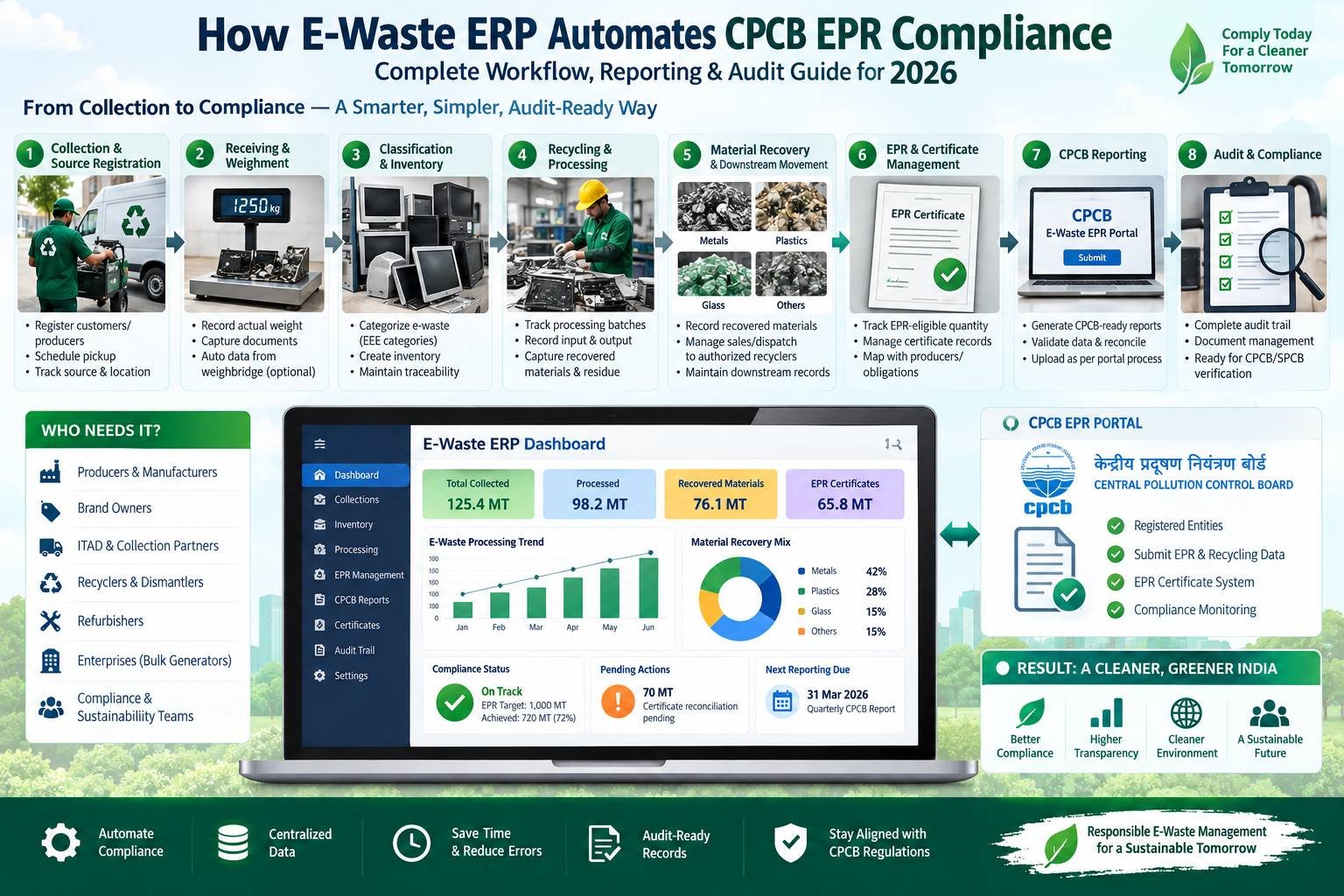
How E-Waste ERP Automates CPCB EPR Compliance: Complete Workflow, Reporting & Audit Guide for 2026
Managing e-waste compliance in India is no longer simply about maintaining a register of material received and recycled. Producers, recyclers, refurbishers and manufacturers may need to manage registrations, quantities, categories, processing records, downstream movement, EPR certificates, reporting data and supporting evidence across multiple transactions.
For businesses handling hundreds or thousands of records, spreadsheets and disconnected files can make reconciliation increasingly difficult.
This is where E-Waste ERP for EPR Compliance becomes valuable. Instead of treating compliance reporting as a separate activity performed at the end of a month or quarter, a properly configured ERP connects compliance data with daily operations—from collection and weighment to processing, material recovery, certificate tracking and audit preparation.
The objective is not to make compliance a one-time reporting exercise. It is to build the required data trail while the actual work is taking place.
Quick Answer: An E-Waste ERP can support CPCB EPR compliance by capturing operational data at each stage of the e-waste lifecycle, connecting collection and weight records with recycling batches, tracking EPR-related quantities and certificates, reconciling material movement, and preparing structured records for reporting and audit. Software supports compliance management, but businesses must still follow the applicable E-Waste Management Rules, CPCB procedures and current portal requirements.
Understanding EPR Compliance for E-Waste in India
India’s E-Waste (Management) Rules, 2022 came into force on 1 April 2023 and established an Extended Producer Responsibility framework for covered electrical and electronic equipment.
According to CPCB guidance, manufacturers, producers, refurbishers and recyclers are among the entities required to register on the E-Waste EPR Portal where applicable.
Under the EPR framework, compliance is closely connected with actual recycling activity and the EPR certificate system.
CPCB documentation states that recyclers upload information including quantities of e-waste procured or collected, quantities recycled, and end products produced and sold. EPR certificates are generated through the portal based on the applicable process, while producers fulfil their EPR obligations through eligible certificates from registered recyclers.
The regulatory framework therefore makes reliable operational data extremely important.
A compliance team should be able to answer questions such as:
Where did this material come from? How much was actually received? Which EEE category does it belong to? Which batch processed it? What quantity was recovered? What happened to non-recycled fractions? Which records support the recycling quantity? How does this activity reconcile with the EPR information being reported?
If those answers live in different Excel files, paper registers, emails and WhatsApp conversations, preparing a reliable compliance record becomes unnecessarily difficult.
What Is E-Waste ERP for EPR Compliance?
E-Waste ERP for EPR Compliance is an integrated business system configured to connect e-waste operations with the information required for compliance monitoring and reporting.
Unlike a standalone reporting spreadsheet, an ERP can create relationships between individual transactions.
For example, one collection record can be connected with its source, vehicle, receiving weight, category classification, inventory batch, processing batch, recovered outputs, residue, downstream transfer documents and compliance records.
The important distinction is this:
Traditional approach: Operations happen first. Compliance data is reconstructed later.
ERP-driven approach: Operations generate the compliance data as they happen.
That change can significantly improve traceability because reporting is based on actual operational records rather than data manually assembled months later.
Why Manual EPR Compliance Becomes Difficult
Excel is useful and can work for smaller operations with limited transactions. The problem usually begins when transaction volume, facilities, material categories and compliance requirements increase.
Imagine a recycler receiving e-waste from 100 sources every month.
Collection information may exist in one spreadsheet. Vehicle records may exist elsewhere. Weight slips may be stored as PDFs. Inventory may be tracked in another file. Recycling output may be recorded by plant operators. Sales invoices may be handled by accounts. EPR data may be prepared separately by the compliance team.
Each individual file may be correct, yet connecting everything together can become difficult.
Common problems include duplicate entries, inconsistent material names, missing documents, incorrect units, delayed data entry, batch mismatches and difficulty identifying who changed a record.
An ERP does not automatically make inaccurate data accurate. What it can do is create structured workflows, validation rules, approval processes and connected records that reduce the amount of information being reconstructed manually.
Complete E-Waste ERP Workflow for CPCB EPR Compliance
The strongest E-Waste ERP for EPR Compliance workflow starts before material reaches the recycling plant.
A practical system can connect the complete lifecycle:
Collection → Pickup → Receiving → Weighment → Classification → Inventory → Processing → Material Recovery → Downstream Movement → EPR Records → Reporting → Audit Trail
Let us examine each stage.
1. Collection and Source Registration
The digital compliance trail can begin when a collection is scheduled.
Instead of recording only a total quantity later, ERP can create a collection transaction containing relevant information such as source, customer or producer, pickup location, expected material, collection date and responsible team.
Supporting documents can remain connected with the transaction rather than being stored separately.
For businesses managing multiple collection teams or facilities, this gives management visibility into material even before it reaches the recycling plant.
More importantly, it establishes the beginning of chain-of-custody documentation.
2. Receiving, Weighment and Classification
When material reaches the facility, actual received quantity needs to be recorded.
This stage is critical because estimated collection quantities and actual receiving weights may not always match.
The system can record gross weight, tare weight, net weight, date and time, source reference and relevant material classification.
Where a weighbridge integration is implemented, weight information may also be captured electronically depending on the organization’s hardware and ERP configuration.
The material can then be classified using standardized internal categories mapped to the appropriate regulatory and operational classification framework.
This prevents situations where one employee enters “computer scrap,” another enters “IT waste,” and another uses an abbreviation that later makes reporting inconsistent.
3. Batch and Inventory Creation
After receiving and classification, e-waste can move into inventory or a processing queue.
ERP allows businesses to maintain a digital relationship between inbound material and the batch in which it is eventually processed.
This becomes especially valuable when material from multiple collections is consolidated.
Instead of losing traceability after materials are mixed, the system can preserve references showing which inbound transactions contributed to a processing batch.
Inventory visibility also helps operations teams understand how much material is awaiting sorting, dismantling, refurbishing, recycling or downstream movement.
4. Recycling and Processing Records
A recycling facility does not simply receive 1,000 kg and magically produce another 1,000 kg of one material.
Processing can generate multiple outputs.
Depending on the type of e-waste and recycling process, the output may include recoverable metals, plastics, glass, components, reusable material, residues and fractions requiring downstream treatment.
ERP can record the input quantity against a processing batch and then record resulting outputs.
This produces an important connection:
Input material → Processing activity → Recovered material → Residue / downstream fraction
CPCB guidance also notes that recyclers are required to maintain records relating to e-waste collected, dismantled, recycled and material sent to registered recyclers, with records available for verification or audit when required.
This makes batch-level traceability much more than an inventory feature. It can become part of the compliance evidence chain.
Mass Balance and Weight Reconciliation
One of the most useful controls in an e-waste ERP is mass-balance reconciliation.
A practical operational formula could be represented as:
Opening Material + Material Received = Material Processed + Material Dispatched + Residue + Closing Material + Documented Process Variance
The exact configuration should match the organization’s process and applicable compliance requirements.
Consider a simplified example.
A recycler receives 5,000 kg of a particular material stream.
During processing:
- 2,700 kg becomes recoverable metal fractions.
- 1,100 kg becomes recyclable plastic or other recoverable material.
- 650 kg is transferred as a specialized downstream fraction.
- 400 kg remains as closing inventory or work in progress.
- 150 kg represents documented process residue or other properly accounted output.
Total accounted quantity:
2,700 + 1,100 + 650 + 400 + 150 = 5,000 kg
The objective of this reconciliation is not simply mathematical accuracy.
It helps the organization detect unexplained gaps.
If ERP shows 5,000 kg entering a process but only 4,200 kg can be accounted for, management has an exception to investigate before using that data for compliance reporting.
How ERP Supports EPR Certificate Tracking
EPR certificate management introduces another layer of data that should not be separated from actual recycling operations.
CPCB’s framework connects certificate generation with information submitted by registered recyclers regarding e-waste procurement or collection, recycling and relevant outputs.
A compliance ERP can therefore maintain an internal reconciliation between operationally supported recycling quantities and EPR-related records.
This can include tracking certificate-linked quantity, certificate status, related material category, producer mapping, transaction reference and any pending reconciliation.
The software should not simply allow users to manually enter a certificate total without supporting operational history.
A stronger system allows the compliance team to move backwards from a reporting figure to the underlying transactions that created it.
The E-Waste (Management) Amendment Rules, 2024 also introduced provisions under which platforms may be established for the exchange or transfer of EPR certificates in accordance with applicable government and CPCB guidelines.
As procedures evolve, ERP configuration should be capable of adapting without requiring businesses to rebuild their entire operational system.
EPR Target vs Fulfilment Dashboard
For relevant organizations, an ERP dashboard can provide a management-level view of obligations and progress.
For example:
| Compliance Metric | Illustrative Value |
| EPR obligation being monitored | 1,000 MT |
| Eligible recycling records | 720 MT |
| Certificate quantity reconciled | 650 MT |
| Certificate reconciliation pending | 70 MT |
| Remaining obligation | 350 MT |
These numbers are only an illustration, but the principle is important.
Senior management should not have to wait until the reporting deadline to understand compliance exposure.
A well-designed dashboard can show exceptions earlier so teams have time to investigate missing records, unreconciled quantities or documentation gaps.
How E-Waste ERP Supports CPCB Reporting
CPCB reporting should ideally be the output of a controlled operational process rather than a separate data-entry exercise.
This is one of the biggest benefits of E-Waste ERP for EPR Compliance.
When collection, receiving, recycling, outputs and compliance records already exist in one structured database, the reporting team can use reconciled information instead of compiling numbers from unrelated spreadsheets.
A reporting workflow may pull information from:
Collection records → Receiving records → Category-wise quantities → Recycling batches → Output records → Downstream movements → EPR-related records → Compliance report
ERP can also use validation controls before a report is finalized.
For example, the system can flag transactions with missing weight records, incomplete category mapping, unreconciled batches or missing supporting documents.
However, businesses should distinguish between preparing CPCB-ready data and official submission to the CPCB portal.
Whether information can be uploaded, integrated or must be entered through a particular portal workflow depends on the current CPCB system, available interfaces and applicable procedures.
ERP implementation should therefore follow current regulatory and portal guidance rather than assuming direct filing is automatically available.
One E-Waste Transaction: From Pickup to Compliance Record
Consider a hypothetical enterprise called ABC Electronics.
ABC Electronics schedules the collection of 5,000 kg of end-of-life electronic equipment.
Stage 1: Pickup
ERP generates a collection ID.
The system associates the transaction with ABC Electronics, pickup location, vehicle, date and material description.
Stage 2: Receiving
The recycling facility receives the material.
Actual verified net weight is recorded as 4,980 kg.
Instead of ignoring the 20 kg difference between estimated and received quantity, ERP preserves both values.
Stage 3: Classification
The material is sorted and mapped to applicable equipment or material categories.
Each classified quantity remains linked with the original collection.
Stage 4: Processing
The material enters one or more recycling batches.
ERP records the amount issued to each batch and prevents the same inventory from being accidentally allocated twice.
Stage 5: Recovery
Plant teams enter the outputs created by the recycling process.
Recovered fractions, residue and downstream material are recorded against the batch.
Stage 6: Reconciliation
The system compares batch inputs with accounted outputs.
Any unexplained difference is flagged for investigation.
Stage 7: Compliance Record
Eligible recycling data is mapped to the relevant compliance workflow.
Supporting records remain connected with the originating collection and processing transactions.
Stage 8: Reporting and Audit
When the compliance team prepares its required reporting data, it can trace the reported quantity back through:
Report → Compliance record → Recycling batch → Weighment → Collection → Source
That is what operational traceability looks like.
Building an Audit-Ready E-Waste Trail
Audit preparation becomes difficult when a business starts collecting documents only after receiving an inspection or verification request.
The better approach is to create audit evidence during normal operations.
CPCB material indicates that EPR certificates are subject to environmental audit under the applicable framework, while CPCB/SPCB/PCC verification activity can include scrutiny of recycler facilities, capacities and records used for certificate generation.
An ERP-supported audit trail could connect records such as:
| Record | ERP Source | Audit Purpose |
| Collection transaction | Collection module | Establish material source |
| Weight record | Receiving/weighbridge | Validate quantity received |
| Material classification | Inventory | Establish category |
| Processing batch | Recycling module | Show processing activity |
| Recovery record | Production/recycling | Show resulting outputs |
| Downstream dispatch | Logistics/inventory | Show further movement |
| Compliance record | EPR module | Connect operation with compliance |
| User history | Audit log | Show who created or changed data |
The result is not simply a larger database.
It is a connected evidence trail.
E-Waste ERP vs Excel for EPR Compliance
Excel remains useful for analysis and smaller operations. But as transaction complexity increases, it becomes harder to use spreadsheets as the primary operational control system.
| Area | Spreadsheet-Based Process | E-Waste ERP |
| Collection tracking | Separate sheets | Connected transactions |
| Weight records | Manual entry | Structured/integrated capture |
| Inventory | File-based | Centralized records |
| Processing batches | Manual reconciliation | Linked batch workflow |
| Mass balance | Manual formulas | Automated validation possible |
| Documents | Separate folders | Attached to transactions |
| EPR tracking | Separate compliance sheet | Connected compliance workflow |
| User control | File permissions | Role-based access possible |
| Audit history | Difficult to reconstruct | System activity logs |
| Multi-location operations | Multiple files | Centralized visibility |
| Reporting | Manual compilation | Structured report generation |
The point is not that spreadsheets are inherently bad.
They become risky when the organization has outgrown the level of control spreadsheets can realistically provide.
Common Compliance Automation Mistakes
Implementing software does not automatically solve weak processes.
One common mistake is digitizing an incorrect workflow exactly as it exists today. If employees currently record inconsistent categories, ERP will simply create a digital version of that inconsistency unless master data is cleaned first.
Another mistake is focusing on dashboards before transaction quality.
A beautiful compliance dashboard is useless if receiving weights, batch records and output quantities are incomplete.
Businesses should also avoid treating compliance as the responsibility of one department only.
Operations, warehouse, logistics, plant, accounts and compliance teams often generate different parts of the evidence chain. ERP works best when responsibilities are clearly assigned across departments.
Finally, organizations should avoid configuring compliance logic once and never reviewing it again. E-waste rules, amendments, portal procedures and CPCB guidance can evolve.
For example, the 2024 amendment introduced provisions related to certificate exchange platforms and relaxation of certain return/report filing timelines under specified circumstances.
Systems should therefore remain configurable.
How to Implement E-Waste ERP for EPR Compliance
A successful E-Waste ERP for EPR Compliance implementation should start with process mapping rather than software installation.
First document how material currently moves through the organization.
Identify where collection information originates, when weights are recorded, how inventory is classified, how recycling batches are created, how recovered materials are recorded, how downstream vendors are managed and how compliance figures are currently calculated.
Next, define one standardized data structure.
Material names, EEE classifications, facilities, customers, producers, recyclers, units of measurement and document types should follow consistent master data rules.
The ERP workflow can then be configured around real operational checkpoints.
Validation rules should prevent critical transactions from progressing when mandatory information is missing.
After configuration, test the system using complete real-world scenarios.
Do not test only whether individual screens work.
Run one transaction from collection through receiving, inventory, processing, output, compliance mapping and report generation.
If the organization cannot trace a final reporting number back to its source transaction, the implementation still has a gap.
Where Infozion Fits Into the E-Waste ERP Workflow
Infozion develops ERP solutions for businesses that require connected e-waste operations rather than isolated reporting tools.
An e-waste recycling operation may need collection management, reverse logistics, scrap inventory, material classification, batch processing, recycling output tracking, EPR monitoring, documentation, multi-location visibility and reporting to work as one connected system.
Infozion’s current E-Waste ERP offering is positioned around these operational and compliance workflows for recycling companies in India.
For SEO and internal-linking purposes, this section should internally link the phrase E-Waste ERP Software for Recycling Companies in India to the main Infozion E-Waste ERP service page.
A second contextual internal link can be added from e-waste management software to Infozion’s detailed guide explaining how e-waste software works across collection, asset tracking, logistics, recycling and documentation.
Frequently Asked Questions
What is E-Waste ERP for EPR compliance?
E-Waste ERP for EPR Compliance is an ERP system configured to connect e-waste operational records with EPR monitoring, recycling documentation, reporting and audit workflows. It can link collections, weights, categories, processing batches, recovered materials, certificates and reporting data in one system.
How can ERP help with CPCB EPR reporting?
ERP can capture and organize compliance-related information during daily operations. Instead of manually compiling numbers at reporting time, businesses can generate structured data from collection, weighment, recycling, inventory and EPR records.
Official filing must still follow the current CPCB procedures applicable to the organization.
Does an ERP automatically make a business EPR compliant?
No.
ERP is a compliance management tool, not a substitute for legal compliance.
Organizations must still maintain applicable registrations, perform actual recycling or other required activities, keep accurate records, meet relevant obligations and submit information according to current CPCB and government requirements.
Who needs to register on the E-Waste EPR Portal?
CPCB’s FAQ identifies manufacturers, producers, refurbishers and recyclers among the entities required to register on the E-Waste EPR Portal under the E-Waste Management Rules where applicable.
Businesses should evaluate their exact role and obligations against the current rules and CPCB guidance.
What Is E-Waste Management Software and How Does It Work?
E-Waste Management Software is a digital system that helps recyclers, waste management companies, ITAD providers, producers, and enterprises track electronic waste from collection to recycling and final disposal. It can manage pickup records, asset details, inventory, weighment, recycling processes, compliance documents, EPR data, certificates, reporting, and audit trails in one centralized platform, helping businesses improve traceability, reduce manual work, and maintain more accurate e-waste records.
Can ERP track EPR certificates?
Yes. ERP can maintain internal certificate-related records such as quantity, category, status, related producer or recycler and transaction references.
The configuration should align with the current CPCB certificate framework and portal process.
What is mass balance in e-waste recycling?
Mass balance is an operational reconciliation of material entering, moving through and leaving a recycling process.
It helps businesses compare received and processed quantities with recovered outputs, residue, downstream material and closing inventory so unexplained differences can be investigated.
Can E-Waste ERP integrate with a weighbridge?
Yes, depending on the ERP, weighbridge equipment, available communication method and implementation design.
Integrating receiving weights with ERP can reduce repeated manual entry and improve transaction traceability.
How does ERP help during an e-waste audit?
ERP can help auditors and compliance teams trace reported information back to supporting operational records.
Instead of searching through separate spreadsheets and folders, authorized users may be able to follow a digital trail from a report to a recycling batch, weight record and source transaction.
Is Excel enough for EPR compliance?
It may be sufficient for some smaller or simpler operations if data is carefully controlled.
The need for dedicated ERP usually increases as transaction volume, facilities, categories, reporting complexity, audit requirements and teams increase.
What should e-waste compliance software include?
A strong system should support operational traceability rather than only report generation.
It should be capable of connecting source records, collections, weights, inventory, processing batches, material outputs, downstream movements, supporting documents, compliance information and reporting records.
Conclusion
EPR compliance becomes easier to manage when compliance information is created as part of daily operations rather than reconstructed at the reporting deadline.
That is the main purpose of E-Waste ERP for EPR Compliance.
A properly designed ERP can connect e-waste collection, weighment, classification, inventory, recycling batches, material recovery, downstream movements, EPR information and audit documentation into a single traceable workflow.
For producers, recyclers and other relevant stakeholders, the biggest benefit is not simply faster reporting.
It is the ability to understand where a compliance number came from and which operational records support it.
As CPCB reporting, certificate frameworks and regulatory procedures continue to evolve, businesses should build compliance systems that are structured, traceable and configurable.
If your organization currently manages e-waste operations through disconnected Excel files, paper records and manual compliance reports, Infozion can help you evaluate how a customized E-Waste ERP can connect operations, reporting and audit readiness within one controlled system.
Talk to Infozion about building an E-Waste ERP workflow designed around your actual recycling operations, EPR processes and reporting requirements.
Regulatory note: This article is intended for general information and software-process guidance. E-waste regulations and CPCB procedures may change. Businesses should verify current requirements through CPCB, MoEFCC and qualified compliance professionals before making regulatory decisions.