 Infozion Technologies LLPInfozion Technologies LLP




Common Odoo ERP Implementation Mistakes and How to Avoid Them
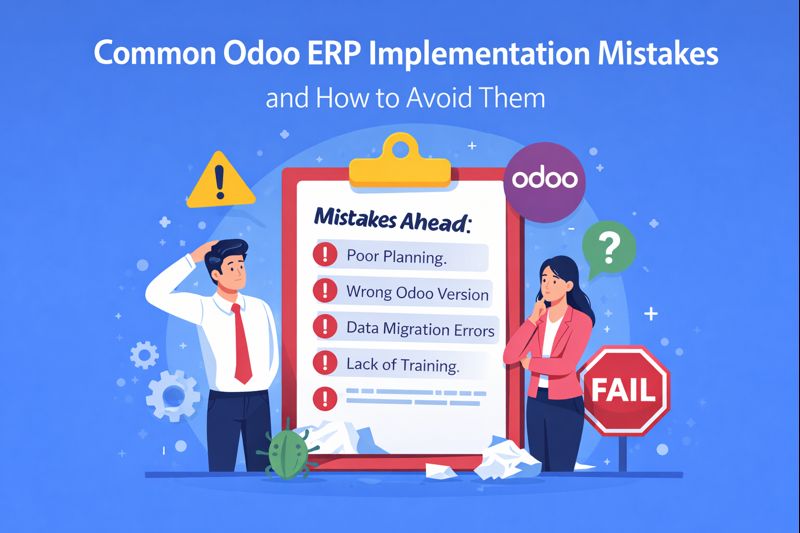
Common Odoo ERP Implementation Mistakes and How to Avoid Them
Introduction
Common Odoo ERP implementation mistakes often cause delays, cost overruns, and poor user adoption. Many businesses choose Odoo ERP for its flexibility and scalability. However, implementation problems usually arise when planning is weak or decisions are rushed. Because ERP affects every department, even small mistakes can create long-term operational issues. For this reason, understanding common mistakes and learning how to avoid them is critical before and during Odoo ERP implementation.
Odoo ERP implementation is not only a technical project. Instead, it is a business transformation process. Therefore, companies must approach it with the right strategy, clear goals, and proper execution. This guide explains the most common Odoo ERP implementation mistakes in simple terms and shows practical ways to avoid them.
If you are new to Odoo ERP, start with this foundational guide:
https://www.infozion.in/odoo-erp-introduction-a-complete-guide-for-businesses-in-2025/
Why Odoo ERP Implementations Fail
Many ERP projects fail not because of software limitations but because of poor implementation practices. In most cases, businesses underestimate planning, ignore user involvement, or rush decisions. As a result, the ERP system fails to deliver expected value.
Odoo ERP is powerful, but it requires a structured approach. When companies skip important steps, problems appear after go-live. Therefore, identifying these mistakes early helps businesses avoid costly corrections later.
Mistake 1: Skipping Proper Business Requirement Analysis
One of the most common Odoo ERP implementation mistakes is skipping detailed requirement analysis. Many businesses start implementation without clearly understanding their processes.
When requirements are unclear, wrong modules get selected. In addition, unnecessary customization increases complexity. Because of this, users struggle to adapt to the system.
How to Avoid This Mistake
Always begin with detailed process mapping. Involve all departments in discussions. Moreover, document pain points and expectations clearly. This approach ensures Odoo ERP aligns with real business needs.
Mistake 2: Choosing the Wrong Odoo Version
Another major mistake is selecting the wrong Odoo edition. Odoo Community and Odoo Enterprise serve different purposes. However, businesses often choose based only on cost.
When the wrong version is selected, limitations appear later. As a result, businesses face migration challenges or additional costs.
How to Avoid This Mistake
Evaluate long-term business goals first. Consider scalability, automation needs, and internal technical expertise. Then choose the version that supports future growth.
Mistake 3: Implementing Too Many Modules at Once
Some businesses try to implement all Odoo modules together. Although this looks efficient, it usually creates confusion.
Users feel overwhelmed. In addition, testing becomes difficult. Because of this, errors increase after go-live.
How to Avoid This Mistake
Use a phased implementation approach. Start with core modules such as accounting, sales, and inventory. Later, add advanced modules. This strategy improves adoption and stability.
To understand modules better, refer to:
https://www.infozion.in/odoo-erp-modules-explained/
Mistake 4: Poor Data Migration Planning
Data migration issues are among the most expensive Odoo ERP implementation mistakes. Dirty or incomplete data causes reporting errors and operational confusion.
When data quality is poor, users lose trust in the ERP system. Consequently, adoption drops.
How to Avoid This Mistake
Clean and validate data before migration. Remove duplicates and outdated records. In addition, test migrated data carefully before go-live.
Mistake 5: Excessive Customization
Odoo is flexible, but excessive customization creates long-term problems. Many businesses customize features that standard Odoo already supports.
Because of heavy customization, system upgrades become difficult. Moreover, maintenance costs increase.
How to Avoid This Mistake
Use standard Odoo features wherever possible. Customize only when business needs cannot be met through configuration. This approach keeps the system upgrade-friendly.
Mistake 6: Ignoring User Training and Change Management
Another common Odoo ERP implementation mistake is neglecting user training. Many companies assume users will learn the system on their own.
Without training, errors increase. As a result, employees resist using the ERP system.
How to Avoid This Mistake
Provide role-based training sessions. Focus on daily tasks rather than theory. In addition, explain how Odoo simplifies work. This improves acceptance and confidence.
Mistake 7: Weak Testing Before Go-Live
Testing is often rushed to meet deadlines. However, weak testing leads to serious issues after deployment.
When workflows are not tested properly, operations slow down. Therefore, businesses face unnecessary disruptions.
How to Avoid This Mistake
Conduct functional and user acceptance testing. Involve real users during testing. This helps identify gaps early and ensures smoother go-live.
Mistake 8: No Clear Implementation Checklist
Many businesses implement Odoo ERP without a structured checklist. As a result, tasks get missed and responsibilities become unclear.
This leads to delays, confusion, and rework.
How to Avoid This Mistake
Follow a step-by-step Odoo ERP implementation checklist. A checklist ensures that every phase is planned and executed properly.
You can follow this detailed checklist guide:
Mistake 9: Lack of Post-Implementation Support
ERP implementation does not end at go-live. However, many businesses stop monitoring the system after deployment.
Without support, minor issues grow into major problems. Consequently, system performance suffers.
How to Avoid This Mistake
Plan post-implementation support in advance. Monitor system usage and collect user feedback. Continuous improvement ensures long-term success.
EEAT Perspective: Why Expert-Led Implementation Matters
From an EEAT perspective, experience and expertise play a key role in ERP success. Businesses that rely on experienced Odoo consultants avoid common mistakes.
Experts follow best practices in planning, configuration, and training. As a result, implementations become more stable and reliable. Industry experts also highlight these mistakes in their implementation guides:
Benefits of Avoiding Common Odoo ERP Implementation Mistakes
Avoiding these mistakes saves time and cost. It also improves user adoption and system performance.
Moreover, businesses gain better control and visibility. As a result, Odoo ERP delivers maximum ROI.
Conclusion
Common Odoo ERP implementation mistakes can seriously impact business operations if ignored. However, most of these issues are preventable with proper planning and execution.
By understanding these mistakes and following best practices, businesses can implement Odoo ERP successfully. A structured approach ensures smooth adoption, better efficiency, and long-term growth.