 Infozion Technologies LLPInfozion Technologies LLP




ERP for Small Businesses: A Complete Beginner-Friendly Guide for 2025
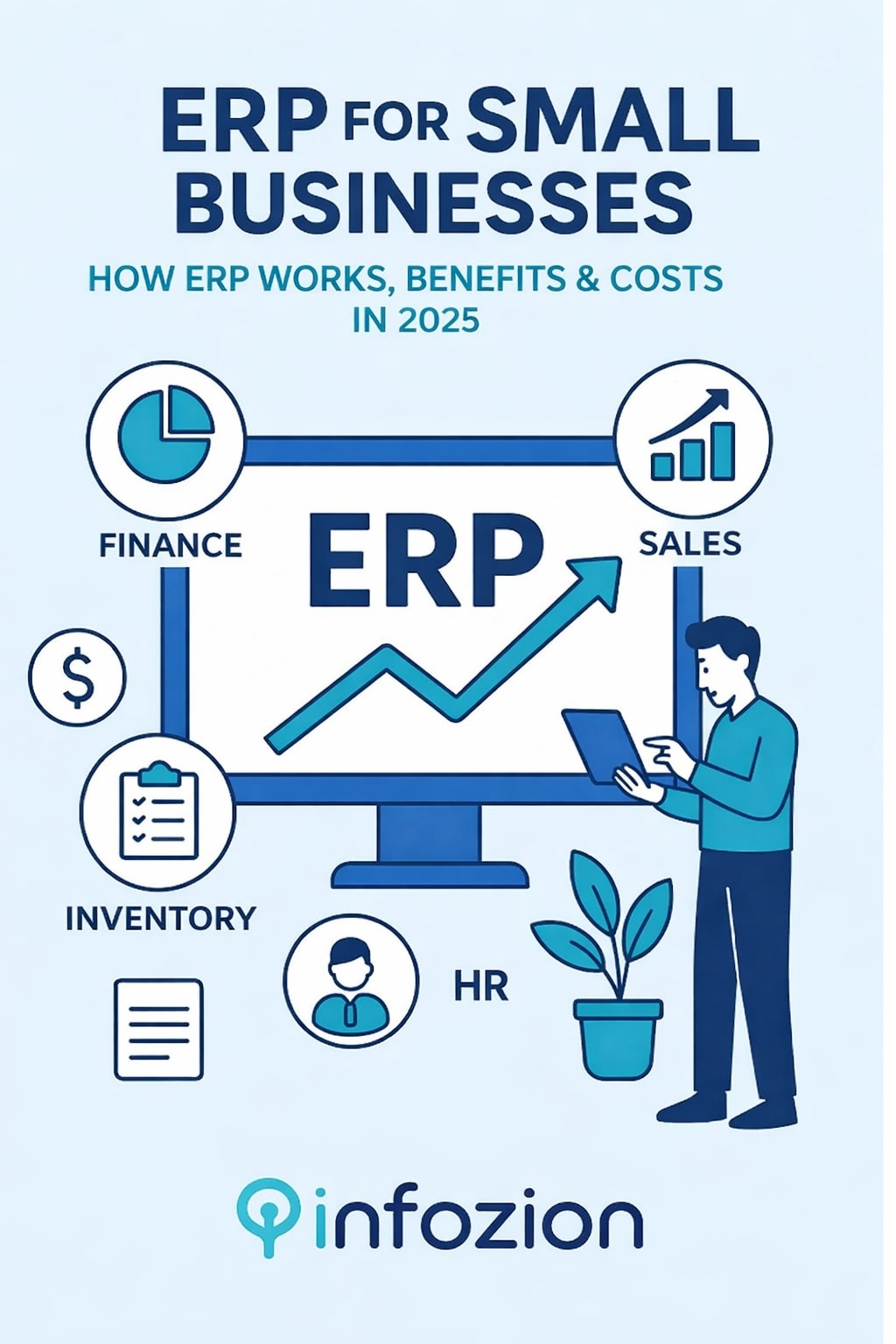
ERP for Small Businesses: A Complete Beginner-Friendly Guide for 2025
Introduction
Running a small business sounds simple, but in reality, it requires handling many things at the same time—customers, stock, payments, suppliers, employees, reports, and more. As a business grows, these tasks become harder to manage manually. This is where ERP for small businesses becomes extremely valuable. ERP brings all business processes together in one organized system to reduce mistakes, save time, and improve daily operations. Even if you are running a small shop, a startup, an agency, or a service-based company, ERP can make your work smoother and your decisions faster.
Many small business owners still rely on notebooks, WhatsApp messages, spreadsheets, and multiple apps to manage their daily operations. But this creates confusion, delays, miscommunication, and incorrect data. ERP solves all these problems by connecting everything—sales, accounts, HR, inventory, CRM, and reports—into one single platform. Today’s modern ERP tools are designed to be simple, affordable, and easy to learn, making them perfect for small businesses.
If you’re new to ERP, here is a simple, beginner-friendly explanation:
👉 https://www.infozion.in/what-is-erp/
What Is ERP, and Why Small Businesses Need It
ERP stands for Enterprise Resource Planning. It is a system that helps companies manage and automate day-to-day activities such as billing, sales tracking, inventory updates, reporting, CRM, HR, accounting, and more.
Small businesses need ERP more than ever because:
- Customers expect faster service
- Markets are more competitive
- Mistakes are expensive
- Owners must make quick decisions
- Teams need clear communication
ERP gives small businesses real-time visibility of what is happening inside the company. Instead of guessing, owners can see accurate stock levels, financial reports, sales performance, customer history, and expenses instantly.
To understand how ERP systems work in detail, explore this guide:
👉 https://www.infozion.in/erp-systems/
How ERP Works Inside a Small Business
ERP connects all departments so that every piece of information flows automatically.
Here’s a simple example:
A customer places an order → ERP updates inventory → invoice generates → payment is recorded → delivery team is notified.
This entire flow happens without anyone needing to send messages or check multiple files.
ERP becomes the central brain of the business.
Key Features of ERP for Small Businesses
1. Inventory Management
Small businesses often struggle with stock mismatches. ERP solves this by showing:
- Real-time stock levels
- Low-stock alerts
- Fast-moving and slow-moving items
- Automatic stock updates after every sale
2. Billing & Accounting
ERP generates invoices, tracks payments, manages expenses, handles taxes, and creates financial reports—all automatically.
3. Customer Relationship Management (CRM)
Small businesses can store customer data, track follow-ups, and maintain communication history.
4. Employee & HR Management
ERP manages attendance, leave, salary calculation, and employee records without paperwork.
5. Reporting & Analytics
Owners get instant reports like
- Daily sales
- Profit & loss
- Inventory summary
- Expense tracking
- Customer buying patterns
Instead of checking multiple files, everything appears on one dashboard.
Benefits of ERP for Small Businesses
1. Saves Time and Labour Costs
ERP eliminates repetitive paperwork and manual entries. Employees can focus on customer service and actual work instead of data entry.
2. Reduces Human Errors
Manual mistakes in billing, stock numbers, or accounting can harm a small business. ERP ensures accurate and updated data at all times.
3. Improved Customer Experience
ERP helps businesses respond quickly with correct information. Customers appreciate faster service and clear communication.
4. Better Decision Making
ERP provides clear reports that help owners understand what is working and what needs improvement.
5. Helps With Business Growth
As your business grows, ERP grows with you. You can add more modules, users, or features anytime.
Cloud ERP vs On-Premise ERP for Small Businesses
Most small businesses choose Cloud ERP because:
- No installation needed
- Very low upfront cost
- Works on mobile and laptop
- Automatic updates
- No IT team required
On-premise ERP is suitable only for companies with:
- Dedicated IT teams
- High customization needs
- Strong internal servers
Real-Life Example of ERP in a Small Business
Imagine you run a small clothing store.
Without ERP:
- Stock is tracked manually
- Invoices are handwritten
- Payment records are often missing
- Reports take hours to prepare
- Customers wait longer
With ERP:
- Stock updates automatically
- The invoice prints in seconds
- Payments sync instantly
- Reports ready in one click
- Customer service becomes faster
This shows how ERP transforms daily work.
Costs of ERP for Small Businesses
The cost depends on:
- Number of users
- Modules required
- Cloud or on-premise
- Custom features
- Training & support
Most small businesses choose affordable cloud ERP monthly subscription plans instead of expensive software.
Challenges Small Businesses Face Without ERP
Without ERP, businesses often experience:
- Wrong stock data
- Delayed billing
- Confused communication
- Missed follow-ups
- Unclear finances
- Lost customers
ERP fixes all these issues instantly.
How to Choose the Right ERP for Your Small Business
Check These Factors Before Choosing ERP
- Is the ERP easy to use?
- Does it fit your budget?
- Can it grow with your business?
- Does it include mobile access?
- Is customer support good?
- Are modules suitable for your industry?
A good ERP should improve your daily workflow, not make it more complicated.
External Reference
For more insights on ERP for small businesses, you can explore this reliable external resource:
Conclusion
ERP for small businesses is not optional anymore—it is essential for staying organized, competitive, and profitable.
It helps businesses save time, avoid errors, improve communication, and make smarter decisions. Whether you run a retail shop, agency, manufacturing unit, or online store, ERP can transform the way you work.
If you want to start learning ERP from scratch, begin here:
👉 https://www.infozion.in/what-is-erp/
Running an e-waste management business can be rewarding, but it also brings major hurdles. In this article, we’ll explore the Top 5 Challenges E-Waste Companies Face and how ERP software helps solve each one through automation, better tracking, and smarter data management.
E-waste management involves tracking, recycling, compliance, and logistics—all at once. Without the right tools, companies struggle to stay organized and efficient. That’s why many e-waste firms now rely on ERP systems to manage operations more effectively.
Inaccurate Inventory Tracking
In e-waste management, every item counts—from refurbished computers to recyclable metals. When tracking is done manually, mistakes happen easily. You might overcount, undercount, or lose valuable components—and these errors often lead to profit loss and safety risks.
How ERP Fixes It
ERP software brings real-time inventory tracking. Every piece of equipment—from collection to recycling—is logged automatically. You can see exactly what’s in stock, what’s under processing, and what’s ready for dispatch.
ERP dashboards even help predict which materials will increase in demand, allowing smarter planning and reduced waste.
If you’d like to learn how ERP planning works in real business stages, read this complete guide on ERP implementation phases
Delayed Recycling Turnaround
Time is money in the e-waste industry. When materials sit idle in storage, it affects your cash flow and customer satisfaction. Delays happen mainly because of manual sorting, lack of coordination, and unclear scheduling.
How ERP Fixes It
ERP software automates daily workflows. It assigns tasks, monitors progress, and alerts managers when deadlines are missed. You can track which items are waiting for processing and who’s responsible for them—all in real time.
According to industry data, businesses using automation recycle up to 40% faster than those using manual processes
Lack of Logistics Visibility
Pickups, deliveries, and shipments happen every day in e-waste recycling. Without proper visibility, it’s hard to know where vehicles are, how much waste has been collected, or which deliveries are pending.
How ERP Fixes It
Modern ERP systems integrate with logistics tracking tools. You can monitor collection routes, optimize vehicle usage, and track deliveries live. This level of visibility not only improves efficiency but also builds client trust. You’ll always know what’s happening in your business—minute by minute.
Compliance and Documentation Overload
E-waste management involves a lot of paperwork—recycling licenses, compliance reports, and audit trails. Manually managing these documents can lead to stress, errors, or missed deadlines. Even one missing report can cause delays or penalties.
How ERP Fixes It
ERP software keeps all compliance data in one secure place. It automatically generates recycling certificates, stores reports, and sends renewal reminders.
Your business stays organized, compliant, and always audit-ready.
For updated sustainability and waste management trends.
Disconnected Departments and Poor Data Flow
In many e-waste companies, every department—finance, warehouse, logistics, and operations—uses a separate system. This disconnect slows down communication and creates confusion.
How ERP Fixes It
ERP integrates all departments into one system. Everyone—from field staff to finance—works with the same live data. No need for manual updates or long email chains. This connected workflow leads to better coordination, faster decisions, and fewer mistakes.
The Future of E-Waste Management
The e-waste industry is growing quickly. To stay competitive, companies must work smarter—not harder. ERP software isn’t just a management tool; it’s a complete solution that improves inventory tracking, workflow automation, compliance management, and team coordination.
By adopting ERP, e-waste companies can reduce costs, boost productivity, and build a sustainable, data-driven future.
Final Thoughts
E-waste businesses face daily challenges—from inventory issues to compliance overload. But with ERP systems, everything becomes simpler and faster. Automation replaces manual work, real-time data replaces guesswork, and transparency replaces confusion.
In simple words, ERP transforms waste management into smart management. And that’s exactly what every e-waste company needs to thrive in the future.