 Infozion Technologies LLPInfozion Technologies LLP




Odoo ERP for Hospitals & Clinics: Modules, Features & Benefits Explained
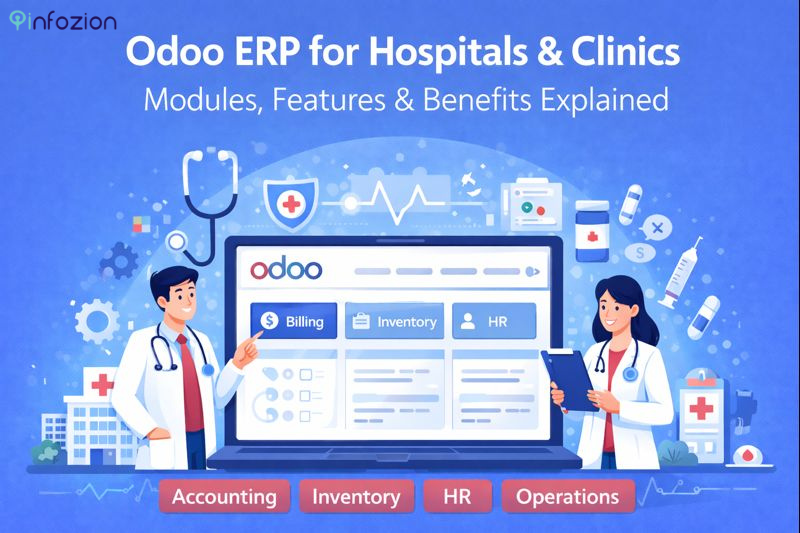
Odoo ERP for Hospitals & Clinics: Modules, Features & Benefits Explained
Introduction
Odoo ERP for hospitals and clinics is becoming a preferred choice for healthcare organizations that want to manage operations efficiently without relying on multiple disconnected systems. Hospitals and clinics handle complex activities every day. These include billing, inventory, staff management, procurement, and reporting. When these processes run on different tools, errors increase and visibility decreases. Because of this, healthcare providers are now looking for a unified ERP solution.
Odoo ERP offers a modular and flexible platform that helps hospitals and clinics manage administrative and operational workflows from one system. Moreover, it reduces manual work and improves coordination across departments. This guide explains the modules, features, and benefits of Odoo ERP for hospitals and clinics in a simple and practical way.
To understand the ERP concept clearly, you can first read this guide:
👉 https://www.infozion.in/odoo-erp-introduction-a-complete-guide-for-businesses-in-2025/
Why Hospitals and Clinics Need an ERP System
Healthcare organizations manage sensitive data, expensive inventory, and large teams. At the same time, they must maintain accuracy and compliance. When operations rely on spreadsheets or isolated software, efficiency drops.
An ERP system connects departments and centralizes data. As a result, hospitals gain better control over costs, resources, and workflows. In addition, management teams receive real-time insights that support better decisions.
Odoo ERP fits healthcare needs because it is flexible, scalable, and easy to customize. Therefore, both small clinics and large hospitals can use it effectively.
Overview of Odoo ERP for Hospitals and Clinics
Odoo ERP is not a clinical system. Instead, it focuses on administrative and operational management. It supports healthcare organizations by managing finance, inventory, HR, procurement, and reporting in one place.
Because Odoo follows a modular structure, hospitals can select only the modules they need. This keeps the system simple and user-friendly. Moreover, additional modules can be added later as the organization grows.
Core Odoo ERP Modules for Hospitals & Clinics
Accounting and Finance Module
Financial management is a critical area for healthcare organizations. Hospitals handle large volumes of transactions every day. These include patient billing, vendor payments, insurance-related entries, and expenses.
Odoo’s accounting module helps manage invoices, payments, taxes, and financial reports efficiently. Moreover, automation reduces manual errors and speeds up closing cycles. As a result, finance teams maintain accuracy and transparency.
Inventory Management Module
Hospitals and clinics depend on medical supplies and equipment. Stock shortages can disrupt services, while overstocking increases costs.
Odoo ERP provides real-time inventory tracking. It helps monitor stock levels, expiry dates, and supplier performance. Therefore, healthcare providers can avoid shortages and reduce wastage.
Purchase and Vendor Management Module
Healthcare organizations work with many suppliers. Managing purchase orders manually often leads to delays and errors.
Odoo’s purchase module simplifies procurement workflows. It allows hospitals to manage suppliers, compare prices, and track orders easily. In addition, integration with inventory ensures smooth replenishment.
Human Resources (HR) Module
Hospitals rely heavily on doctors, nurses, and support staff. Managing attendance, payroll, and schedules manually is time-consuming.
Odoo ERP’s HR module helps manage employee records, attendance, leaves, and payroll. Consequently, administrative workload reduces and staff management improves.
CRM and Operations Module
While healthcare is service-focused, clinics still need structured operational tracking. Odoo CRM helps manage inquiries, follow-ups, and service coordination.
Moreover, operational modules help track workflows and tasks. As a result, internal coordination improves across departments.
Key Features of Odoo ERP for Healthcare Organizations
Centralized Data Management
Odoo ERP stores operational data in a single system. This eliminates duplication and confusion.
Because data is centralized, departments access accurate information instantly. Therefore, coordination improves and errors reduce.
Real-Time Reporting and Dashboards
Healthcare administrators need clear insights into operations. Odoo ERP provides customizable dashboards and reports.
These reports help track costs, inventory usage, and staff performance. As a result, management decisions become data-driven.
Scalability and Flexibility
Healthcare organizations grow over time. Odoo ERP supports this growth.
New modules, users, and workflows can be added without replacing the system. Therefore, Odoo ERP remains useful in the long term.
Cost Control and Automation
Manual processes increase operational costs. Odoo ERP automates repetitive tasks such as billing entries, inventory updates, and payroll calculations.
Because of automation, efficiency improves and costs reduce. Over time, hospitals experience better ROI.
Benefits of Using Odoo ERP for Hospitals and Clinics
Improved Operational Efficiency
Odoo ERP streamlines workflows across departments. Tasks move faster and with fewer errors.
As a result, staff spend less time on administration and more time on patient services.
Better Resource Utilization
Hospitals must manage staff and inventory carefully. Odoo ERP provides visibility into resource usage.
Therefore, organizations can optimize schedules and inventory planning.
Reduced Errors and Manual Work
Automation reduces dependency on spreadsheets and manual entries. Consequently, errors decrease and data accuracy improves.
Long-Term Scalability
Odoo ERP grows with the organization. Clinics can start small and expand later.
Because of this flexibility, Odoo ERP suits healthcare organizations of all sizes.
Odoo ERP Implementation for Hospitals and Clinics
Implementing ERP in healthcare requires careful planning. Downtime and data issues can affect operations.
A phased implementation approach works best. Hospitals can begin with core modules such as Accounting and Inventory. Later, advanced modules can be added.
For a structured approach, you can refer to this guide:
👉 https://www.infozion.in/odoo-erp-for-healthcare-hospital-clinic-management-solution/
Common Challenges and How Odoo ERP Helps
Healthcare staff often resist new systems. However, user-friendly interfaces and proper training improve adoption.
Data migration is another challenge. With proper validation and testing, Odoo ERP ensures reliable data.
Therefore, planning and support play a key role in successful implementation.
Odoo ERP vs Traditional Hospital Management Systems
Traditional hospital management software often focuses on limited functions. In contrast, Odoo ERP provides a broader operational view.
It integrates finance, inventory, HR, and operations. As a result, hospitals gain better visibility and control.You can also explore additional insights here:
Why Odoo ERP Is a Smart Choice for Healthcare
Odoo ERP combines flexibility, scalability, and affordability. Healthcare organizations can customize workflows without heavy development.
Moreover, the modular structure keeps implementation manageable. Therefore, Odoo ERP becomes a practical long-term solution.
Future-Ready Healthcare Operations with Odoo ERP
Healthcare is evolving rapidly. Digital systems are no longer optional.
Odoo ERP helps hospitals and clinics stay future-ready. It supports growth, compliance, and operational excellence.
Conclusion
Odoo ERP for hospitals and clinics provides a powerful solution for managing healthcare operations efficiently. It helps streamline finance, inventory, HR, and procurement through a single platform.
By using Odoo ERP, healthcare organizations reduce manual work, improve coordination, and gain better visibility. With proper planning and implementation, Odoo ERP becomes a strong foundation for sustainable healthcare management.