 Infozion Technologies LLPInfozion Technologies LLP




Top 7 Benefits of Outsourcing Software Development to India in 2026
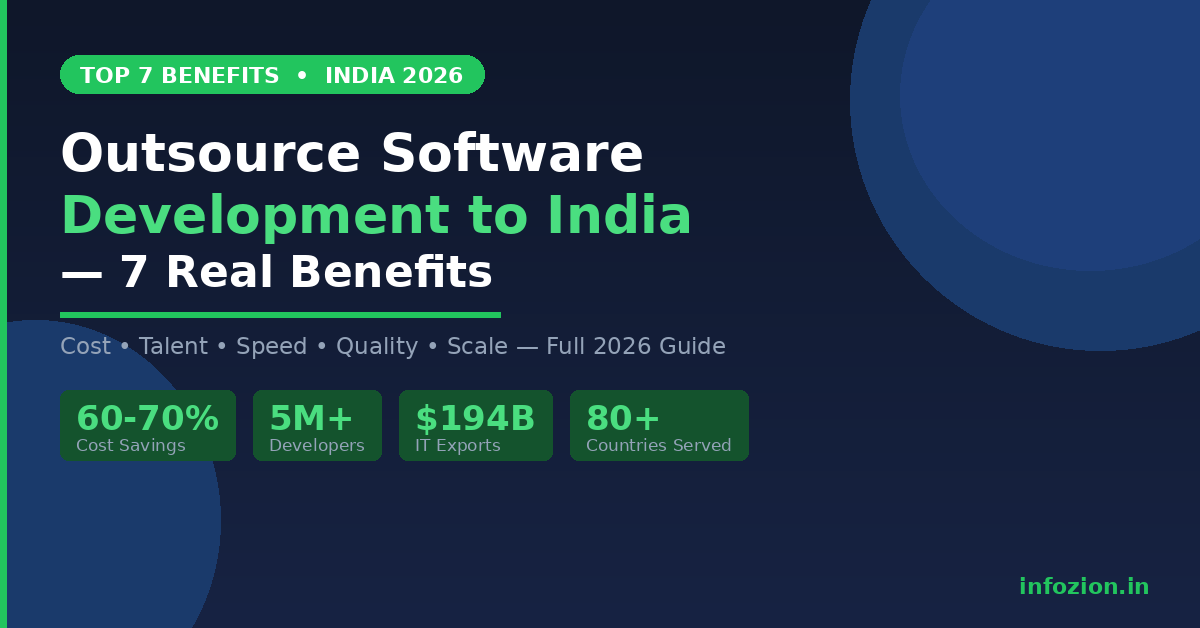
Top 7 Benefits of Outsourcing Software Development to India in 2026
Businesses that outsource software development to India are not just saving money — they are building better products, faster, with access to a talent pool that simply does not exist at this scale anywhere else in the world.
In 2026, over 500 global companies — from funded startups to Fortune 500 enterprises — choose India as their primary software development destination. The reasons go far beyond cost. In this guide, we break down the top 7 benefits of outsourcing software development to India, the risks to watch out for, and exactly how to choose the right partner for your project.
Why India Dominates Global Software Outsourcing
Before diving into the benefits, it helps to understand why India has maintained its position as the world’s leading software outsourcing destination for over two decades.
India produces over 1.5 million engineering graduates every year. Additionally, cities like Noida, Bengaluru, Hyderabad, and Pune have developed deep ecosystems of technology companies, specialised talent, and supporting infrastructure that make software delivery reliable and scalable.
According to NASSCOM, India’s IT and software exports crossed $194 billion in 2023-24 — serving clients in over 80 countries. Furthermore, India holds the second largest developer pool in the world, with over 5 million active software professionals.
These are not just numbers. They represent a talent market where your business can find experienced React.js developers, cloud architects, AI engineers, and enterprise software specialists — at competitive rates, with strong English communication, and in a time zone that works for both Asian and European business hours.
Benefit 1 — Cost Savings of 60-70% Without Quality Compromise
The most well-known benefit of outsourcing software development to India is cost — and for good reason. The numbers are significant.
| Role | US/UK Rate | India Rate | Savings |
|---|---|---|---|
| Senior Full-Stack Developer | $120–$180/hr | $25–$45/hr | 70-75% |
| UI/UX Designer | $80–$120/hr | $15–$30/hr | 70% |
| QA Engineer | $60–$100/hr | $12–$25/hr | 70-75% |
| Project Manager | $90–$150/hr | $20–$40/hr | 70% |
However, this cost advantage is not about finding cheap labour. Indian software companies charge less because the cost of living is lower — not because the quality is lower. Many Indian developers have worked on the same codebases, used the same frameworks, and followed the same standards as their counterparts in the US or UK.
Note: These are approximate industry averages for 2026. Contact Infozion for a free project estimate.
Benefit 2 — Access to a Deep and Diverse Talent Pool
When you outsource software development to India, you gain access to specialists that are extremely difficult to find and prohibitively expensive to hire locally in most Western markets.
This includes:
- Frontend specialists — React.js, Angular, Vue.js, Next.js
- Backend engineers — Node.js, Python, Laravel, Django, Java
- Mobile developers — Flutter, React Native, Swift, Kotlin
- CMS specialists — Drupal 10, WordPress, Headless CMS
- Cloud and DevOps — AWS, Google Cloud, Azure, Docker, Kubernetes
- AI and ML engineers — TensorFlow, PyTorch, NLP, computer vision
Moreover, India’s IT ecosystem has matured significantly. Developers working in Noida, Bengaluru, and Hyderabad are routinely collaborating with teams at Google, Amazon, Microsoft, and Adobe — which means the talent quality bar is set by global standards, not local ones.
Benefit 3 — Faster Time to Market
Speed is one of the most underrated benefits of outsourcing software development to India.
A well-structured Indian development team can start within one to two weeks of engagement. They work in agile sprints, deliver working software every two weeks, and scale the team up or down based on project needs—without the months-long hiring process required for building an in-house team.
Furthermore, the time zone advantage works in your favor. Indian Standard Time (IST) overlaps with European morning hours and US evening hours. This means you can send requirements at the end of your business day and receive completed work the next morning — an effective round-the-clock development cycle.
Benefit 4 — Established Processes and Quality Standards
The best Indian software companies do not just write code. They follow documented processes for project management, code review, quality assurance, and security — often backed by international certifications.
Look for companies with:
- ISO 9001:2015—Quality Management Systems certification
- ISO/IEC 27001:2022—Information Security Management certification
- Agile or Scrum methodology — structured sprint-based delivery
- Code review processes — peer review before every merge
- Dedicated QA teams — separate from development
Infozion Technologies holds ISO 9001:2015, ISO/IEC 27001:2022, and ISO 27003 certifications — meaning every project is delivered under internationally recognised quality and security frameworks, not just best-effort processes.
Benefit 5 — Scalability Without Long-Term Commitment
One of the biggest advantages of outsourcing software development to India is the ability to scale your team up or down based on project needs — without the legal, HR, and financial complexity of hiring and firing employees.
Need to scale from 2 developers to 6 for a product launch? A good outsourcing partner can make that happen within a week.
Project phase complete and you need to reduce the team temporarily? Simply adjust the engagement — no redundancy costs, no legal complications.
This flexibility is particularly valuable for startups and growing businesses that need to move fast but cannot commit to the long-term cost of a large in-house team.
Benefit 6 — Focus Your In-House Team on Core Business
When you outsource software development to India, your in-house team is freed from the complexity of hiring, managing, and retaining developers. Consequently, they can focus entirely on what they do best — product strategy, sales, customer relationships, and business growth.
Many successful businesses maintain a small in-house product team for strategy and stakeholder management, while outsourcing all execution to an Indian development partner. This hybrid model delivers the best of both worlds—business context from your team and technical execution from specialists.
Additionally, outsourcing removes the operational burden of managing developer tools, infrastructure, payroll, benefits, and performance reviews — all of which are handled by the outsourcing partner.
Benefit 7 — Risk Reduction Through Proven Delivery Models
Reputable Indian software companies have delivered hundreds of projects across dozens of industries. Therefore, they have seen — and solved — most of the problems your project will encounter.
This experience translates into:
- Better project scoping — they know what questions to ask upfront
- Realistic timelines — based on actual delivery data, not optimistic estimates
- Risk identification early — potential issues flagged before they become expensive
- Contingency planning — backup approaches ready when requirements change
Furthermore, a contractual relationship with milestone-based payments, IP ownership clauses, and NDAs gives you legal protection that is difficult to achieve with freelancers or small local teams.
What to Look for When You Outsource Software Development to India
Not all Indian software companies deliver the same quality. Here is what separates the best from the rest:
Verified Portfolio with Named Clients
Ask for a portfolio with real project names and verifiable client references. Strong companies like Infozion Technologies have delivered 250+ projects for clients including HCL, VidyaGyan, and multiple startups across India and globally.
ISO Certifications
ISO 9001 and ISO 27001 certifications are not just badges. They represent audited, documented processes that protect your project and your data.
Clear Contract Terms
Before signing anything, ensure the contract includes: scope of work, milestone-based payment schedule, IP ownership clause (you own the code), NDA, and a change management process.
Dedicated Project Manager
Your single point of contact should be a project manager — not a developer who also handles communication on the side.
Transparent Communication
Weekly written updates, a shared project management tool (Jira, Trello, Asana), and regular video calls are non-negotiable. If a company resists transparency, walk away.
India vs Other Outsourcing Destinations—2026 Comparison
| Factor | India | Eastern Europe | Philippines | Vietnam |
|---|---|---|---|---|
| Developer Rate (hr) | $15–$45 | $35–$75 | $15–$35 | $15–$35 |
| Talent Pool Size | Very Large | Medium | Medium | Medium |
| English Proficiency | Very High | High | Very High | Medium |
| Tech Stack Depth | Very High | High | Medium | Medium |
| Time Zone (IST) | Asia + Europe | Europe only | Asia + Australia | Asia only |
| ISO-Certified Companies | Many | Some | Few | Few |
India’s combination of talent depth, English proficiency, tech stack diversity, and time zone coverage is unmatched by any other outsourcing destination at scale.
Frequently Asked Questions
Why should I outsource software development to India in 2026?
India offers 60-70% cost savings versus US or UK rates, access to 5 million+ developers across all modern tech stacks, strong English communication, and a proven track record of enterprise-grade software delivery. Moreover, India’s IT exports crossed $194 billion in 2023-24 — proof that global businesses trust Indian developers with mission-critical projects.
How much can I save by outsourcing software development to India?
Typically 60-70% compared to US or UK development costs. A senior developer costs $25-45/hr in India versus $120-180/hr in the US. For a 4-person team over 6 months, this can represent savings of ₹50-80 lakhs or more. Get a free estimate from Infozion.
Is it safe to outsource software development to India?
Yes — when done with the right safeguards. Always use a contract with IP ownership clauses and an NDA. Choose ISO-certified companies with verified client references. Use milestone-based payments rather than paying upfront. Additionally, maintain regular communication through video calls and shared project management tools.
How do I choose the right software development company in India?
Check for ISO certifications, verified client reviews on Clutch or GoodFirms, a portfolio with named clients, transparent pricing, and a dedicated project manager. Ask for a technical assessment or small paid test project before committing to a full engagement.
What types of software can Indian companies build?
Indian software companies build virtually any type of software — web applications, mobile apps, custom CRM and ERP systems, e-commerce platforms, AI and ML solutions, cloud infrastructure, and enterprise platforms. Infozion’s team covers React.js, Node.js, Python, Laravel, Flutter, Drupal, and more.
How quickly can an Indian software company start my project?
Most reputable companies can start within one to two weeks of contract signing. The discovery and scoping phase typically takes one additional week. Therefore, you can have a development team working on your project within three weeks of your first conversation.
Conclusion
Outsourcing software development to India in 2026 is not just a cost decision — it is a strategic one. The combination of deep talent, proven processes, time zone advantages, and scalable engagement models makes India the smartest choice for businesses that want to build great software without building a large in-house engineering team.
The key is choosing the right partner — one with verifiable experience, international certifications, transparent processes, and a track record of delivering real results for real businesses.
Infozion Technologies has been that partner for 250+ businesses across India and globally since 2016. If you are ready to outsource software development to India, we are ready to deliver.
Get a free project consultation today →