 Infozion Technologies LLPInfozion Technologies LLP




Digital Transformation for SMBs in India — Complete 2026 Guide
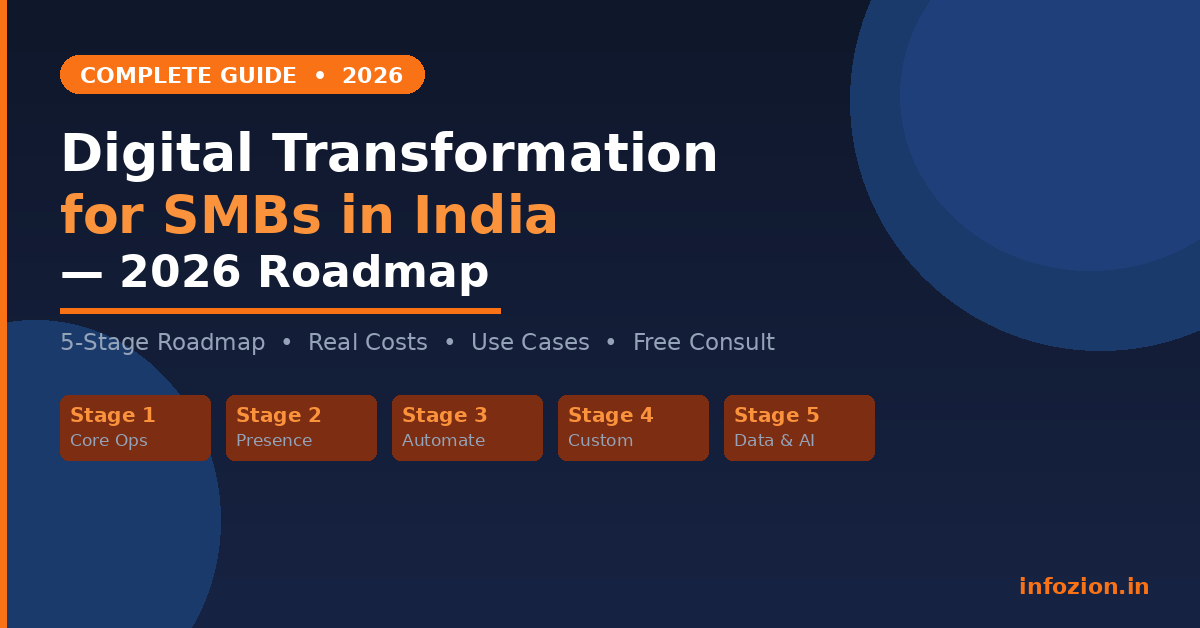
Digital Transformation for SMBs in India — Complete 2026 Guide
Small and medium businesses in India that embraced digital transformation for SMBs grew three times faster than those that did not — and 2026 is the year your business cannot afford to wait any longer.
If you are running a small or medium business in India and still managing operations on Excel sheets, WhatsApp groups, and manual processes — you are not just falling behind. You are actively losing customers, revenue, and competitive advantage to businesses that have already made the shift.
This complete guide breaks down exactly what digital transformation means for Indian SMBs, what it costs, which tools actually work, and how to start — even if your budget is limited and your team is not technical.
What is Digital Transformation for SMBs?
Digital transformation is the process of replacing manual, paper-based, or disconnected business processes with integrated digital systems — so your business runs faster, smarter, and with less human error.
For a small or medium business in India, this does not mean buying expensive enterprise software. In fact, it means starting small and solving your biggest operational pain points first.
Common examples of digital transformation for Indian SMBs:
- Replacing Excel lead tracking with a CRM system
- Moving from WhatsApp-based customer support to a ticketing platform
- Building a web portal for clients to track their orders or projects
- Automating invoicing, payroll, or inventory management
- Creating a mobile app for your field sales or delivery team
According to NASSCOM, Indian SMBs that adopted digital tools in the last three years reported an average 30% improvement in operational efficiency and a significant reduction in manual errors.
Why Digital Transformation for SMBs in India Cannot Wait
Many Indian business owners believe digital transformation is only for large enterprises. However, this thinking is costing them deeply.
Here is what is happening right now:
Your competitors are already digitising. Businesses that automate lead follow-up, inventory, and customer communication are responding faster, losing fewer leads, and delivering better service — without hiring more people.
Customers expect digital experiences. Whether you are a B2B service provider or a D2C brand, your customers now expect online portals, real-time updates, digital invoices, and instant communication. Businesses that cannot deliver this are losing clients to those that can.
Government is pushing digital India hard. GST compliance, e-invoicing, UPI payments, and MSME digital registration are just the beginning. Furthermore, businesses that are digitally mature will benefit most from government schemes, credit access, and tender eligibility.
The cost of NOT transforming is rising. Every month you spend on manual processes is a month of wasted salaries, avoidable errors, and missed growth opportunities.
The 5-Stage Digital Transformation Roadmap for Indian SMBs
Stage 1 — Digitise Your Core Operations
Start with the processes that waste the most time or cause the most errors. For most Indian SMBs, this means:
- CRM software for lead and customer management — replace Excel and WhatsApp
- Cloud accounting — Tally on cloud, Zoho Books, or QuickBooks for invoicing and GST
- Digital communication — Google Workspace or Microsoft 365 for email, documents, and collaboration
This stage is low cost, fast to implement, and delivers immediate ROI. Most SMBs complete Stage 1 within 30-60 days.
Stage 2 — Build Your Digital Presence
Once internal operations are digitised, focus on your external digital presence.
- A professional website with clear service pages and a contact form
- A Google Business Profile for local search visibility
- Basic SEO so customers can find you online
- LinkedIn company page for B2B credibility
At Infozion Technologies, we have helped dozens of Indian SMBs build their first professional web presence — from simple corporate websites to full web application development with client portals and lead capture systems.
Stage 3 — Automate Repetitive Processes
This is where the real efficiency gains happen. Automation removes human error and frees your team to focus on high-value work.
- Marketing automation — email sequences, lead nurturing, WhatsApp Business API
- Sales automation — CRM with automatic follow-up reminders and pipeline tracking
- Operations automation — inventory alerts, auto-generated reports, payment reminders
- HR automation — attendance, payroll, leave management
Moreover, most automation tools in India are now affordable enough for SMBs — Zoho, Freshworks, and LeadSquared all offer SMB-friendly pricing starting at ₹800-2,000 per user per month.
Stage 4 — Build Custom Digital Products
When off-the-shelf tools no longer fit your specific business needs, it is time to build custom.
This could mean:
- A custom CRM built around your unique sales process
- A mobile app for your delivery team or field engineers
- A client portal where customers can track orders, raise tickets, and view invoices
- An internal dashboard that gives management real-time visibility across all departments
Custom development costs more upfront. However, it delivers a competitive advantage that off-the-shelf software simply cannot — because your competitors cannot buy the same thing.
Explore Infozion’s custom software development services to understand what is possible for your budget.
Stage 5 — Data-Driven Decision Making
The final stage of digital transformation is using the data your systems generate to make better business decisions.
- Sales data from your CRM shows which lead sources convert best
- Website analytics show which pages drive the most enquiries
- Operations data shows where your biggest inefficiencies are
- Financial data shows your most and least profitable products or services
Additionally, businesses at this stage begin exploring AI and machine learning — using predictive analytics for inventory, customer churn prediction, and personalised marketing.
Digital Transformation Cost for Indian SMBs — 2026 Breakdown
One of the biggest barriers for Indian SMBs is fear of cost. However, digital transformation does not have to be expensive if approached in stages.
| Stage | What You Need | Approximate Cost |
|---|---|---|
| Stage 1 — Core Operations | CRM + Cloud Accounting + Google Workspace | ₹2,000 – ₹8,000/month |
| Stage 2 — Digital Presence | Website + SEO + Google Business Profile | ₹30,000 – ₹1,50,000 one-time |
| Stage 3 — Automation | Marketing + Sales + HR automation tools | ₹5,000 – ₹20,000/month |
| Stage 4 — Custom Products | Custom CRM, web app, or mobile app | ₹3,00,000 – ₹15,00,000 |
| Stage 5 — Data & AI | Analytics + ML integration | ₹1,00,000 – ₹5,00,000 |
Note: These are approximate industry averages for India in 2026. Your actual cost depends on business size and specific requirements. Contact Infozion for a free digital transformation consultation.
The smartest approach is to start with Stage 1 and Stage 2 — which together cost less than ₹2 lakhs — and fund further stages from the efficiency savings and revenue growth they generate.
Real Digital Transformation Use Cases for Indian SMBs
Manufacturing SMB — Noida
A mid-size manufacturing company was managing 200+ distributor relationships on Excel. After implementing a custom CRM and distributor portal, they reduced order processing time by 60% and eliminated ₹8 lakhs per year in manual processing costs.
Professional Services Firm — Delhi NCR
A CA firm was sending all client documents via email and WhatsApp. After building a client portal where customers upload documents, track filing status, and receive automated reminders — client retention improved by 35% and staff overtime dropped significantly.
D2C Brand — Pan India
A growing D2C brand was managing inventory, orders, and customer support across 3 different tools with no integration. After building a unified operations dashboard, they reduced fulfilment errors by 80% and scaled from 500 to 2,000 daily orders without hiring additional ops staff.
Common Digital Transformation Mistakes Indian SMBs Make
Trying to Do Everything at Once
The biggest mistake is attempting a complete digital overhaul in one go. This leads to cost overruns, team resistance, and failed implementations. Therefore, always start with Stage 1 and prove ROI before moving to the next stage.
Choosing Tools Before Defining Problems
Many SMBs buy software because a competitor uses it or a salesperson recommended it — not because it solves a specific problem. Always start with your pain point, then find the tool that addresses it.
Ignoring Team Training
Digital transformation fails when the team does not adopt the new tools. Consequently, every implementation must include proper training, a clear handover process, and a champion within the team who drives adoption.
Underestimating Change Management
Technology is the easy part. Getting your team to change how they work is the hard part. Plan for resistance, communicate the benefits clearly, and give the team time to adapt.
How Infozion Helps Indian SMBs Transform Digitally
At Infozion Technologies, we have partnered with SMBs across India to deliver digital transformation at every stage — from building their first professional website to developing custom enterprise platforms.
Our work includes:
- Custom CRM development for sales-driven businesses
- Web portals and client dashboards for service businesses
- Mobile apps for field teams and delivery operations
- Drupal and WordPress websites for institutional and corporate clients
- Digital marketing and SEO to drive online lead generation
We hold ISO 9001:2015 and ISO/IEC 27001:2022 certifications — meaning every project is delivered under internationally recognised quality and security standards.
View our project portfolio to see what we have built for businesses like yours, or learn how we work before starting a conversation.
Frequently Asked Questions
What is digital transformation for SMBs in India?
Digital transformation for SMBs in India is the process of replacing manual and disconnected business processes with integrated digital systems — such as CRM software, web portals, mobile apps, and automation tools — to improve efficiency, reduce costs, and grow revenue. It can be done in stages starting from as little as ₹2,000 per month.
How much does digital transformation cost for a small business in India?
It depends on the stage. Basic digitisation — CRM, cloud accounting, and a professional website — can be done for ₹50,000–₹2,00,000. Custom software development for specific business needs typically costs ₹3,00,000–₹15,00,000. Contact Infozion for a free assessment.
Where should an Indian SMB start with digital transformation?
Start with your biggest operational pain point. For most Indian SMBs, this is lead and customer management — which means implementing a CRM first. Once that delivers ROI, move to automating the next most painful process.
How long does digital transformation take for an SMB?
Stage 1 — basic digitisation — can be completed in 30–60 days. A full digital transformation across all five stages typically takes 12–24 months when done properly, in phases. Rushing the process is the most common reason transformations fail.
Can a small business in India afford digital transformation?
Yes. Digital transformation does not require a large upfront investment when approached in stages. Starting with affordable cloud tools and a professional website costs less than ₹2 lakhs — and typically pays for itself within 6–12 months through efficiency savings and new business generated online.
How is Infozion different from other software companies for SMBs?
Infozion Technologies starts every engagement with a discovery session to understand your specific business challenges — not a sales pitch. We recommend the right solution for your stage and budget, build it with a dedicated team, and provide long-term support. Our ISO certifications and 250+ project portfolio back this up.
Conclusion
Digital transformation for SMBs in India in 2026 is not optional — it is the difference between businesses that scale and businesses that stagnate.
The good news is that you do not need to transform everything at once. Start with Stage 1 — digitise your core operations, fix your biggest pain points, and prove ROI. Then build from there.
The businesses growing fastest in India right now are not the ones with the biggest budgets. They are the ones with the clearest digital strategy and the right technology partner to execute it.
Infozion Technologies is ready to help you take the first step.
Book a free digital transformation consultation today →