 Infozion Technologies LLPInfozion Technologies LLP




Top 8 Freight Forwarding ERP Software Features You Cannot Ignore in 2026
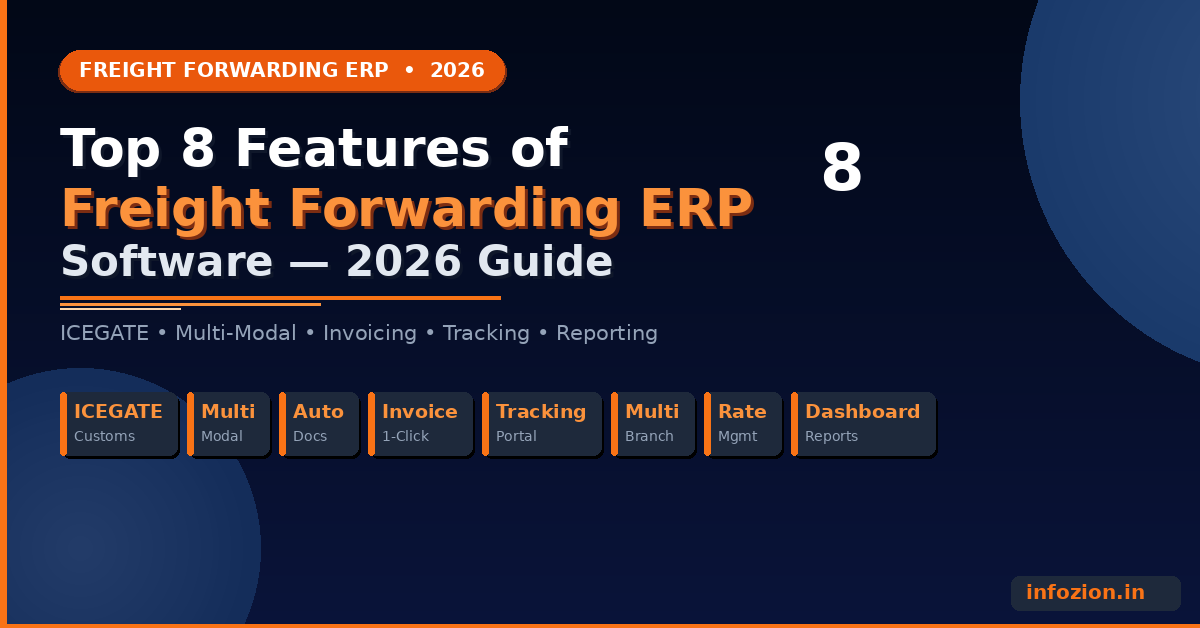
Top 8 Freight Forwarding ERP Software Features You Cannot Ignore in 2026
The freight forwarding ERP software features your system includes—or lacks—will determine whether your business grows efficiently or struggles with the same manual bottlenecks year after year.
Most freight forwarders evaluate ERP software on price and interface design. However, the features underneath the surface are what separate a system that transforms your operations from one that creates new problems while solving old ones.
In this guide, we break down the 8 most critical freight forwarding ERP software features in 2026 — explaining what each one does, why it matters, and what to look for when evaluating vendors.
Why Features Matter More Than Price in Freight Forwarding ERP
Choosing an ERP based on the lowest price is one of the most expensive mistakes a freight forwarding business can make. A cheap system missing critical features will cost far more in manual workarounds, billing errors, and lost customers than the money saved upfront.
Furthermore, not all ERP systems are built specifically for freight forwarding. Many generic ERP platforms are adapted for logistics, but they lack the domain-specific features that freight operations actually require. Consequently, your team ends up fighting the software instead of using it.
The 8 features below are non-negotiable for any serious freight forwarding ERP in 2026. Additionally, they are the exact features that Infozion Technologies builds into every custom freight forwarding ERP solution.
Feature 1 — ICEGATE Integration for Customs Clearance
ICEGATE integration is the single most important feature of any freight forwarding ERP software in India. Without it, your customs team files import and export declarations manually — a slow, error-prone process that delays shipments and exposes your business to regulatory penalties.
A properly integrated ERP submits customs declarations electronically via India’s ICEGATE system—reducing clearance time from 2-3 days to under 8 hours for standard shipments. Moreover, it automatically validates documentation before submission, flagging missing or incorrect data before it reaches the customs portal.
What to look for:
- Native ICEGATE integration—not a third-party middleware
- Automatic document validation before filing
- Real-time status updates from ICEGATE back into the ERP
- DGFT compliance built into the workflow
Furthermore, ask every vendor to demonstrate ICEGATE integration live — not in a slide presentation. A vendor who cannot show it working is a vendor who does not have it working.
Feature 2 — Multi-Modal Operations in One Interface
Air freight, sea freight, and road freight each have different workflows, documentation requirements, and rate structures. However, your team should not have to switch between different systems — or different screens — to manage each mode.
The right freight forwarding ERP software handles all three transport modes from a single unified interface. Your operations team uses the same booking screens, the same documentation workflows, and the same reporting dashboard — regardless of whether the shipment is moving by air, sea, or road.
What to look for:
- Air, sea, and road operations in one login
- Mode-specific documentation templates built in
- Consolidated management dashboard across all modes
- Single customer record that spans all shipment types
Additionally, multimodal capability means management sees a complete picture of all operations—not fragmented data across three separate systems.
Feature 3 — Automated Documentation Generation
Documentation is the most time-consuming and error-prone part of freight forwarding. A single mistake on a house bill of lading or commercial invoice can delay a shipment by days—damaging client relationships and triggering demurrage charges.
Custom freight forwarding ERP software automates the generation of every document your team produces:
- House Bill of Lading (HBL) and Master Bill of Lading (MBL)
- House Airway Bill (HAWB) and Master Airway Bill (MAWB)
- Commercial invoices and packing lists
- Certificate of Origin
- Customs declaration forms
- Delivery orders and arrival notices
Moreover, all documents are generated from data already captured in the system—eliminating re-keying errors completely. Consequently, your documentation team produces accurate paperwork in minutes instead of hours.
What to look for:
- One-click document generation from shipment data
- Customisable document templates matching your letterhead
- PDF and email delivery directly from the ERP
- Document version control and audit trail
Feature 4 — One-Click Invoicing and Finance Management
Revenue leakage from missed charges is one of the most significant hidden costs in freight forwarding. Origin handling fees, destination charges, customs documentation fees, fuel surcharges — any one of these missed on an invoice represents direct profit loss.
The right ERP captures every charge at the quotation stage and automatically includes them when generating invoices. Your finance team selects the customer, reviews the charges, and issues the invoice in one click—with zero manual calculation required.
What to look for:
- Automatic charge capture from quotation to invoice
- Multi-currency invoicing for international clients
- Accounts receivable aging with automated reminders
- Cost-per-shipment profitability analysis
- Integration with accounting software like Tally or QuickBooks
Additionally, the finance module should provide management with real-time profit visibility per shipment, per customer, and per lane—making pricing decisions data-driven rather than instinctive.
Feature 5 — Real-Time Shipment Tracking and Customer Portal
In 2026, customers expect real-time cargo visibility as a baseline expectation — not a premium feature. A freight forwarding ERP without a customer tracking portal forces your operations team to manually answer status inquiries, consuming hours that should be spent on actual operations.
The right ERP provides a branded customer portal where clients independently track their shipments, download documents, and raise queries. Furthermore, automated milestone notifications—booking confirmed, cargo departed, customs cleared, arrived at destination—keep customers informed without any manual effort from your team.
What to look for:
- Branded customer portal with your company identity
- Real-time shipment status visible to customers 24/7
- Automated email and SMS notifications at key milestones
- Document download — HBL, invoices, delivery orders
- Mobile-friendly interface for customers on the go
Moreover, a professional customer portal significantly improves client retention — customers who have visibility into their shipments are far less likely to switch to a competitor.
Feature 6 — Multi-Branch and Agent Network Management
Freight forwarding companies rarely operate from a single location. Whether you have multiple branches across India or work with an agent network globally, your ERP must support multi-entity operations from a single system.
What to look for:
- Each branch with its own users, data, and P&L reporting
- Consolidated management dashboard across all branches
- Agent portal with controlled access — no exposure of sensitive rate data
- Inter-branch job transfer and cost allocation
- Consolidated invoicing across multiple branches for large clients
Additionally, agent management within the ERP allows you to assign jobs to agents, track their status, and settle commissions—all without spreadsheets or email chains.
Consequently, management gains complete operational visibility across the entire network in real time — something that is simply impossible with manual systems or disconnected branch offices.
Feature 7 — Contract and Rate Management
Managing rate contracts with multiple shipping liners, airlines, and trucking partners is one of the most complex operational tasks in freight forwarding. Contracts expire, rates change seasonally, and different liners offer different terms for different port pairs.
Without a proper rate management module, your team manually checks contract files before every booking — a slow process that delays confirmations and introduces pricing errors.
What to look for:
- Central repository for all liner and agent contracts
- Rate validity periods and automatic expiry alerts
- Port-pair rate lookup with automatic best-rate suggestion
- Surcharge management—BAF, CAF, THC, PSS built in
- Bulk rate upload from liner tariff sheets
Furthermore, a strong rate management module means your sales team can quote accurately in minutes — not hours — giving your business a genuine competitive advantage in a market where speed of response wins business.
Feature 8 — Reporting and Management Dashboard
Data without visibility is worthless. The right freight forwarding ERP software provides management with real-time dashboards and configurable reports that answer the questions that drive business decisions.
What to look for:
- Real-time operational dashboard — jobs in progress, pending documentation, overdue shipments
- Financial reports — revenue by customer, profitability by lane, outstanding receivables
- Sales reports — quotations converted, win rate by customer, revenue pipeline
- Compliance reports — shipments pending customs clearance, document expiry alerts
- Custom report builder — so management can create the specific views they need
Moreover, dashboards should be accessible on mobile—so management has visibility into operations even when away from the office.
Additionally, look for role-based access—the operations team sees operational data, the finance team sees financial data, and senior management sees the consolidated view.
How Infozion Technologies Builds These Features
At Infozion Technologies, we build every one of these 8 features into our custom freight forwarding ERP solutions—designed specifically for how Indian freight forwarding businesses actually operate.
Our ERP development process begins with a structured discovery session where we map your complete workflows before writing a single line of code. Consequently, every feature is built around your specific rate structures, documentation templates, agent relationships, and reporting requirements — not adapted from a generic template.
We hold ISO 9001:2015 and ISO/IEC 27001:2022 certifications, and our team has delivered 250+ custom software projects for clients across India and globally—including enterprise clients like HCL.
According to NASSCOM, Indian logistics companies that adopted purpose-built digital ERP solutions reported 35-40% improvements in operational efficiency within 12 months — proof that the right features, implemented correctly, deliver measurable business results.
Frequently Asked Questions
What are the most important features of freight forwarding ERP software?
The 8 most critical features are ICEGATE integration for customs clearance, multi-modal operations in one interface, automated documentation generation, one-click invoicing, a real-time customer tracking portal, multi-branch and agent management, contract and rate management, and a real-time management dashboard. These features together eliminate manual processes, reduce errors, and give management complete operational visibility.
Is ICEGATE integration available in all freight forwarding ERP systems?
No. Many generic ERP platforms claim ICEGATE compatibility but require third-party middleware that adds cost and complexity. Always ask vendors to demonstrate native ICEGATE integration live—with actual document submission—before signing any contract. Infozion’s freight ERP includes native ICEGATE integration.
How much does freight forwarding ERP software cost in India with all these features?
A custom freight forwarding ERP with all 8 features typically costs ₹5,00,000–₹20,00,000 as a one-time investment in India. Furthermore, this eliminates per-user monthly fees charged by off-the-shelf platforms — delivering significantly better ROI for businesses with 10+ users over three to five years. Get a free estimate from Infozion.
Can freight forwarding ERP software handle both air and sea freight?
Yes — a properly built freight forwarding ERP handles air, sea, and road freight from a single unified interface. However, not all ERP platforms offer genuine multi-modal capability. Many are strong in one mode and limited in others. Always verify multi-modal functionality with a live demo using your actual shipment types before committing.
Does a customer tracking portal require separate software?
No. A well-built freight forwarding ERP includes an integrated customer tracking portal as a core module — not a separate add-on. Customers access it through a branded web portal, while the data is automatically synced from your operational ERP in real time. Contact Infozion to see a live demo.
How long does it take to implement freight forwarding ERP software with all 8 features?
A complete custom freight forwarding ERP with all 8 features typically takes 4–6 months to build and deploy. However, the implementation timeline depends on the complexity of your rate structures, number of branches, and integration requirements. Discuss your specific timeline with Infozion.
Conclusion
The freight forwarding ERP software features your system includes will determine the efficiency, profitability, and competitive position of your business for years to come.
ICEGATE integration, multimodal operations, automated documentation, one-click invoicing, customer tracking, multi-branch management, rate management, and real-time dashboards—these are not optional extras. They are the operational foundation of a freight forwarding business that can scale.
Infozion Technologies builds all 8 features into every custom freight forwarding ERP solution — designed specifically for how Indian freight businesses operate, not adapted from a generic template.
Book a free freight forwarding ERP demo today →