 Infozion Technologies LLPInfozion Technologies LLP




Odoo ERP Modules Explained – Features, Uses & Benefits (2026 Guide)
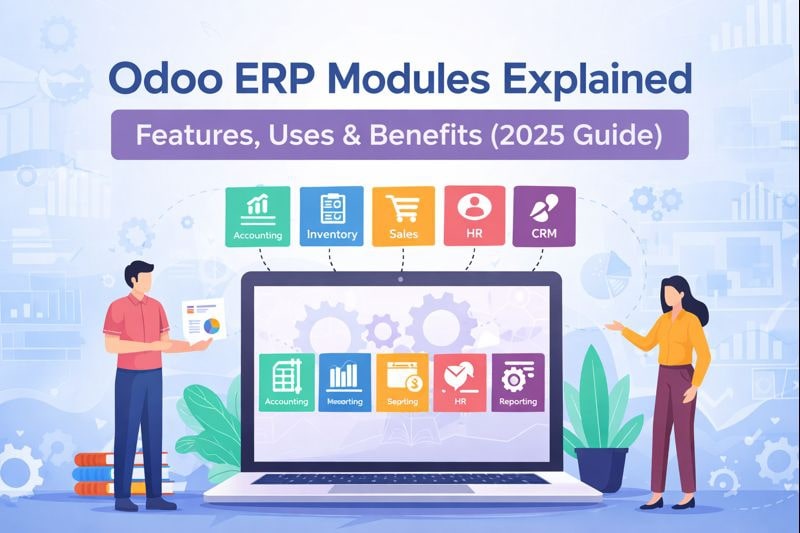
Odoo ERP Modules Explained – Features, Uses & Benefits (2026 Guide)
H2: Introduction
Odoo ERP modules are the core reason why businesses choose Odoo to manage their daily operations smoothly. When companies search for a flexible and easy ERP solution, Odoo ERP modules stand out because they allow businesses to use only what they need while keeping everything connected in one system. Instead of juggling multiple software tools, companies can manage sales, accounting, inventory, HR, and operations through Odoo’s modular ERP structure.
As businesses grow, daily tasks become complex. Managing customers, tracking stock, handling invoices, and coordinating teams can quickly turn into chaos without a proper system. This is where Odoo ERP modules help. They bring structure, clarity, and automation to business processes. This guide explains Odoo ERP modules in very simple language so even a non-technical business owner can understand how they work and why they matter.
If you are new to Odoo and want to understand its basics first, you can start here:
👉 https://www.infozion.in/odoo-erp-introduction/
What Are Odoo ERP Modules?
Simple Explanation
An Odoo ERP module is a specific part of the Odoo system designed to manage one business function. Each module focuses on a particular task such as sales, accounting, inventory, HR, or manufacturing. What makes Odoo special is that all these modules work together in real time.
For example, when a sale is confirmed in the Sales module, the Inventory module updates stock automatically, the Accounting module prepares the invoice, and the CRM module updates customer records. Everything happens smoothly without manual effort.
Why Odoo Uses a Modular System
Odoo follows a modular approach because every business is different. A small company may need only sales and accounting, while a manufacturing company may need inventory, production, purchasing, and quality control. With Odoo ERP modules, businesses can start small and add more modules as they grow.
How Odoo ERP Modules Work Together
Connected System in Real Time
Odoo ERP modules are fully integrated. This means data entered in one module instantly reflects in others. Teams do not need to call or message each other to share updates. Everyone sees the same information at the same time.
Real-Life Example
Imagine a customer places an order.
The Sales module confirms the order.
Inventory updates stock levels automatically.
Accounting generates the invoice.
Delivery receives shipping details.
Management sees updated reports instantly.
This seamless flow is what makes Odoo ERP powerful.
Core Odoo ERP Modules Explained
Sales Module
The Sales module manages quotations, sales orders, pricing, discounts, and customer communication. It helps businesses track the complete sales journey from inquiry to payment.
This module improves sales efficiency and reduces follow-up mistakes.
CRM Module
Odoo CRM helps businesses manage leads, customer interactions, meetings, and follow-ups. Sales teams can track every opportunity and improve conversion rates.
CRM works closely with the Sales module to turn leads into customers.
Accounting Module
The accounting module handles invoices, payments, expenses, taxes, profit-loss reports, and financial statements. It gives business owners clear visibility into cash flow and financial health.
Automation reduces errors and saves time.
Inventory Management Module
The inventory module tracks stock levels, warehouses, product movement, and reorder rules. Businesses always know what is available and what needs to be restocked.
This prevents shortages, overstocking, and delivery delays.
Purchase Module
The Purchase module manages suppliers, purchase orders, pricing, and delivery timelines. It helps businesses maintain strong vendor relationships and control procurement costs.
Manufacturing Module
This module is ideal for factories and production units. It manages bills of materials, work orders, production schedules, and resource planning.
Manufacturing operations become more predictable and efficient.
Human Resources (HR) Module
The HR module handles employee records, attendance, leaves, payroll, and performance tracking. It reduces paperwork and simplifies employee management.
Project Management Module
This module helps teams plan tasks, assign responsibilities, track deadlines, and monitor progress. It is useful for service-based businesses and IT companies.
Website & eCommerce Module
Odoo allows businesses to build websites and online stores directly connected to ERP. Orders from the website update inventory, accounting, and CRM automatically.
Reporting & Dashboard Module
Odoo provides real-time dashboards and reports for sales, finance, inventory, and performance. Business owners can make better decisions using live data.
Benefits of Using Odoo ERP Modules
Odoo ERP modules help businesses work faster and smarter. They reduce manual tasks, improve accuracy, and increase team productivity. Businesses gain better control over operations and data.
Key benefits include better organization, real-time insights, reduced errors, improved customer service, and scalability.
Odoo ERP Modules for Small vs Large Businesses
Small businesses benefit from starting with basic modules and expanding later. Large enterprises benefit from deep customization and advanced integrations.
Odoo works well for both because of its flexible structure.
Customization & Scalability in Odoo Modules
One major advantage of Odoo is customization. Businesses can modify workflows, fields, and reports according to their needs. New modules can be added without disturbing existing operations.
Security & Data Control in Odoo ERP
Odoo provides strong security features like access controls, data encryption, and backups. Cloud and on-premise deployment options give businesses flexibility.
External Reference for Odoo ERP Modules
For an additional trusted explanation, you can explore this reference:
Choosing the Right Odoo ERP Modules for Your Business
Businesses should analyze their needs before selecting modules. Retailers focus on sales and inventory. Manufacturers need production and purchasing. Service companies need CRM and projects.
Selecting the right modules ensures better ROI.
Future of Odoo ERP Modules
Odoo continues to evolve with AI features, automation, and better analytics. Future modules will offer smarter predictions and improved decision-making tools.
Conclusion
Odoo ERP modules are the backbone of an efficient and scalable business system. They simplify operations, improve collaboration, and help businesses grow without confusion. By choosing the right ERP modules, companies gain control, clarity, and confidence in daily operations.
If you want to understand Odoo from the beginning, start here:
👉 https://www.infozion.in/odoo-erp-introduction/