 Infozion Technologies LLPInfozion Technologies LLP




Odoo ERP for Healthcare: Hospital & Clinic Management Solution
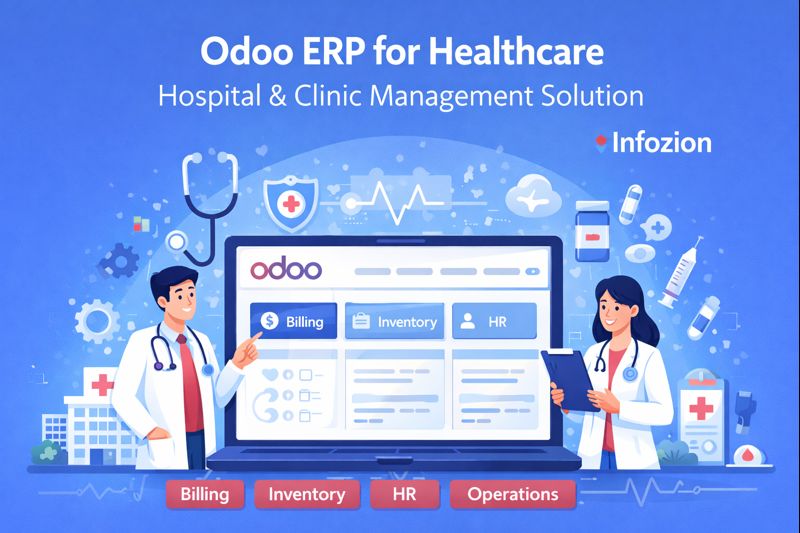
Odoo ERP for Healthcare: Hospital & Clinic Management Solution
Introduction
Odoo ERP for healthcare is becoming one of the most preferred solutions for hospitals and clinics that want better control over operations, data, and patient services. Healthcare organizations deal with complex workflows every day. These include patient registration, billing, inventory management, staff scheduling, compliance, and reporting. When systems are disconnected, errors increase and efficiency drops. Because of this, many hospitals and clinics are now moving toward ERP-based healthcare management solutions.
Odoo ERP offers a flexible and scalable platform that helps healthcare providers manage all operations from a single system. Instead of using multiple software tools, hospitals can centralize processes and data. As a result, decision-making improves and operational costs reduce. This guide explains how Odoo ERP works as a complete hospital and clinic management solution and why it is suitable for modern healthcare organizations.
If you want to understand ERP basics first, you can read this guide:
https://www.infozion.in/odoo-erp-introduction-a-complete-guide-for-businesses-in-2025/
Why Healthcare Organizations Need an ERP System
Healthcare operations are different from other industries. Hospitals and clinics manage sensitive patient data, medical inventory, staff schedules, and financial records at the same time. When these areas are handled through separate systems, coordination becomes difficult.
Moreover, healthcare providers must follow strict compliance and reporting standards. Manual processes or outdated software increase the risk of errors. Therefore, an integrated ERP system becomes essential.
Odoo ERP helps healthcare organizations streamline workflows. It connects departments and ensures data flows smoothly across the organization. As a result, hospitals can focus more on patient care and less on administrative work.
What Makes Odoo ERP Suitable for Healthcare?
Odoo ERP stands out because of its modular and flexible structure. Healthcare organizations can choose only the modules they need. This keeps the system simple and user-friendly.
In addition, Odoo ERP supports customization without heavy development. Hospitals can adapt workflows based on their size and services. Because of this flexibility, Odoo ERP works well for small clinics as well as large hospitals.
Another important factor is scalability. As healthcare organizations grow, Odoo ERP can grow with them. New departments, users, and features can be added without changing the entire system.
Core Features of Odoo ERP for Hospitals and Clinics
Centralized Patient and Operational Data
Odoo ERP allows hospitals to manage operational data from a single platform. While Odoo is not a replacement for clinical systems, it supports administrative and operational workflows efficiently.
Patient-related administrative records, billing details, and service data can be accessed quickly. As a result, coordination between departments improves.
Billing and Financial Management
Billing is one of the most critical areas in healthcare. Errors in billing can affect revenue and patient trust.
Odoo ERP helps healthcare organizations manage invoices, payments, taxes, and financial reports accurately. Automated billing workflows reduce manual effort. Therefore, finance teams can close accounts faster and with fewer errors.
Inventory and Medical Supplies Management
Hospitals manage a wide range of medical supplies. Stock shortages or overstocking can cause serious issues.
Odoo ERP provides real-time inventory tracking. It helps healthcare providers monitor stock levels, expiry dates, and supplier performance. As a result, inventory costs reduce and availability improves.
Staff and Resource Management
Healthcare organizations depend heavily on staff availability. Managing doctors, nurses, and support staff manually is time-consuming.
Odoo ERP simplifies HR operations. It helps manage attendance, shifts, payroll, and performance records. Because of this, administrative workload reduces and staff productivity improves.
How Odoo ERP Improves Healthcare Operations
Better Workflow Coordination
Odoo ERP connects departments like finance, inventory, HR, and administration. This integration removes data silos.
For example, when a service is billed, accounting records update automatically. At the same time, inventory adjusts if supplies are used. Therefore, operations remain aligned.
Improved Decision-Making
Healthcare managers need accurate data to make decisions. Odoo ERP provides real-time dashboards and reports.
These insights help administrators monitor costs, resource usage, and operational efficiency. As a result, planning becomes more data-driven.
Cost Control and Efficiency
Manual processes increase operational costs. Odoo ERP automates repetitive tasks.
Because of automation, errors reduce and efficiency improves. Over time, this leads to better cost control and improved ROI.
Odoo ERP for Clinics vs Large Hospitals
Odoo ERP works well for both clinics and large hospitals. However, the implementation approach differs.
Small clinics may use basic modules such as accounting, inventory, and HR. On the other hand, large hospitals may require advanced workflows, integrations, and reporting.
Because Odoo ERP is modular, both types of organizations can use the same platform without unnecessary complexity.
Odoo ERP Implementation in Healthcare
Implementing ERP in healthcare requires careful planning. Unlike other industries, healthcare cannot afford system downtime.
A phased implementation approach works best. Hospitals can start with core administrative modules. Later, they can expand to advanced features.
If you want a structured implementation approach, refer to this guide:
https://www.infozion.in/odoo-erp-implementation-checklist-step-by-step-guide/
Common Challenges in Healthcare ERP Implementation
Healthcare ERP projects often face resistance from staff. Users may feel uncomfortable switching systems.
In addition, data migration must be handled carefully. Poor data quality can affect reporting and trust.
However, these challenges can be avoided with proper planning, training, and support.
Security and Compliance in Odoo ERP
Data security is critical in healthcare. Odoo ERP supports role-based access control.
This ensures that sensitive data is accessible only to authorized users. In addition, regular system updates help maintain security standards.
Because of these features, healthcare organizations can manage data responsibly.
Odoo ERP vs Traditional Healthcare Software
Traditional healthcare software often focuses on one function. For example, billing software handles only finances.
Odoo ERP provides a unified platform. It connects finance, inventory, HR, and operations.
As a result, healthcare organizations gain better control and visibility across departments.
You can also explore another healthcare-focused Odoo solution here:
Benefits of Using Odoo ERP for Healthcare
Odoo ERP helps healthcare organizations reduce manual work. It also improves coordination between departments.
In addition, it supports scalability and long-term growth. Because of these benefits, many hospitals and clinics are choosing Odoo ERP as their operational backbone.
Conclusion
Odoo ERP for healthcare provides a reliable and scalable solution for hospitals and clinics that want better operational control. It simplifies billing, inventory, HR, and financial management.
By using a single integrated system, healthcare organizations can reduce errors, improve efficiency, and focus more on patient care. With proper planning and implementation, Odoo ERP becomes a strong foundation for long-term healthcare operations and growth.