 Infozion Technologies LLPInfozion Technologies LLP




How Odoo ERP Can Transform E-Waste Management Operations
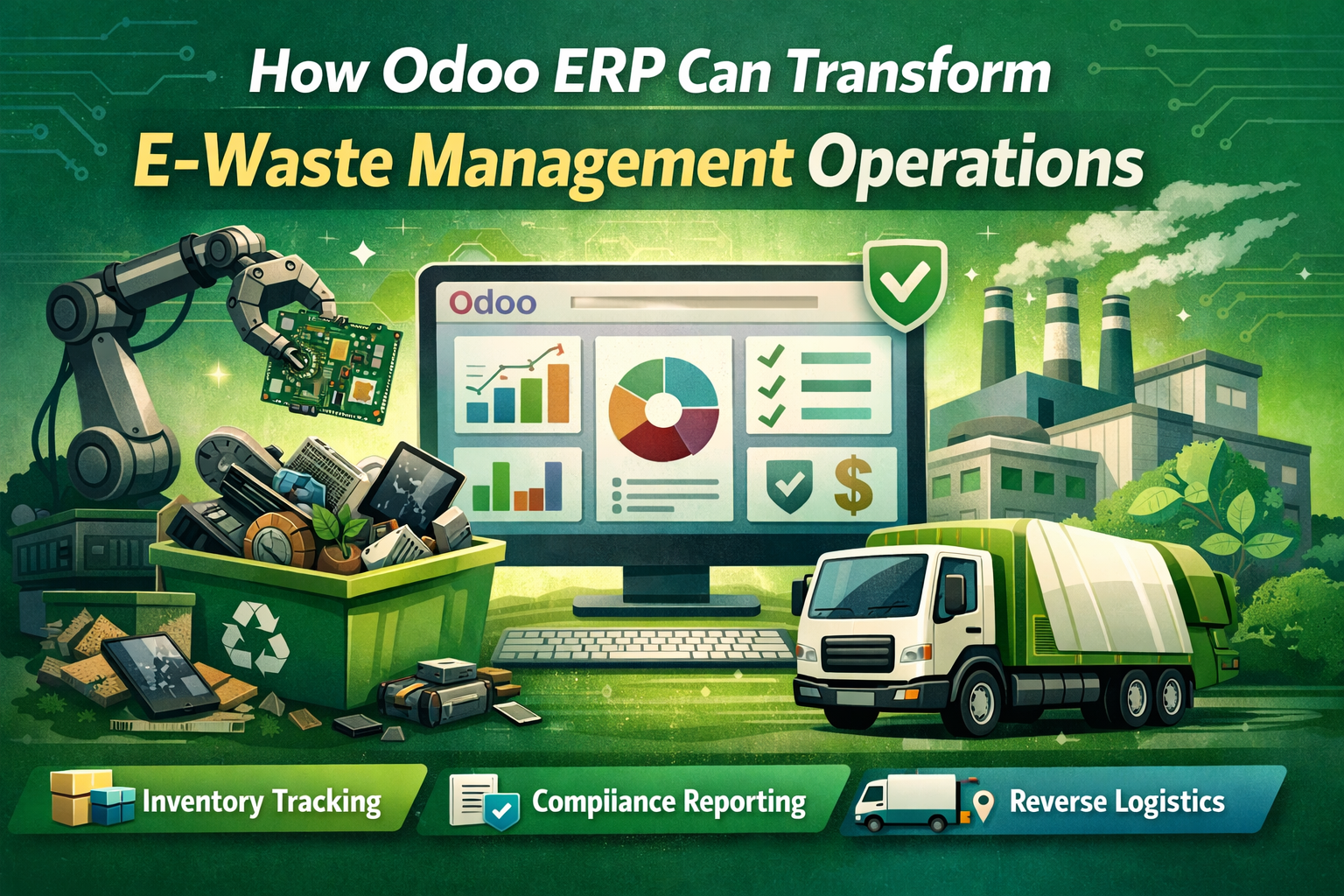
How Odoo ERP Can Transform E-Waste Management Operations
Introduction
Electronic waste is increasing rapidly across the world. Recycling companies must manage large volumes of discarded electronics while ensuring environmental compliance. Odoo ERP for e-waste management helps recycling businesses automate inventory tracking, manage waste collection, streamline logistics, and improve compliance reporting through a single integrated platform.
E-waste recycling companies deal with multiple operational activities such as waste collection, transportation, inventory tracking, recycling processes, and compliance reporting. Without proper digital systems, these activities become difficult to manage and monitor. This is why many recycling companies are adopting ERP systems to automate and streamline their operations.
One of the most powerful solutions for this industry is Odoo ERP for e-waste management. Odoo ERP helps recycling companies manage inventory, logistics, compliance reporting, and financial operations from a single integrated platform. By implementing ERP software, recycling businesses can improve operational efficiency, maintain transparency, and reduce operational costs.
Challenges Faced by E-Waste Recycling Companies
The e-waste recycling industry faces several operational challenges that impact efficiency and profitability. Many recycling companies still rely on spreadsheets or manual records to track their operations. This approach often leads to data errors, poor visibility, and inefficient workflows.
One of the major challenges is managing different types of waste materials. Recycling plants receive various electronic components such as circuit boards, batteries, cables, plastic components, and metal parts. Tracking these materials accurately is extremely difficult without a centralized system.
Another major issue is traceability. Recycling companies must track where the waste is collected from, how it is processed, and what materials are recovered during recycling. Without proper traceability systems, it becomes difficult to maintain transparency and regulatory compliance.
Compliance reporting is another critical challenge. Governments require recycling companies to maintain detailed records of waste collection, recycling activities, and disposal processes. Manual reporting increases the chances of errors and delays, which can lead to compliance issues.
Additionally, logistics management in the recycling industry is complex. Waste must be collected from multiple locations and transported to recycling facilities. Without automated route planning and fleet management systems, transportation costs increase and operational efficiency decreases.
These challenges highlight the need for digital solutions such as ERP systems that can automate operations and improve visibility across the entire recycling process.
What is Odoo ERP for E-Waste Management?
Odoo ERP is an integrated business management system that helps organizations manage their core operations through a single platform. It includes modules for inventory management, logistics management, accounting, customer relationship management, and reporting.
When implemented in the recycling industry, Odoo ERP helps companies manage the entire lifecycle of electronic waste. From collection to recycling and final disposal, every process can be tracked and monitored through the ERP system.
Odoo ERP provides real-time visibility into operations, enabling recycling companies to make informed decisions. It eliminates manual processes and helps businesses automate workflows, improve operational efficiency, and maintain accurate records.
Many companies in the recycling and disposal industry are now adopting ERP systems to manage complex operations. A detailed overview of ERP usage in this sector can also be found here:
https://www.pptssolutions.com/blogs/erp-for-recycling-and-disposal-industry
Key Features of Odoo ERP for Recycling Businesses
Smart Inventory Management
Inventory management is one of the most critical aspects of e-waste recycling operations. Recycling plants receive different types of scrap materials that must be categorized, stored, and processed properly.
Odoo ERP provides a powerful inventory management system that allows businesses to track scrap materials, hazardous components, and recovered metals in real time. The system supports barcode tracking, warehouse location management, and batch tracking. These features help recycling companies maintain accurate inventory records and reduce material loss.
With ERP-based inventory management, businesses gain complete visibility into their warehouse operations. This improves stock control and ensures that recycling materials are processed efficiently.
Waste Traceability and Tracking
Traceability is extremely important in the recycling industry. Companies must maintain clear records of waste sources, processing stages, and final outputs.
Odoo ERP allows businesses to track electronic waste throughout the entire recycling lifecycle. From collection points to recycling facilities and final material recovery, every stage can be recorded in the system.
This level of transparency helps businesses maintain compliance with environmental regulations and improves accountability across operations.
Reverse Logistics and Waste Collection Management
Reverse logistics plays a crucial role in e-waste management. Recycling companies must collect waste from multiple locations including households, businesses, and collection centers.
Odoo ERP helps businesses manage waste pickup schedules, route planning, and fleet tracking. By automating logistics processes, companies can reduce transportation costs and improve collection efficiency.
Route optimization features also help companies reduce fuel consumption and improve delivery timelines.
Automated Compliance Reporting
Environmental regulations require recycling companies to maintain accurate documentation of waste collection, recycling activities, and disposal records.
Odoo ERP automates compliance reporting by generating detailed reports on recycling operations. Businesses can easily track waste quantities, recycling output, and disposal records through automated dashboards.
This significantly reduces administrative work and ensures that businesses remain compliant with regulatory requirements.
Financial and Cost Management
Managing operational costs is another important aspect of the recycling business. Odoo ERP provides integrated financial management tools that help companies track expenses, revenues, and profit margins.
Businesses can monitor operational costs related to logistics, labor, processing, and material recovery. Real-time financial insights allow management teams to make strategic decisions that improve profitability.
ERP systems also help companies identify inefficiencies and optimize resource utilization.
Benefits of ERP in the Recycling Industry
Implementing ERP software provides several advantages for recycling companies. Automation reduces manual work and improves operational efficiency. Employees can focus more on productive activities rather than maintaining spreadsheets and manual records.
ERP systems also improve data accuracy. Since all information is stored in a centralized database, businesses can easily access real-time insights and analytics.
Another major benefit is improved decision-making. Managers can monitor operational performance through dashboards and reports, enabling them to take corrective actions quickly.
Cost reduction is another significant advantage of ERP systems. By optimizing logistics, inventory management, and operational workflows, companies can reduce overall operational expenses.
ERP systems also improve collaboration between departments. Inventory teams, logistics teams, and management can access the same data, ensuring better coordination across the organization.
Why ERP is the Future of E-Waste Management
The recycling industry is evolving rapidly as environmental awareness increases and regulations become stricter. Companies must adopt modern technologies to manage growing volumes of electronic waste effectively.
Digital transformation is becoming essential for recycling companies that want to scale their operations and remain competitive. ERP systems provide the infrastructure required to manage complex recycling processes efficiently.
By implementing waste management ERP software, businesses can streamline operations, improve traceability, and enhance compliance management.
ERP adoption also enables companies to improve sustainability practices by ensuring responsible recycling and waste disposal.
ERP Implementation for Waste Management Businesses
Implementing ERP software requires proper planning, customization, and industry expertise. Recycling companies need ERP solutions that are tailored to their specific operational requirements.
Infozion provides specialized ERP implementation services for businesses looking to automate their operations and improve efficiency. With expertise in Odoo ERP implementation, Infozion helps organizations design customized ERP solutions that align with their operational needs.
Businesses interested in ERP implementation can learn more about the process here:
https://www.infozion.in/erp-implementation-phases/
With the right ERP strategy and implementation partner, recycling companies can achieve better operational control and long-term growth.
Conclusion
E-waste management companies face numerous operational challenges including inventory tracking, logistics coordination, compliance reporting, and cost management. Traditional manual systems are no longer sufficient to manage the growing complexity of recycling operations.
Odoo ERP provides a powerful solution for recycling businesses by integrating inventory management, logistics tracking, compliance reporting, and financial management into a single platform.
By adopting ERP technology, recycling companies can improve operational efficiency, reduce costs, maintain regulatory compliance, and build a scalable business model for the future.
Digital ERP systems will play a crucial role in transforming the recycling industry and helping businesses manage electronic waste more responsibly and efficiently.
Introduction
Top Benefits of Odoo ERP for Small & Medium Enterprises is a topic every growing business owner should understand today. Small and medium enterprises often struggle with managing daily operations like accounting, sales, inventory, HR, and customer data using multiple tools. This scattered system wastes time, increases errors, and slows down growth. Odoo ERP solves this problem by bringing everything under one powerful and easy-to-use platform. It helps businesses work smarter, reduce costs, and scale faster without technical complexity. In simple words, Odoo ERP acts like the brain of your business, keeping all departments connected and updated in real time.
In today’s competitive market, SMEs cannot afford slow systems or manual processes. Customers expect fast responses, accurate billing, and smooth service. This is where Odoo ERP becomes a game changer. It gives small and medium businesses the same level of control and automation that large enterprises enjoy, but at a much lower cost. If you are new to ERP systems, you can first read this beginner guide to understand the basics of Odoo ERP:
👉 https://www.infozion.in/odoo-erp-introduction-a-complete-guide-for-businesses-in-2025/
This blog explains the real benefits of Odoo ERP in simple language so even non-technical business owners can easily understand why Odoo is one of the best ERP solutions for SMEs.
What Is Odoo ERP, and Why SMEs Need It
Odoo ERP is an all-in-one business management software designed to manage different business functions from a single platform. Instead of using separate software for accounting, inventory, CRM, HR, and sales, Odoo connects everything in one system. This reduces confusion, saves time, and improves decision-making.
Small and medium enterprises usually operate with limited staff and budget. Managing multiple tools becomes difficult and expensive over time. Data mismatch, manual entries, and delayed reports create serious problems. Odoo ERP removes these challenges by providing a centralized system that updates data automatically across departments.
For example, when a sale is confirmed, inventory updates automatically, invoices are generated, and accounting entries are recorded without manual work. This level of automation helps SMEs focus more on business growth instead of daily operational stress.
Why Odoo ERP Is Ideal for Small & Medium Enterprises
Affordable ERP Solution for Growing Businesses
One of the biggest reasons SMEs choose Odoo ERP is affordability. Traditional ERP systems are expensive and designed mainly for large enterprises. Odoo, on the other hand, offers a flexible pricing model that allows businesses to pay only for the modules they need. This makes Odoo ERP highly cost-effective for small and medium enterprises.
Instead of investing heavily at once, SMEs can start small and expand later as their business grows. This reduces financial risk and makes ERP adoption practical even for startups.
Modular Structure That Fits Every Business
Odoo ERP works on a modular system. This means you don’t need to install everything at once. You can choose only the modules required for your business operations. Whether you need accounting, inventory, CRM, HR, or manufacturing, Odoo gives you complete control.
To understand how Odoo modules work in detail, you can explore this guide:
👉 https://www.infozion.in/odoo-erp-modules-explained/
This modular flexibility ensures that SMEs are not forced to use unnecessary features, keeping the system clean, fast, and easy to manage.
Top Benefits of Odoo ERP for Small & Medium Enterprises
Improved Business Efficiency and Automation
Odoo ERP significantly improves business efficiency by automating repetitive tasks. Manual data entry is one of the biggest productivity killers in SMEs. Odoo reduces this by automating workflows across departments.
For example, once a customer order is placed, the system automatically updates inventory, generates invoices, and tracks delivery status. This automation reduces errors, saves time, and ensures smoother operations.
Centralized Data Management
One of the strongest benefits of Odoo ERP for small and medium enterprises is centralized data. All business information is stored in one place and updated in real time. This eliminates confusion caused by multiple spreadsheets or disconnected software.
When data is centralized, business owners get a clear view of sales, expenses, inventory, and customer behavior. This helps in making faster and better decisions.
Better Financial Control and Accounting
Managing finances is critical for SMEs. Odoo ERP offers powerful accounting features that help businesses track income, expenses, taxes, and cash flow accurately. It supports automated invoicing, payment follow-ups, and bank reconciliation.
With Odoo ERP, financial reports are generated instantly. This allows business owners to monitor profitability and avoid cash flow issues before they become serious problems.
Odoo ERP Helps SMEs Scale Without Stress
Easy Scalability as Business Grows
Small businesses aim to grow, but growth often brings complexity. Odoo ERP is designed to scale smoothly as your business expands. You can add new users, modules, and features without changing the entire system.
This scalability ensures that SMEs don’t need to migrate to another ERP system after a few years. Odoo grows with your business, saving time and future costs.
Cloud and On-Premise Flexibility
Odoo ERP offers both cloud-based and on-premise deployment options. SMEs can choose what works best for their business. Cloud deployment reduces IT maintenance and allows access from anywhere. On-premise deployment offers full control over data and infrastructure.
This flexibility makes Odoo suitable for different business needs and compliance requirements.
Better Customer Relationship Management With Odoo
Strong CRM for Sales Growth
Odoo ERP includes a powerful CRM module that helps SMEs manage leads, opportunities, and customer interactions effectively. It tracks customer history, follow-ups, and communication in one place.
This improves sales efficiency and ensures no lead is lost due to poor tracking. Sales teams can focus more on closing deals rather than managing data manually.
Improved Customer Satisfaction
When internal processes are smooth, customers automatically receive better service. Faster order processing, accurate billing, and timely deliveries improve customer trust.
Odoo ERP helps SMEs deliver consistent and professional customer experiences, which leads to repeat business and referrals.
Inventory and Supply Chain Optimization
Real-Time Inventory Tracking
Inventory mismanagement causes losses in many small businesses. Odoo ERP provides real-time inventory tracking, ensuring accurate stock levels at all times.
This helps avoid overstocking and stock shortages. Businesses can plan purchases better and reduce unnecessary storage costs.
Smarter Supply Chain Decisions
With accurate inventory data and demand forecasting, SMEs can optimize their supply chain. Odoo ERP helps identify fast-moving products, slow-moving stock, and supplier performance.
This leads to better supplier negotiations and improved operational efficiency.
Employee Management Made Simple
HR and Payroll Automation
Managing employees manually becomes difficult as teams grow. Odoo ERP simplifies HR processes such as attendance, payroll, leaves, and performance tracking.
This reduces administrative workload and ensures transparency in employee management.
Improved Team Productivity
When employees have access to clear processes and accurate data, productivity improves. Odoo ERP reduces confusion and helps teams collaborate better across departments.
Data-Driven Decision Making With Odoo ERP
Odoo ERP provides detailed reports and dashboards that help SMEs analyze business performance. Business owners can track sales trends, profit margins, customer behavior, and operational efficiency in real time.
Data-driven insights help businesses identify opportunities and fix problems early. This strategic advantage is crucial for long-term success.
Security and Compliance Benefits for SMEs
Odoo ERP offers strong data security features, including access control, backups, and user permissions. SMEs can decide who can access specific data, ensuring sensitive information remains protected.
Compliance with accounting and taxation rules also becomes easier with automated reporting and record-keeping.
Why Odoo ERP Is a Smart Investment for SMEs
Investing in Odoo ERP is not just about software; it’s about building a strong foundation for growth. SMEs that adopt ERP early gain better control, efficiency, and scalability.
According to industry insights, businesses implementing Odoo ERP experience improved productivity, reduced operational costs, and better customer satisfaction. You can read additional insights here:
Final Thoughts: Is Odoo ERP Right for Your Business?
The top benefits of Odoo ERP for small & medium enterprises make it one of the most practical and future-ready ERP solutions today. From cost savings and automation to scalability and customer satisfaction, Odoo ERP covers every critical business need.
If your business is struggling with disconnected systems, manual work, or slow growth, Odoo ERP can bring structure, clarity, and control. It empowers SMEs to compete with larger businesses while staying agile and efficient.
Adopting Odoo ERP is not an expense; it is a strategic move toward sustainable growth and long-term success.
Introduction
Odoo ERP is a modern business management system that helps companies handle daily operations from one place. Many businesses still rely on different software for sales, accounting, inventory, HR, and reporting. As a result, teams often face confusion, data mismatch, and wasted time. This ERP system solves the problem by connecting all business processes into a single platform. Therefore, companies can work faster and make better decisions. In 2026, businesses prefer this solution because it is simple, flexible, and affordable. Moreover, even non-technical users can learn the system without difficulty.
In today’s competitive market, businesses need real-time data to survive. However, manual systems often fail to deliver accurate information on time. That is why Odoo ERP plays an important role in modern organizations. It brings clarity, control, and transparency to business operations. This guide explains the platform in simple language so that beginners and business owners can clearly understand its value.
What Is Odoo ERP?
Simple Meaning of Odoo ERP
Simple Meaning of This ERP System
Odoo ERP is an open-source enterprise resource planning solution that helps businesses manage all operations from a single platform. Instead of using separate tools for CRM, accounting, inventory, HR, and sales, companies can rely on one integrated system. As a result, data moves smoothly between departments, and teams stay aligned.
This platform works on a modular structure. Therefore, businesses can choose only the features they need at the beginning. Later, they can add more modules as operations expand. Because of this flexibility, the system suits businesses of all sizes and industries.
To understand ERP basics before moving ahead, you can read this guide:
👉 https://www.infozion.in/what-is-erp/
Types of Odoo ERP
Odoo ERP mainly comes in two types. Therefore, businesses should understand both before making a decision.
Odoo Community Edition
Odoo Community Edition is the free and open-source version of Odoo ERP. This version supports businesses that want basic ERP features without paying license costs. It includes important modules such as sales, CRM, inventory, purchasing, manufacturing, and project management.
Small businesses and startups often choose this version because it helps them organize operations at a low cost. Moreover, companies with technical support can customize the system according to their needs. As a result, Community edition becomes a good entry-level ERP solution.
However, this version has limitations. It does not include advanced accounting, payroll, or official Odoo support. Therefore, businesses with complex requirements may outgrow this version over time.
Odoo Enterprise Edition
Odoo Enterprise Edition is the paid and advanced version of Odoo ERP. It supports growing and large businesses that need professional automation. Along with Community features, Enterprise edition offers advanced accounting, HR and payroll, dashboards, and mobile app support.
In addition, Odoo Enterprise includes Odoo Studio. This tool allows users to customize workflows without coding. Because of this, non-technical users can easily adapt the system. Moreover, businesses also receive official Odoo support, which helps during setup and maintenance.
As a result, companies that plan long-term growth usually prefer the Enterprise edition.
Why Businesses Are Choosing This ERP Platform in 2026
Designed for Business Growth
Odoo ERP supports business growth in a step-by-step manner. First, companies can begin with basic modules that match their current needs. Later, they can add advanced features as operations expand. Therefore, businesses do not need to change their ERP system again and again, which saves both time and money.
Many traditional ERP systems feel expensive and complex for modern companies. However, this platform offers flexibility and affordability at the same time. As a result, many growing businesses trust this solution in 2026 to manage their operations smoothly and efficiently.
One Connected Platform
Odoo ERP connects all departments into one system. For example, sales teams can check inventory instantly. At the same time, finance teams can track invoices without delay. Meanwhile, managers can view reports in real time. Because of this connection, teams work better together.
To learn how ERP systems work across departments, you can explore:
👉 https://www.infozion.in/erp-systems/
Key Features of This ERP System
Modular and Flexible Design
This ERP system provides multiple modules such as sales, accounting, inventory, HR, CRM, and manufacturing. Businesses can enable or disable these modules based on their current needs. Therefore, companies pay only for the features they actually use, which helps control costs and improve efficiency.
Easy-to-Use Interface
The platform offers a clean and simple interface that users can understand quickly. Employees learn the system without long training sessions. As a result, organizations reduce training time and improve overall productivity across teams.
How Odoo ERP Works in Real Business Life
A Practical Example
Consider a small manufacturing business using Odoo ERP. First, a customer places an order. Immediately, the system updates inventory. Next, it creates an invoice automatically. After that, the finance team tracks payment status. Meanwhile, managers review performance dashboards. Because everything updates in real time, teams avoid delays and errors.
Odoo ERP for Small and Medium Businesses
Cost-Effective and Scalable
Odoo ERP suits small and medium businesses very well. Companies can start with the Community edition. Later, they can upgrade to Enterprise edition. Therefore, businesses grow without financial pressure.
Cloud and On-Premise Options
Odoo ERP supports both cloud and on-premise deployment. Businesses can choose cloud for convenience. On the other hand, they can choose on-premise for security control. As a result, companies enjoy full flexibility.
Benefits of Odoo ERP for Businesses in 2026
Odoo ERP improves business control by offering real-time visibility into operations. Moreover, automation reduces manual work and errors. As a result, employees focus on important tasks instead of repetitive work.
Additionally, customization allows businesses to adjust workflows easily. Because of these advantages, Odoo ERP helps companies stay competitive in 2026
Common Challenges During Odoo ERP Implementation
Although Odoo ERP offers many benefits, businesses should plan implementation carefully. Sometimes, choosing the wrong modules creates confusion. Also, lack of training slows adoption. However, with proper planning and expert guidance, businesses can avoid these issues. Therefore, preparation plays a key role in success.
External Reference on Odoo ERP
For additional information about Odoo ERP software, you can read this guide:
Future of Odoo ERP
Continuous Improvements
Odoo releases new features every year. Therefore, businesses can expect better automation and smarter reporting in 2026.
Strong Community Support
Because Odoo is open-source, a strong global community supports it. As a result, the platform remains reliable and future-ready.
Conclusion
Odoo ERP is a flexible and affordable ERP solution for businesses in 2026. Whether a company chooses the Community or Enterprise edition, Odoo ERP helps streamline operations and support growth. Therefore, businesses that want simplicity and control should consider Odoo ERP as a long-term solution.