 Infozion Technologies LLPInfozion Technologies LLP





SEO vs AEO vs GEO: Key Differences and How to Optimize Your Website for AI Search
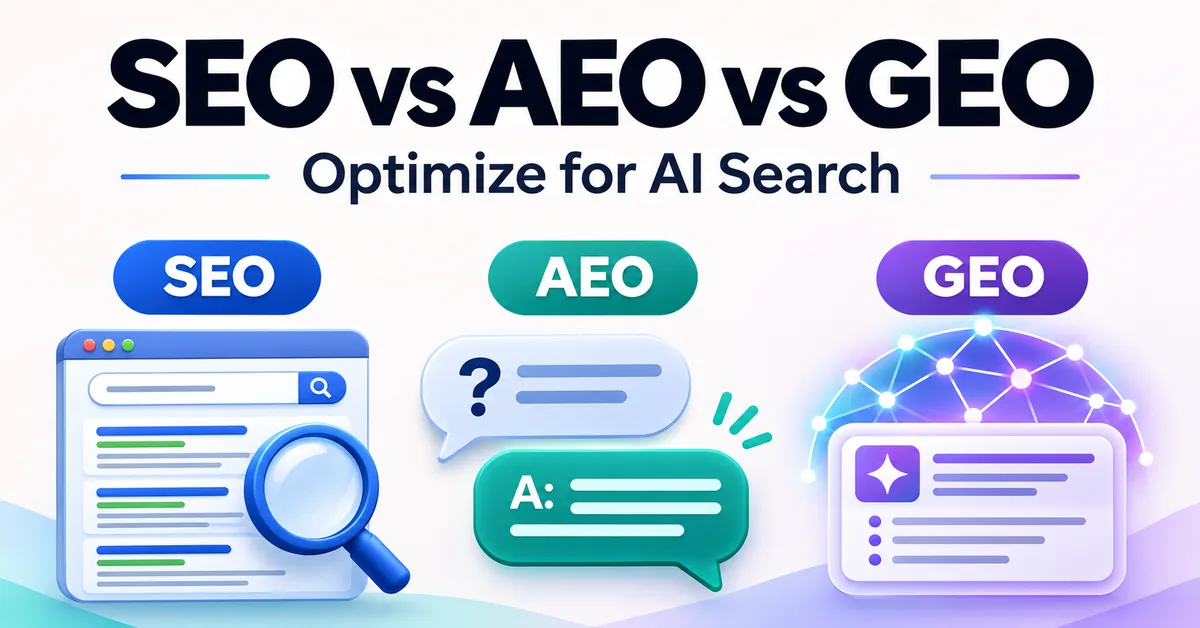
SEO vs AEO vs GEO: Key Differences and How to Optimize Your Website for AI Search
Search visibility now involves more than appearing in a list of links. Buyers can ask detailed questions, compare solutions through AI assistants, and discover businesses through generated answers. Understanding SEO vs AEO vs GEO helps you plan content for these different discovery paths.
For a business such as Infozion, the opportunity is practical: answer the questions buyers ask before choosing software or an implementation partner. Explain the problem, show the options, and provide evidence that helps someone make a decision.
This guide explains the terminology, compares the approaches, and provides a practical framework for how to optimize website for AI search without losing focus on leads and revenue.
Quick Answer: What Is the Difference Between SEO, AEO, and GEO?
SEO improves a website’s visibility in search engines. AEO focuses on making information useful for direct answers. GEO focuses on visibility within responses generated by AI systems, including relevant mentions and citations.
These activities overlap. Clear explanations, useful content, accessible pages, and credible evidence support the overall strategy. Google explicitly treats optimization for its generative AI search features as part of SEO, rather than a separate requirement.[1]
What Is SEO?
Search Engine Optimization is the practice of improving a website so search engines can discover, understand, and potentially show its pages for relevant searches.
For Infozion, an example might be a buyer searching for “ERP implementation partner in India.” A helpful service page should explain who the service suits, what implementation includes, and how prospects can discuss their requirements.
An effective SEO plan combines technical accessibility, relevant content, sensible navigation, and a positive browsing experience. Businesses looking for help with this foundation can explore Infozion’s SEO services. Google’s Search Essentials also emphasizes using the language people search with and making links crawlable.[2]
What Is Answer Engine Optimization?
Answer Engine Optimization, commonly called AEO, means organizing information so it answers a user’s question clearly and directly. In practice, the term is used for both traditional answer surfaces and AI-generated answers.
Consider the question, “What is ERP implementation?”
A useful opening answer would be:
“ERP implementation is the process of configuring business software, moving relevant data, connecting workflows, training users, and preparing the organization to use the system.”
The page can then explain the stages, responsibilities, costs, and common problems.
What Is Generative Engine Optimization?
Generative Engine Optimization, or GEO, focuses on improving the visibility of content within answers produced by generative systems. The original GEO research introduced a framework for evaluating this visibility across different queries and sources.[3]
For example, someone might ask an AI assistant:
“How should an Indian retailer choose ERP software for multiple stores?”
A relevant article, such as Infozion’s guide to retail ERP software in India, can explain stock synchronization, store-level reporting, accounting integration, implementation scope, and vendor evaluation. These details provide substance that an answer may reference.
However, publication does not guarantee inclusion. Systems differ in how they retrieve information, generate responses, and display sources. An article can be useful without being cited, and a citation does not automatically produce a sales enquiry.
SEO vs AEO vs GEO: Comparison Table
| Area | SEO | AEO | GEO |
| Main focus | Search discovery | Clear, direct answers | Visibility in generated responses |
| Typical content approach | Pages matched to search intent | Definitions, steps, focused answers | Evidence, comparisons, contextual explanations |
| Example objective | Attract ERP buyers from search | Answer an ERP cost question | Be referenced in an ERP buying explanation |
| Useful formats | Service pages, guides, product pages | Q&A sections, lists, short explanations | Detailed guides, original research, documented examples |
| Measurement | Relevant impressions, clicks, conversions | Observed answer appearances and engagement | Mentions, citations, referral visits |
| Shared foundation | Useful content and accessible pages | Useful content and accessible pages | Useful content and accessible pages |
Treat this table as a planning framework. These are overlapping practices, and the labels are not universally standardized.
AEO vs GEO: Where Do They Overlap?
A practical distinction is to use AEO for answer clarity and GEO for the broader usefulness of content within generated explanations.
An AEO-oriented section might answer, “How long does ERP implementation take?” immediately. A GEO-oriented article could expand that answer with project phases, factors affecting delivery, and examples of different implementation scopes.
The same page can serve both purposes. It can give a concise answer and then explain assumptions, limitations, and alternatives.
Avoid creating separate pages that repeat the same information merely to target each acronym. For Infozion, a strong article addressing a real buyer problem is a better editorial choice than several thin variations of the same explanation.
How Do Google AI Overviews and AI Search Use Website Content?
Google explains that AI Overviews and AI Mode can use related searches across subtopics to develop an answer. Its documentation calls this “query fan-out.” Different AI experiences can return different answers and supporting links.[4]
Imagine a buyer asking whether their company should replace accounting software with ERP. Useful supporting topics could include inventory problems, approval workflows, reporting limitations, implementation effort, and training.
The editorial opportunity is to cover the decision thoroughly. Answer the central question, then address the natural follow-up questions. Keep each section specific enough to help someone who arrives directly at that part of the page.
How to Optimize Website for AI Search: 10 Practical Steps
The following steps are an editorial and website improvement plan for Infozion. They should be evaluated through real performance data rather than treated as guaranteed ranking factors.
1. Start With Buyer Questions
Gather questions from discovery calls, contact forms, sales conversations, and customer support. These reveal the information prospects need before they enquire.
For an ERP business, useful questions include:
- What should an ERP implementation budget include?
- When does accounting software become insufficient?
- What causes delays during data migration?
- How should retailers compare ERP vendors?
Choose one main intent per article. A cost guide should help readers understand costs, while a vendor-selection guide should help them evaluate providers. For a broader approach to matching content with buyer needs, read Infozion’s content marketing guide.
2. Put the Main Answer Near the Beginning
Write a short opening explanation that directly addresses the title. Then add the context necessary to apply the answer responsibly.
For a pricing question, explain which components affect the estimate, as illustrated in Infozion’s ERP implementation cost in India guide. If no reliable universal price exists, say so and describe the variables.
For a timeline question, distinguish software configuration from migration, testing, training, and rollout.
This structure helps a busy reader understand the key point without scanning several introductory paragraphs.
3. Use Descriptive Headings
Headings should tell readers what each section will help them understand.
“Factors That Increase ERP Implementation Cost” is clearer than “Important Considerations.” “Questions to Ask an ERP Partner” is more useful than “Know More.”
Use question headings when the section answers a question, but vary the structure naturally. There is no need to turn every heading into an exact-match keyword.
4. Add Evidence From Real Work
Build content around information your team can verify.
Potential examples include an anonymized migration checklist, a sample requirements worksheet, a documented testing process, or a project lesson approved for publication.
Explain what the example demonstrates and where it may not apply. A rollout involving one location is different from a deployment across several entities.
Avoid invented customer stories, unsupported percentages, and claims that every business will receive the same outcome.
5. Explain Choices and Trade-Offs
Buyers need help choosing between alternatives.
An ERP comparison might consider implementation effort, reporting flexibility, integration requirements, ongoing support, and total ownership cost.
Describe when each option makes sense. A smaller company with straightforward accounting requirements may need a different solution from a growing retailer managing several warehouses.
6. Check Technical Accessibility
Before investing in more articles, check whether important pages are accessible and eligible for indexing.
Review accidental noindex directives, incorrect canonical URLs, broken navigation, server errors, and essential content that fails to render.
For Google’s AI search features, the page must meet the relevant search eligibility requirements. Google does not require a special AI file or dedicated schema to appear.[4]
Review crawler controls individually when other platforms matter. Permission for search retrieval and permission for model training are separate considerations.
7. Build Useful Internal Links
Connect articles according to the reader’s next question.
A guide comparing ERP and accounting software can lead into implementation planning. A cost article can link to budgeting guidance, while a migration article can link to data preparation advice.
For Infozion, consider this reading path:
“Do we need ERP?” → “What will implementation involve?” → “How should we budget?” → “Which partner should we choose?”
Use descriptive anchor text and link to verified, live pages. Each link should help the reader progress.
8. Keep Business and Author Information Accurate
Explain who is responsible for the content and how readers can contact the business.
Use accurate author details, a useful company description, and consistent service information. If a specialist reviews an article, name that person only when the review actually happened.
Maintain realistic service claims. Avoid stating that Infozion has certifications, partnerships, or project results unless those details are documented.
Where structured data is appropriate, ensure it accurately describes the visible page. Markup should reinforce the content rather than introduce unsupported claims.
9. Improve the Reading and Enquiry Experience
Review the article on a phone as well as a desktop.
Check whether tables remain readable, text is comfortable to scan, links work, and forms are simple to complete. Remove intrusive elements that interrupt the explanation.
Offer a relevant next step. A cost article might invite readers to prepare their requirements before requesting an estimate.
10. Refresh Content When the Substance Changes
Review pages when products, workflows, documentation, or business requirements change.
Update outdated examples and broken links. Add new questions when prospects repeatedly ask them. Remove claims that your team can no longer support.
A changed date alone does not improve an article. The information should become more accurate, complete, or useful.