 Infozion Technologies LLPInfozion Technologies LLP




Common Odoo ERP Implementation Mistakes and How to Avoid Them
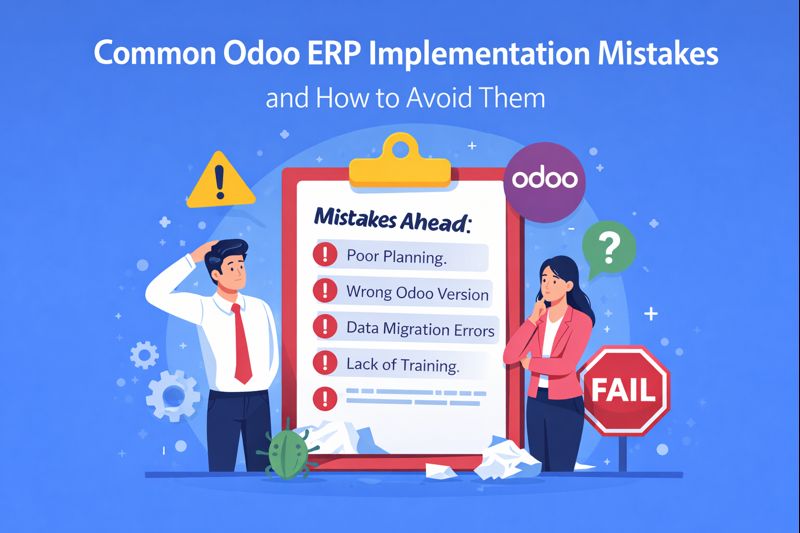
Common Odoo ERP Implementation Mistakes and How to Avoid Them
Introduction
Common Odoo ERP implementation mistakes often cause delays, cost overruns, and poor user adoption. Many businesses choose Odoo ERP for its flexibility and scalability. However, implementation problems usually arise when planning is weak or decisions are rushed. Because ERP affects every department, even small mistakes can create long-term operational issues. For this reason, understanding common mistakes and learning how to avoid them is critical before and during Odoo ERP implementation.
Odoo ERP implementation is not only a technical project. Instead, it is a business transformation process. Therefore, companies must approach it with the right strategy, clear goals, and proper execution. This guide explains the most common Odoo ERP implementation mistakes in simple terms and shows practical ways to avoid them.
If you are new to Odoo ERP, start with this foundational guide:
https://www.infozion.in/odoo-erp-introduction-a-complete-guide-for-businesses-in-2025/
Why Odoo ERP Implementations Fail
Many ERP projects fail not because of software limitations but because of poor implementation practices. In most cases, businesses underestimate planning, ignore user involvement, or rush decisions. As a result, the ERP system fails to deliver expected value.
Odoo ERP is powerful, but it requires a structured approach. When companies skip important steps, problems appear after go-live. Therefore, identifying these mistakes early helps businesses avoid costly corrections later.
Mistake 1: Skipping Proper Business Requirement Analysis
One of the most common Odoo ERP implementation mistakes is skipping detailed requirement analysis. Many businesses start implementation without clearly understanding their processes.
When requirements are unclear, wrong modules get selected. In addition, unnecessary customization increases complexity. Because of this, users struggle to adapt to the system.
How to Avoid This Mistake
Always begin with detailed process mapping. Involve all departments in discussions. Moreover, document pain points and expectations clearly. This approach ensures Odoo ERP aligns with real business needs.
Mistake 2: Choosing the Wrong Odoo Version
Another major mistake is selecting the wrong Odoo edition. Odoo Community and Odoo Enterprise serve different purposes. However, businesses often choose based only on cost.
When the wrong version is selected, limitations appear later. As a result, businesses face migration challenges or additional costs.
How to Avoid This Mistake
Evaluate long-term business goals first. Consider scalability, automation needs, and internal technical expertise. Then choose the version that supports future growth.
Mistake 3: Implementing Too Many Modules at Once
Some businesses try to implement all Odoo modules together. Although this looks efficient, it usually creates confusion.
Users feel overwhelmed. In addition, testing becomes difficult. Because of this, errors increase after go-live.
How to Avoid This Mistake
Use a phased implementation approach. Start with core modules such as accounting, sales, and inventory. Later, add advanced modules. This strategy improves adoption and stability.
To understand modules better, refer to:
https://www.infozion.in/odoo-erp-modules-explained/
Mistake 4: Poor Data Migration Planning
Data migration issues are among the most expensive Odoo ERP implementation mistakes. Dirty or incomplete data causes reporting errors and operational confusion.
When data quality is poor, users lose trust in the ERP system. Consequently, adoption drops.
How to Avoid This Mistake
Clean and validate data before migration. Remove duplicates and outdated records. In addition, test migrated data carefully before go-live.
Mistake 5: Excessive Customization
Odoo is flexible, but excessive customization creates long-term problems. Many businesses customize features that standard Odoo already supports.
Because of heavy customization, system upgrades become difficult. Moreover, maintenance costs increase.
How to Avoid This Mistake
Use standard Odoo features wherever possible. Customize only when business needs cannot be met through configuration. This approach keeps the system upgrade-friendly.
Mistake 6: Ignoring User Training and Change Management
Another common Odoo ERP implementation mistake is neglecting user training. Many companies assume users will learn the system on their own.
Without training, errors increase. As a result, employees resist using the ERP system.
How to Avoid This Mistake
Provide role-based training sessions. Focus on daily tasks rather than theory. In addition, explain how Odoo simplifies work. This improves acceptance and confidence.
Mistake 7: Weak Testing Before Go-Live
Testing is often rushed to meet deadlines. However, weak testing leads to serious issues after deployment.
When workflows are not tested properly, operations slow down. Therefore, businesses face unnecessary disruptions.
How to Avoid This Mistake
Conduct functional and user acceptance testing. Involve real users during testing. This helps identify gaps early and ensures smoother go-live.
Mistake 8: No Clear Implementation Checklist
Many businesses implement Odoo ERP without a structured checklist. As a result, tasks get missed and responsibilities become unclear.
This leads to delays, confusion, and rework.
How to Avoid This Mistake
Follow a step-by-step Odoo ERP implementation checklist. A checklist ensures that every phase is planned and executed properly.
You can follow this detailed checklist guide:
Mistake 9: Lack of Post-Implementation Support
ERP implementation does not end at go-live. However, many businesses stop monitoring the system after deployment.
Without support, minor issues grow into major problems. Consequently, system performance suffers.
How to Avoid This Mistake
Plan post-implementation support in advance. Monitor system usage and collect user feedback. Continuous improvement ensures long-term success.
EEAT Perspective: Why Expert-Led Implementation Matters
From an EEAT perspective, experience and expertise play a key role in ERP success. Businesses that rely on experienced Odoo consultants avoid common mistakes.
Experts follow best practices in planning, configuration, and training. As a result, implementations become more stable and reliable. Industry experts also highlight these mistakes in their implementation guides:
Benefits of Avoiding Common Odoo ERP Implementation Mistakes
Avoiding these mistakes saves time and cost. It also improves user adoption and system performance.
Moreover, businesses gain better control and visibility. As a result, Odoo ERP delivers maximum ROI.
Conclusion
Common Odoo ERP implementation mistakes can seriously impact business operations if ignored. However, most of these issues are preventable with proper planning and execution.
By understanding these mistakes and following best practices, businesses can implement Odoo ERP successfully. A structured approach ensures smooth adoption, better efficiency, and long-term growth.
Introduction
An Odoo ERP implementation checklist helps businesses implement Odoo ERP in a structured and risk-free way. Many companies select Odoo ERP because it is flexible and scalable. However, problems start when the implementation process is rushed or unplanned. In such cases, businesses face user resistance, data errors, and workflow issues. Because of this, a clear step-by-step checklist becomes essential for success.
Odoo ERP implementation is more than software setup. It connects people, processes, and data into one system. Therefore, following a proper checklist ensures smooth adoption and long-term benefits.
If you are new to Odoo ERP, start by understanding the basics here:
https://www.infozion.in/odoo-erp-introduction-a-complete-guide-for-businesses-in-2025/
What Is Odoo ERP Implementation?
Odoo ERP implementation is the process of planning and configuring Odoo according to business needs. It includes system setup, data migration, testing, and deployment. Most importantly, it aligns daily operations with a centralized platform.
As a result, teams work faster and make fewer mistakes. In addition, managers gain real-time visibility into business performance. This is why a structured implementation approach is always recommended.
Why an Odoo ERP Implementation Checklist Matters
Many ERP projects fail due to poor planning. Without a checklist, tasks become unclear and timelines slip. Moreover, teams lose confidence in the system.
An Odoo ERP implementation checklist solves this problem. It provides clarity at every stage. As a result, businesses reduce risks and control costs. In addition, user adoption improves significantly.
Step 1: Analyze Business Requirements
The first step in the Odoo ERP implementation checklist is requirement analysis. At this stage, businesses review how their processes work today.
Each department should share its challenges. For example, sales teams may need better tracking. Finance teams may need accurate reports. Inventory teams may struggle with stock control. Therefore, gathering input from all teams is critical.
Step 2: Set Clear Implementation Goals
After gathering requirements, businesses must define clear goals. These goals guide the entire implementation process.
For instance, a company may want to reduce manual work. Another goal could be improving order processing speed. Because goals are clear, decisions become easier throughout the project.
Step 3: Choose the Right Odoo Version
Choosing the right version is a key part of the Odoo ERP implementation checklist. Odoo offers Community and Enterprise editions.
Odoo Community works well for basic needs. On the other hand, Odoo Enterprise offers automation, advanced reporting, and official support. Therefore, businesses should consider budget, growth plans, and internal expertise before deciding.
Step 4: Select the Required Odoo Modules
Odoo uses a modular structure. This allows businesses to install only what they need.
Common modules include Sales, Accounting, Inventory, CRM, and HR. However, selecting unnecessary modules can confuse users. Because of this, module selection should match actual workflows.
You can understand Odoo modules in detail here:
https://www.infozion.in/odoo-erp-modules-explained/
Step 5: Create an Implementation Plan
Once modules are selected, an implementation plan is required. This plan defines tasks, timelines, and responsibilities.
A phased approach works best. First, core modules are implemented. Later, advanced features are added. As a result, teams adapt smoothly to the new system.
Step 6: Prepare and Migrate Data
Data migration is one of the most sensitive steps. Therefore, businesses must clean and validate data before migration.
Customer records, product data, and financial details should be accurate. Otherwise, reporting issues may appear after go-live. Clean data builds trust in the ERP system.
Step 7: Configure Odoo Properly
Odoo offers many configuration options. These settings allow businesses to match workflows without heavy customization.
Customization should be minimal. Because excessive customization increases costs, standard features should be used whenever possible. This approach keeps the system stable and upgrade-friendly.
Step 8: Define User Roles and Access Rights
Security is essential in ERP systems. Odoo allows role-based access control.
Each user should see only relevant data. As a result, data security improves and errors reduce. Moreover, accountability becomes clear across teams.
Step 9: Test the System Thoroughly
Testing ensures the system works as expected. During this phase, real business scenarios are tested.
End-users should participate in testing. This helps identify gaps early. In addition, users gain confidence before go-live.
Step 10: Train Users and Manage Change
Training is critical for ERP success. Even a perfect system fails without trained users.
Training should focus on daily tasks. Moreover, change management helps users accept the new system. Because of this, resistance reduces and adoption improves.
Step 11: Go Live with Odoo ERP
Go-live is when Odoo replaces old systems. At this stage, close monitoring is required.
Support teams should be ready. Additionally, backups must be in place. This ensures business continuity during the transition.
Step 12: Post-Implementation Support and Improvement
ERP implementation does not end at go-live. Continuous support is required.
Regular reviews help improve performance. As business needs change, Odoo can be optimized further. Therefore, long-term success depends on ongoing improvement.
EEAT Perspective: Why a Step-by-Step Approach Works
From an EEAT perspective, experience and expertise matter in ERP implementation. Businesses that follow a structured checklist achieve better results.
Experts recommend a phased approach to reduce risks. You can explore an expert-backed guide here:
Benefits of Using an Odoo ERP Implementation Checklist
A checklist reduces mistakes. It also improves user confidence.
Moreover, it ensures better ROI. As a result, businesses grow with a stable ERP foundation.
Conclusion
An Odoo ERP implementation checklist provides a clear roadmap for successful ERP adoption. It helps businesses avoid common mistakes and achieve operational efficiency.
By following this step-by-step guide, organizations can implement Odoo ERP with confidence. Ultimately, a well-planned implementation leads to long-term business success.
Introduction
Top Benefits of Odoo ERP for Small & Medium Enterprises is a topic every growing business owner should understand today. Small and medium enterprises often struggle with managing daily operations like accounting, sales, inventory, HR, and customer data using multiple tools. This scattered system wastes time, increases errors, and slows down growth. Odoo ERP solves this problem by bringing everything under one powerful and easy-to-use platform. It helps businesses work smarter, reduce costs, and scale faster without technical complexity. In simple words, Odoo ERP acts like the brain of your business, keeping all departments connected and updated in real time.
In today’s competitive market, SMEs cannot afford slow systems or manual processes. Customers expect fast responses, accurate billing, and smooth service. This is where Odoo ERP becomes a game changer. It gives small and medium businesses the same level of control and automation that large enterprises enjoy, but at a much lower cost. If you are new to ERP systems, you can first read this beginner guide to understand the basics of Odoo ERP:
👉 https://www.infozion.in/odoo-erp-introduction-a-complete-guide-for-businesses-in-2025/
This blog explains the real benefits of Odoo ERP in simple language so even non-technical business owners can easily understand why Odoo is one of the best ERP solutions for SMEs.
What Is Odoo ERP, and Why SMEs Need It
Odoo ERP is an all-in-one business management software designed to manage different business functions from a single platform. Instead of using separate software for accounting, inventory, CRM, HR, and sales, Odoo connects everything in one system. This reduces confusion, saves time, and improves decision-making.
Small and medium enterprises usually operate with limited staff and budget. Managing multiple tools becomes difficult and expensive over time. Data mismatch, manual entries, and delayed reports create serious problems. Odoo ERP removes these challenges by providing a centralized system that updates data automatically across departments.
For example, when a sale is confirmed, inventory updates automatically, invoices are generated, and accounting entries are recorded without manual work. This level of automation helps SMEs focus more on business growth instead of daily operational stress.
Why Odoo ERP Is Ideal for Small & Medium Enterprises
Affordable ERP Solution for Growing Businesses
One of the biggest reasons SMEs choose Odoo ERP is affordability. Traditional ERP systems are expensive and designed mainly for large enterprises. Odoo, on the other hand, offers a flexible pricing model that allows businesses to pay only for the modules they need. This makes Odoo ERP highly cost-effective for small and medium enterprises.
Instead of investing heavily at once, SMEs can start small and expand later as their business grows. This reduces financial risk and makes ERP adoption practical even for startups.
Modular Structure That Fits Every Business
Odoo ERP works on a modular system. This means you don’t need to install everything at once. You can choose only the modules required for your business operations. Whether you need accounting, inventory, CRM, HR, or manufacturing, Odoo gives you complete control.
To understand how Odoo modules work in detail, you can explore this guide:
👉 https://www.infozion.in/odoo-erp-modules-explained/
This modular flexibility ensures that SMEs are not forced to use unnecessary features, keeping the system clean, fast, and easy to manage.
Top Benefits of Odoo ERP for Small & Medium Enterprises
Improved Business Efficiency and Automation
Odoo ERP significantly improves business efficiency by automating repetitive tasks. Manual data entry is one of the biggest productivity killers in SMEs. Odoo reduces this by automating workflows across departments.
For example, once a customer order is placed, the system automatically updates inventory, generates invoices, and tracks delivery status. This automation reduces errors, saves time, and ensures smoother operations.
Centralized Data Management
One of the strongest benefits of Odoo ERP for small and medium enterprises is centralized data. All business information is stored in one place and updated in real time. This eliminates confusion caused by multiple spreadsheets or disconnected software.
When data is centralized, business owners get a clear view of sales, expenses, inventory, and customer behavior. This helps in making faster and better decisions.
Better Financial Control and Accounting
Managing finances is critical for SMEs. Odoo ERP offers powerful accounting features that help businesses track income, expenses, taxes, and cash flow accurately. It supports automated invoicing, payment follow-ups, and bank reconciliation.
With Odoo ERP, financial reports are generated instantly. This allows business owners to monitor profitability and avoid cash flow issues before they become serious problems.
Odoo ERP Helps SMEs Scale Without Stress
Easy Scalability as Business Grows
Small businesses aim to grow, but growth often brings complexity. Odoo ERP is designed to scale smoothly as your business expands. You can add new users, modules, and features without changing the entire system.
This scalability ensures that SMEs don’t need to migrate to another ERP system after a few years. Odoo grows with your business, saving time and future costs.
Cloud and On-Premise Flexibility
Odoo ERP offers both cloud-based and on-premise deployment options. SMEs can choose what works best for their business. Cloud deployment reduces IT maintenance and allows access from anywhere. On-premise deployment offers full control over data and infrastructure.
This flexibility makes Odoo suitable for different business needs and compliance requirements.
Better Customer Relationship Management With Odoo
Strong CRM for Sales Growth
Odoo ERP includes a powerful CRM module that helps SMEs manage leads, opportunities, and customer interactions effectively. It tracks customer history, follow-ups, and communication in one place.
This improves sales efficiency and ensures no lead is lost due to poor tracking. Sales teams can focus more on closing deals rather than managing data manually.
Improved Customer Satisfaction
When internal processes are smooth, customers automatically receive better service. Faster order processing, accurate billing, and timely deliveries improve customer trust.
Odoo ERP helps SMEs deliver consistent and professional customer experiences, which leads to repeat business and referrals.
Inventory and Supply Chain Optimization
Real-Time Inventory Tracking
Inventory mismanagement causes losses in many small businesses. Odoo ERP provides real-time inventory tracking, ensuring accurate stock levels at all times.
This helps avoid overstocking and stock shortages. Businesses can plan purchases better and reduce unnecessary storage costs.
Smarter Supply Chain Decisions
With accurate inventory data and demand forecasting, SMEs can optimize their supply chain. Odoo ERP helps identify fast-moving products, slow-moving stock, and supplier performance.
This leads to better supplier negotiations and improved operational efficiency.
Employee Management Made Simple
HR and Payroll Automation
Managing employees manually becomes difficult as teams grow. Odoo ERP simplifies HR processes such as attendance, payroll, leaves, and performance tracking.
This reduces administrative workload and ensures transparency in employee management.
Improved Team Productivity
When employees have access to clear processes and accurate data, productivity improves. Odoo ERP reduces confusion and helps teams collaborate better across departments.
Data-Driven Decision Making With Odoo ERP
Odoo ERP provides detailed reports and dashboards that help SMEs analyze business performance. Business owners can track sales trends, profit margins, customer behavior, and operational efficiency in real time.
Data-driven insights help businesses identify opportunities and fix problems early. This strategic advantage is crucial for long-term success.
Security and Compliance Benefits for SMEs
Odoo ERP offers strong data security features, including access control, backups, and user permissions. SMEs can decide who can access specific data, ensuring sensitive information remains protected.
Compliance with accounting and taxation rules also becomes easier with automated reporting and record-keeping.
Why Odoo ERP Is a Smart Investment for SMEs
Investing in Odoo ERP is not just about software; it’s about building a strong foundation for growth. SMEs that adopt ERP early gain better control, efficiency, and scalability.
According to industry insights, businesses implementing Odoo ERP experience improved productivity, reduced operational costs, and better customer satisfaction. You can read additional insights here:
Final Thoughts: Is Odoo ERP Right for Your Business?
The top benefits of Odoo ERP for small & medium enterprises make it one of the most practical and future-ready ERP solutions today. From cost savings and automation to scalability and customer satisfaction, Odoo ERP covers every critical business need.
If your business is struggling with disconnected systems, manual work, or slow growth, Odoo ERP can bring structure, clarity, and control. It empowers SMEs to compete with larger businesses while staying agile and efficient.
Adopting Odoo ERP is not an expense; it is a strategic move toward sustainable growth and long-term success.
Introduction
Odoo ERP implementation cost in 2026 is one of the first questions business owners ask when they decide to move towards ERP software. Many companies are interested in Odoo because it is flexible, modular, and affordable compared to other ERP systems. However, most businesses struggle to understand how much the full implementation will actually cost and what factors increase or reduce that cost.
The truth is simple: Odoo ERP implementation cost is not fixed. It depends on your business size, number of users, modules, customization needs, hosting choice, and long-term support requirements. This guide explains everything clearly, step by step, in simple language so you can plan your ERP budget with confidence and avoid hidden surprises later.
What Does Odoo ERP Implementation Really Mean?
Odoo ERP implementation is not just about installing software. It is a structured process where Odoo is configured to match how your business actually works. This includes setting up modules, defining workflows, importing data, training employees, testing processes, and finally making the system live.
Many businesses underestimate implementation effort and later face delays or extra costs. That is why understanding the full implementation process is important before discussing pricing.
If you want to understand the complete step-by-step process clearly, you can read this guide first:
👉 https://www.infozion.in/odoo-erp-implementation-process/
Why Odoo ERP Implementation Cost Is Different for Every Business
There is no single price tag for Odoo ERP implementation because no two businesses work in the same way. A small trading company may only need basic sales and accounting modules, while a manufacturing business may require inventory, production, purchase, quality, and custom workflows.
Odoo is designed to grow with your business, which means cost depends on what you choose to implement now and what you plan to add later. The flexibility that makes Odoo powerful is also the reason why implementation costs vary.
Key Factors That Decide Odoo ERP Implementation Cost in 2026
Odoo Edition Selection
Odoo comes in two editions: Community and Enterprise. The community edition is open-source and free to use, but it requires more development effort and does not include official support. The enterprise edition is paid but includes advanced features, regular updates, and a better user experience.
Most growing businesses in 2025 prefer Enterprise because it reduces risk and long-term maintenance effort. Your edition choice directly impacts licensing and implementation cost.
Number of Users
User count plays a major role in implementation cost. More users mean more system access, more roles, more permissions, and more training sessions. Even if modules remain the same, user complexity increases effort and testing time.
Businesses should always plan user count realistically instead of underestimating it.
Modules You Choose to Implement
Odoo works on a modular system. Each module handles a specific business function such as sales, CRM, accounting, inventory, HR, manufacturing, or project management.
Implementing fewer modules keeps costs low. As you add more modules, configuration effort increases because modules must work smoothly together. Choosing only essential modules in phase one helps control cost.
Customization Requirements
Customization is one of the biggest cost drivers in Odoo ERP implementation. Basic configuration uses standard Odoo features and workflows, which keeps costs reasonable. Heavy customization includes custom fields, reports, automation rules, integrations, and new features.
Every customization requires development, testing, and future maintenance. That is why businesses should customize only when it is truly necessary.
Data Migration Complexity
Most businesses move to Odoo from Excel, legacy software, or another ERP. Data migration effort depends on how clean and structured your data is.
Poor data quality increases cost because it requires manual correction, validation, and mapping. Clean data reduces time, effort, and implementation expense.
Hosting and Infrastructure Choice
Odoo can be hosted on cloud or on-premise servers. Cloud hosting is more popular in 2026 because it reduces infrastructure cost and maintenance burden. On-premise hosting offers more control but requires higher initial investment and IT support.
Your hosting choice directly affects both implementation and long-term cost.
Training and Change Management
ERP implementation fails not because of software, but because users are not comfortable using it. Training cost depends on how many departments are involved and how complex your workflows are.
Good training reduces errors, improves adoption, and ensures a better return on investment.
Support and Maintenance After Go-Live
Implementation does not end at go-live. Businesses need ongoing support for bug fixes, minor changes, updates, and user assistance. Annual support contracts add recurring costs but ensure system stability and smooth operations.
Estimated Odoo ERP Implementation Cost Range in 2026
In 2026, Odoo ERP implementation cost usually falls into different ranges based on business complexity.
Small businesses with basic needs usually have lower costs. Medium businesses with multiple departments and integrations fall into the mid-range cost. Large enterprises with heavy customization, advanced workflows, and integrations require higher investment.
The key point is that cost depends more on requirements than company size.
Common Hidden Costs Businesses Overlook
Many businesses plan ERP budgets based only on initial setup and forget long-term factors. Hidden costs usually appear when businesses request new features after go-live, underestimate training, or ignore support needs.
Planning implementation in phases helps control these hidden costs.
How Businesses Can Control Odoo ERP Implementation Cost
Businesses can reduce implementation cost by clearly defining requirements, avoiding unnecessary customization, preparing data early, and implementing modules in phases. Choosing an experienced implementation partner also reduces rework and delays, which saves money in the long run.
Is Odoo ERP Worth the Implementation Cost?
Yes, when implemented correctly.
Odoo ERP improves efficiency, data accuracy, transparency, and decision-making. Over time, the benefits usually outweigh the implementation cost, especially for growing businesses that want scalable systems.
External Reference for Cost Understanding
For an external perspective on Odoo ERP implementation cost, you can explore this detailed breakdown:
This reference supports cost understanding, but everything essential is already explained in this guide.
Conclusion
Odoo ERP implementation cost in 2026 depends on users, modules, customization, hosting, training, and long-term support. There is no fixed price, but businesses that plan carefully can control costs and achieve strong ROI.
By focusing on real business needs and using Odoo’s flexibility wisely, companies can turn ERP implementation into a long-term growth investment instead of a financial burden.
Introduction
Odoo ERP implementation is a critical step for businesses that want to bring structure, automation, and clarity into their daily operations. Many companies select Odoo ERP because it is flexible, modular, and cost-effective, but the real success of Odoo depends on how well the implementation process is planned and executed. A proper implementation helps businesses reduce confusion, avoid manual errors, and ensure that all departments work with the same accurate data.
When businesses rush into ERP without understanding the implementation process, they often face problems like employee resistance, wrong data, delayed workflows, and poor reporting. That is why understanding the Odoo ERP implementation process step by step is essential before starting the project. This guide explains everything in simple language so business owners, managers, and decision-makers can clearly understand how to implement Odoo ERP successfully in 2026.
What Is Odoo ERP Implementation?
Odoo ERP implementation is the process of setting up the Odoo system according to real business requirements. It involves analyzing current workflows, selecting the right modules, configuring the system, migrating data, training users, and providing continuous support after go-live. It is not just about installing software but about transforming how a business operates daily.
A well-planned implementation ensures that Odoo ERP supports business goals instead of becoming an extra burden. When ERP aligns with actual processes, teams adopt it faster, and management gains better control over operations.
If you are new to Odoo ERP and want to understand the system before implementation, you can start with this beginner guide:
👉 https://www.infozion.in/odoo-erp-introduction/
Why Odoo ERP Implementation Needs Proper Planning
Many ERP projects fail not because the software is weak, but because implementation is done without a clear roadmap. Odoo ERP offers powerful features, but without structured planning, businesses may struggle to use them effectively.
Proper planning helps identify what the business actually needs, which modules are essential, and what level of customization is required. It also reduces unnecessary costs and ensures smoother adoption across teams.
When implementation follows a step-by-step approach, businesses experience fewer disruptions and faster returns on investment.
Step-by-Step Odoo ERP Implementation Process
Step 1 – Business Requirement Analysis
The first and most important step in Odoo ERP implementation is understanding the business. At this stage, the implementation team studies how the company currently works. They analyze workflows, departments, reporting needs, and existing challenges.
This step helps identify gaps where ERP can improve efficiency. It also ensures that Odoo is configured to match business operations instead of forcing teams to change processes unnecessarily.
Clear requirement analysis prevents confusion in later stages.
Step 2 – Selecting the Right Odoo ERP Modules
Odoo ERP is modular, which means businesses can choose only the modules they need. Selecting the right modules keeps the system simple and user-friendly.
Commonly used modules include sales, CRM, accounting, inventory, purchasing, manufacturing, and HR. Choosing modules based on current needs avoids complexity and reduces training time.
To understand how these modules work together, you can explore this detailed guide:
👉 https://www.infozion.in/odoo-erp-modules-explained/
Step 3 – System Configuration
After module selection, the next step is configuring the system. Configuration includes setting company details, tax rules, currencies, approval workflows, user roles, and access permissions.
This step ensures that Odoo ERP reflects real business rules. Proper configuration reduces errors and improves day-to-day efficiency.
Even small mistakes at this stage can affect operations later, so accuracy is important.
Step 4 – Customization (Only If Needed)
One major advantage of Odoo ERP is flexibility. Businesses can customize workflows, reports, dashboards, and features when standard options do not meet their requirements.
However, unnecessary customization should be avoided. Over-customization increases costs and makes future upgrades difficult. A good implementation balances standard features with limited, meaningful customization.
Step 5 – Data Migration
Data migration is one of the most sensitive stages of Odoo ERP implementation. Existing data from spreadsheets, accounting software, or legacy systems must be cleaned and transferred carefully.
This includes customer records, supplier details, products, opening stock, accounting balances, and historical transactions. Clean data ensures accurate reports and smooth operations after go-live.
Step 6 – Testing the ERP System
Before going live, thorough testing is done to ensure that all workflows function correctly. Testing helps identify errors, missing configurations, or process gaps.
User acceptance testing allows actual users to test the system in real scenarios. Their feedback helps fine-tune the system before deployment.
Step 7 – User Training and Change Management
ERP success depends on users, not just software. Employees must be trained to use Odoo ERP confidently in their daily work.
Training reduces resistance and improves adoption. When users understand how ERP makes their work easier, they accept the system faster.
Step 8 – Go-Live and Deployment
After testing and training, the system is ready for go-live. Businesses may choose phased deployment or full deployment depending on size and complexity.
During go-live, close monitoring ensures that operations continue smoothly without disruptions.
Step 9 – Post-Implementation Support
Odoo ERP implementation does not end at go-live. Continuous support is required to fix issues, optimize performance, and support users.
Post-implementation support ensures long-term ERP success and system stability.
Common Challenges in Odoo ERP Implementation
Businesses often face challenges like poor planning, unclear requirements, over-customization, lack of training, and unrealistic timelines. These issues can slow adoption and reduce ERP benefits.
Most challenges can be avoided with proper guidance and structured implementation.
Best Practices for Successful Odoo ERP Implementation
Successful businesses follow simple best practices. They focus on core modules first, keep processes simple, train users properly, and choose experienced ERP partners.
Clear communication between management, users, and implementation teams is essential.
External Reference on Odoo ERP Implementation
For additional industry insight, you can explore this detailed implementation resource:
How Long Does Odoo ERP Implementation Take?
Implementation timelines depend on business size, module count, customization level, and data complexity. Small businesses may complete implementation within weeks, while larger organizations may take several months.
Planning realistic timelines ensures smoother execution.
Conclusion
Odoo ERP implementation is a business transformation process, not just a software setup. When implemented with clarity and planning, Odoo ERP helps businesses improve efficiency, reduce errors, and gain better control over operations.
By following a structured implementation approach, businesses can unlock the full potential of Odoo ERP and ensure long-term success. A well-implemented ERP always delivers stronger results than a rushed one.
H2: Introduction
Odoo ERP modules are the core reason why businesses choose Odoo to manage their daily operations smoothly. When companies search for a flexible and easy ERP solution, Odoo ERP modules stand out because they allow businesses to use only what they need while keeping everything connected in one system. Instead of juggling multiple software tools, companies can manage sales, accounting, inventory, HR, and operations through Odoo’s modular ERP structure.
As businesses grow, daily tasks become complex. Managing customers, tracking stock, handling invoices, and coordinating teams can quickly turn into chaos without a proper system. This is where Odoo ERP modules help. They bring structure, clarity, and automation to business processes. This guide explains Odoo ERP modules in very simple language so even a non-technical business owner can understand how they work and why they matter.
If you are new to Odoo and want to understand its basics first, you can start here:
👉 https://www.infozion.in/odoo-erp-introduction/
What Are Odoo ERP Modules?
Simple Explanation
An Odoo ERP module is a specific part of the Odoo system designed to manage one business function. Each module focuses on a particular task such as sales, accounting, inventory, HR, or manufacturing. What makes Odoo special is that all these modules work together in real time.
For example, when a sale is confirmed in the Sales module, the Inventory module updates stock automatically, the Accounting module prepares the invoice, and the CRM module updates customer records. Everything happens smoothly without manual effort.
Why Odoo Uses a Modular System
Odoo follows a modular approach because every business is different. A small company may need only sales and accounting, while a manufacturing company may need inventory, production, purchasing, and quality control. With Odoo ERP modules, businesses can start small and add more modules as they grow.
How Odoo ERP Modules Work Together
Connected System in Real Time
Odoo ERP modules are fully integrated. This means data entered in one module instantly reflects in others. Teams do not need to call or message each other to share updates. Everyone sees the same information at the same time.
Real-Life Example
Imagine a customer places an order.
The Sales module confirms the order.
Inventory updates stock levels automatically.
Accounting generates the invoice.
Delivery receives shipping details.
Management sees updated reports instantly.
This seamless flow is what makes Odoo ERP powerful.
Core Odoo ERP Modules Explained
Sales Module
The Sales module manages quotations, sales orders, pricing, discounts, and customer communication. It helps businesses track the complete sales journey from inquiry to payment.
This module improves sales efficiency and reduces follow-up mistakes.
CRM Module
Odoo CRM helps businesses manage leads, customer interactions, meetings, and follow-ups. Sales teams can track every opportunity and improve conversion rates.
CRM works closely with the Sales module to turn leads into customers.
Accounting Module
The accounting module handles invoices, payments, expenses, taxes, profit-loss reports, and financial statements. It gives business owners clear visibility into cash flow and financial health.
Automation reduces errors and saves time.
Inventory Management Module
The inventory module tracks stock levels, warehouses, product movement, and reorder rules. Businesses always know what is available and what needs to be restocked.
This prevents shortages, overstocking, and delivery delays.
Purchase Module
The Purchase module manages suppliers, purchase orders, pricing, and delivery timelines. It helps businesses maintain strong vendor relationships and control procurement costs.
Manufacturing Module
This module is ideal for factories and production units. It manages bills of materials, work orders, production schedules, and resource planning.
Manufacturing operations become more predictable and efficient.
Human Resources (HR) Module
The HR module handles employee records, attendance, leaves, payroll, and performance tracking. It reduces paperwork and simplifies employee management.
Project Management Module
This module helps teams plan tasks, assign responsibilities, track deadlines, and monitor progress. It is useful for service-based businesses and IT companies.
Website & eCommerce Module
Odoo allows businesses to build websites and online stores directly connected to ERP. Orders from the website update inventory, accounting, and CRM automatically.
Reporting & Dashboard Module
Odoo provides real-time dashboards and reports for sales, finance, inventory, and performance. Business owners can make better decisions using live data.
Benefits of Using Odoo ERP Modules
Odoo ERP modules help businesses work faster and smarter. They reduce manual tasks, improve accuracy, and increase team productivity. Businesses gain better control over operations and data.
Key benefits include better organization, real-time insights, reduced errors, improved customer service, and scalability.
Odoo ERP Modules for Small vs Large Businesses
Small businesses benefit from starting with basic modules and expanding later. Large enterprises benefit from deep customization and advanced integrations.
Odoo works well for both because of its flexible structure.
Customization & Scalability in Odoo Modules
One major advantage of Odoo is customization. Businesses can modify workflows, fields, and reports according to their needs. New modules can be added without disturbing existing operations.
Security & Data Control in Odoo ERP
Odoo provides strong security features like access controls, data encryption, and backups. Cloud and on-premise deployment options give businesses flexibility.
External Reference for Odoo ERP Modules
For an additional trusted explanation, you can explore this reference:
Choosing the Right Odoo ERP Modules for Your Business
Businesses should analyze their needs before selecting modules. Retailers focus on sales and inventory. Manufacturers need production and purchasing. Service companies need CRM and projects.
Selecting the right modules ensures better ROI.
Future of Odoo ERP Modules
Odoo continues to evolve with AI features, automation, and better analytics. Future modules will offer smarter predictions and improved decision-making tools.
Conclusion
Odoo ERP modules are the backbone of an efficient and scalable business system. They simplify operations, improve collaboration, and help businesses grow without confusion. By choosing the right ERP modules, companies gain control, clarity, and confidence in daily operations.
If you want to understand Odoo from the beginning, start here:
👉 https://www.infozion.in/odoo-erp-introduction/
Introduction
Running a small business sounds simple, but in reality, it requires handling many things at the same time—customers, stock, payments, suppliers, employees, reports, and more. As a business grows, these tasks become harder to manage manually. This is where ERP for small businesses becomes extremely valuable. ERP brings all business processes together in one organized system to reduce mistakes, save time, and improve daily operations. Even if you are running a small shop, a startup, an agency, or a service-based company, ERP can make your work smoother and your decisions faster.
Many small business owners still rely on notebooks, WhatsApp messages, spreadsheets, and multiple apps to manage their daily operations. But this creates confusion, delays, miscommunication, and incorrect data. ERP solves all these problems by connecting everything—sales, accounts, HR, inventory, CRM, and reports—into one single platform. Today’s modern ERP tools are designed to be simple, affordable, and easy to learn, making them perfect for small businesses.
If you’re new to ERP, here is a simple, beginner-friendly explanation:
👉 https://www.infozion.in/what-is-erp/
What Is ERP, and Why Small Businesses Need It
ERP stands for Enterprise Resource Planning. It is a system that helps companies manage and automate day-to-day activities such as billing, sales tracking, inventory updates, reporting, CRM, HR, accounting, and more.
Small businesses need ERP more than ever because:
- Customers expect faster service
- Markets are more competitive
- Mistakes are expensive
- Owners must make quick decisions
- Teams need clear communication
ERP gives small businesses real-time visibility of what is happening inside the company. Instead of guessing, owners can see accurate stock levels, financial reports, sales performance, customer history, and expenses instantly.
To understand how ERP systems work in detail, explore this guide:
👉 https://www.infozion.in/erp-systems/
How ERP Works Inside a Small Business
ERP connects all departments so that every piece of information flows automatically.
Here’s a simple example:
A customer places an order → ERP updates inventory → invoice generates → payment is recorded → delivery team is notified.
This entire flow happens without anyone needing to send messages or check multiple files.
ERP becomes the central brain of the business.
Key Features of ERP for Small Businesses
1. Inventory Management
Small businesses often struggle with stock mismatches. ERP solves this by showing:
- Real-time stock levels
- Low-stock alerts
- Fast-moving and slow-moving items
- Automatic stock updates after every sale
2. Billing & Accounting
ERP generates invoices, tracks payments, manages expenses, handles taxes, and creates financial reports—all automatically.
3. Customer Relationship Management (CRM)
Small businesses can store customer data, track follow-ups, and maintain communication history.
4. Employee & HR Management
ERP manages attendance, leave, salary calculation, and employee records without paperwork.
5. Reporting & Analytics
Owners get instant reports like
- Daily sales
- Profit & loss
- Inventory summary
- Expense tracking
- Customer buying patterns
Instead of checking multiple files, everything appears on one dashboard.
Benefits of ERP for Small Businesses
1. Saves Time and Labour Costs
ERP eliminates repetitive paperwork and manual entries. Employees can focus on customer service and actual work instead of data entry.
2. Reduces Human Errors
Manual mistakes in billing, stock numbers, or accounting can harm a small business. ERP ensures accurate and updated data at all times.
3. Improved Customer Experience
ERP helps businesses respond quickly with correct information. Customers appreciate faster service and clear communication.
4. Better Decision Making
ERP provides clear reports that help owners understand what is working and what needs improvement.
5. Helps With Business Growth
As your business grows, ERP grows with you. You can add more modules, users, or features anytime.
Cloud ERP vs On-Premise ERP for Small Businesses
Most small businesses choose Cloud ERP because:
- No installation needed
- Very low upfront cost
- Works on mobile and laptop
- Automatic updates
- No IT team required
On-premise ERP is suitable only for companies with:
- Dedicated IT teams
- High customization needs
- Strong internal servers
Real-Life Example of ERP in a Small Business
Imagine you run a small clothing store.
Without ERP:
- Stock is tracked manually
- Invoices are handwritten
- Payment records are often missing
- Reports take hours to prepare
- Customers wait longer
With ERP:
- Stock updates automatically
- The invoice prints in seconds
- Payments sync instantly
- Reports ready in one click
- Customer service becomes faster
This shows how ERP transforms daily work.
Costs of ERP for Small Businesses
The cost depends on:
- Number of users
- Modules required
- Cloud or on-premise
- Custom features
- Training & support
Most small businesses choose affordable cloud ERP monthly subscription plans instead of expensive software.
Challenges Small Businesses Face Without ERP
Without ERP, businesses often experience:
- Wrong stock data
- Delayed billing
- Confused communication
- Missed follow-ups
- Unclear finances
- Lost customers
ERP fixes all these issues instantly.
How to Choose the Right ERP for Your Small Business
Check These Factors Before Choosing ERP
- Is the ERP easy to use?
- Does it fit your budget?
- Can it grow with your business?
- Does it include mobile access?
- Is customer support good?
- Are modules suitable for your industry?
A good ERP should improve your daily workflow, not make it more complicated.
External Reference
For more insights on ERP for small businesses, you can explore this reliable external resource:
Conclusion
ERP for small businesses is not optional anymore—it is essential for staying organized, competitive, and profitable.
It helps businesses save time, avoid errors, improve communication, and make smarter decisions. Whether you run a retail shop, agency, manufacturing unit, or online store, ERP can transform the way you work.
If you want to start learning ERP from scratch, begin here:
👉 https://www.infozion.in/what-is-erp/
Introduction
Choosing between Cloud ERP vs On-Premise ERP has become one of the most important decisions for businesses that want to streamline operations, improve data management, and increase overall efficiency. The type of ERP deployment you select will directly impact your business in multiple ways, including cost, security, speed, accessibility, updates, scalability, and long-term performance. That is why it is essential to understand the key differences clearly before making a final decision.
In simple terms, Cloud ERP runs online and is hosted by the ERP provider, whereas On-Premise ERP is installed on your company’s own servers. This means Cloud ERP removes the need for physical infrastructure, while On-Premise ERP allows you to control your entire system internally. Understanding these differences helps you choose a solution that supports your business operations today and creates a foundation for future growth.
Modern companies use ERP systems to manage almost every critical department, including finance, HR, sales, CRM, supply chain, inventory, manufacturing, and operations. However, the biggest confusion for new users is whether they should shift to cloud-based ERP or continue using traditional on-premise infrastructure. This guide explains both models in simple language, making it easy for even non-technical readers to understand.
If you are completely new to ERP, you can start with this beginner-friendly explanation:
Understanding ERP Deployment Options
Although ERP systems are created to unify processes across departments, the way they are deployed has a major impact on functionality and cost. Some companies prefer Cloud ERP because it is affordable, easy to access, and requires no physical hardware. On the other hand, some organizations choose on-premise ERP because they want complete control over their data, system customizations, and security policies.
Before selecting any deployment model, it is important to evaluate your business structure, internal IT capability, industry compliance requirements, and long-term strategic goals. Small businesses often prefer the cloud because it offers faster setup and flexibility. Large enterprises with strict data policies may lean toward on-premise because it offers complete control over sensitive data.
To understand how ERP works across multiple departments in detail, you can refer to this guide:
What Is Cloud ERP?
Simple Explanation
Cloud ERP is a modern software model where the entire ERP system runs on remote servers maintained and secured by the ERP vendor. You don’t need to install hardware, purchase servers, or maintain a dedicated IT room. Instead, you access everything through your web browser or mobile device, just like you use Gmail, Google Drive, or any online application. This makes Cloud ERP extremely simple to use and suitable for businesses that want to reduce complexity.
Why Cloud ERP Is Popular in 2025
In 2025, Cloud ERP continues to be the first choice for many companies because it removes the burden of maintaining internal systems and allows teams to work from anywhere. Businesses prefer cloud solutions because they provide automatic updates, strong security, and predictable subscription pricing. Since there is no upfront cost for servers, small and medium businesses can start using ERP without large investments. This makes cloud adoption faster and more practical for companies that want agility and quick scalability.
What Is On-Premise ERP?
Simple Explanation
On-premise ERP is the traditional model where the software is physically installed on your company’s servers. All data, security controls, customizations, and backups are managed internally by your IT team. This gives your business complete ownership of everything related to ERP management. Although this model requires higher technical resources, it is still preferred by industries where strict compliance, privacy, or government regulations are involved, such as banks, hospitals, manufacturing plants, and government departments.
Why Businesses Still Choose On-Premise ERP
Many companies choose on-premise ERP because it provides deep system customization, internal data protection, and the ability to tailor workflows exactly as needed. If your business already has a strong IT team and existing infrastructure, then on-premise can be a long-term stable solution. Additionally, companies that operate in environments with limited internet availability or require offline access often prefer this deployment method.
Cloud ERP vs On-Premise ERP—A Detailed Comparison
Choosing between these two models becomes easier when the differences are clearly visible. Below is a simple comparison table that explains how each model performs based on key business factors.
Comparison Table
| Feature | Cloud ERP | On-Premise ERP |
|---|---|---|
| Deployment | Hosted online | Installed on office servers |
| Cost | Low upfront (subscription) | High upfront (hardware + setup) |
| Customization | Moderate customization | Highly customizable |
| Maintenance | Vendor-managed | Internal IT required |
| Updates | Automatic updates | Manual updates |
| Accessibility | Anywhere, anytime | Office-only access |
Advantages of Cloud ERP
Cloud ERP has gained massive popularity because it is flexible, secure, cost-effective, and easy to maintain. Businesses no longer have to worry about server failures, hardware upgrades, or expensive technical staff. Since everything is managed by the vendor, companies can focus entirely on their core operations rather than technical issues.
Another major advantage of Cloud ERP is business continuity. Even if your office network fails, your data remains safe and accessible from anywhere because it is hosted on secure remote servers with multiple backup layers. Cloud ERP also scales easily, meaning you can add more users, modules, or storage as your business grows—without any physical limitations.
Advantages of On-Premise ERP
Despite the rise of cloud technology, on-premise ERP continues to be relevant for businesses that require strong control over their system infrastructure. Many industries handle extremely sensitive information, and they prefer storing and managing this data internally. Additionally, on-premise ERP allows deep customization, enabling companies to modify the software at the code level to match their internal workflow and operational structure.
For organizations with dedicated IT staff, on-premise ERP offers a stable environment where systems are not dependent on internet connectivity. This ensures smooth operations even in remote or restricted areas where cloud access may be limited. As a result, highly regulated businesses still rely on on-premise ERP for secure and long-term deployment.
Cost Comparison
The cost difference between Cloud ERP and On-Premise ERP shows why many small and medium businesses choose cloud over traditional setups. Cloud ERP requires minimal initial investment because companies only pay a subscription fee, and everything else—security, backups, updates, and hosting—is included.
In contrast, on-premise ERP requires a significant upfront investment. Businesses must purchase servers, data storage, networking equipment, software licenses, and IT tools and often hire additional staff for monitoring and maintenance. While on-premise may be cheaper in the very long run for large companies with thousands of users, it is typically expensive for startups and small enterprises.
Security Comparison
Both Cloud ERP and On-Premise ERP are secure, but their approach to security is different. Cloud ERP providers use enterprise-grade security tools, advanced firewalls, AI-based monitoring, and frequent patches to keep systems protected. Since cloud vendors manage thousands of clients, they invest heavily in security, making their protection stronger and more consistent.
On the other hand, on-premise ERP security depends entirely on the company’s internal IT team. This gives complete control but also increases responsibility. Organizations must handle their own firewalls, encryption, backups, physical security, and patch management. If the IT team is strong, on-premise security can be extremely robust; however, it requires constant attention and resources.
Which One Should Your Business Choose?
Choosing between Cloud ERP and On-Premise ERP depends completely on your business needs, goals, resources, and future plans. If your company wants flexibility, remote working, low cost, and fast implementation, then Cloud ERP is the best option. It is ideal for small and medium businesses that want to reduce IT burden and focus on operations.
However, if your business requires full control, advanced customization, or operates in a highly regulated industry, then on-premise ERP might be the right choice. Large enterprises with established IT infrastructure often select on-premise because it allows deeper modifications and internal hosting.
A trusted external comparison can also help you decide Here:
Conclusion
In the end, Cloud ERP vs. On-Premise ERP is not about choosing the “better” option—it is about selecting the right fit for your business. Cloud ERP provides flexibility, lower cost, easy maintenance, and faster deployment, making it ideal for growing organizations. On the other hand, on-premise ERP offers full control, deeper customization, and internal data ownership, making it suitable for industries that operate under strict compliance requirements.
Before deciding, evaluate your budget, IT capability, industry regulations, and long-term growth plans. When chosen correctly, ERP can transform your entire business and help you achieve operational excellence.
If you want to learn more about ERP and how it can help your organization, start here:
Introduction
Businesses today rely heavily on software to manage their daily operations, sales activities, customer communication, and financial processes. As companies grow, two systems become extremely important: ERP and CRM. Many business owners often compare both and try to understand ERP vs CRM clearly, because choosing the right system affects the entire workflow. In reality, ERP and CRM serve very different purposes. CRM helps a business get customers, while ERP helps the business run smoothly from the inside.
In this detailed 2025 guide, we will break down the difference between ERP and CRM in the simplest possible way. You’ll understand what each system does, how they work, how they impact your business, and which one you should choose. Whether you are a new business owner, a manager, or a student learning technology, this guide will help you make complete sense of these two powerful systems.
What Are ERP and CRM? (Beginner-Friendly Explanation)
What Is ERP?
ERP stands for Enterprise Resource Planning. It is a complete business management software that connects all major departments of a company—such as finance, human resources, inventory, purchasing, sales, and operations. Instead of using separate tools for each department, ERP brings everything into a single connected platform. This ensures that the entire company works using the same updated information.
If you want to understand ERP basics clearly, you can read the foundation guide here:
https://www.infozion.in/what-is-erp/
What Is CRM?
CRM stands for Customer Relationship Management. Its primary goal is to help a business manage leads, customers, follow-ups, calls, messages, meetings, and sales opportunities. CRM is mainly used by sales teams, marketing teams, and customer support teams to improve communication and increase revenue.
While ERP works across the whole company, CRM focuses mainly on improving customer relationships and boosting sales.
How ERP Works Compared to CRM
How ERP Works (Simple Example)
Imagine a customer places an order. ERP will automatically update inventory, notify the finance team about payment, send details to the delivery team, and update the sales dashboard—all instantly. ERP removes manual work and connects the entire business in real time. This automation helps companies avoid mistakes, delays, and confusion.
To see how ERP systems actually function, you can read the detailed overview here:
How CRM Works (Simple Example)
Now imagine your sales team is trying to convert a new lead. CRM will track the lead’s name, phone number, email, follow-up history, meeting notes, proposals, and deal stage. Every update is visible to sales managers, so no lead gets ignored or forgotten. CRM also sends reminders for follow-ups and helps sales teams close deals faster.
Key Differences Between ERP and CRM (Explained in Depth)
1. Focus Area
ERP focuses on the internal operations of a business. It keeps the company organized by managing stock, employees, money flow, and daily tasks. CRM focuses on customers—how to acquire them, follow up with them, communicate with them, and retain them. ERP = internal operations, CRM = customer relationships.
2. Main Purpose
The purpose of ERP is to increase efficiency, reduce errors, automate processes, and ensure the business runs smoothly. CRM’s purpose is to grow revenue by improving customer communication, managing leads, and increasing sales.
3. Who Uses It?
ERP is used by almost every department: HR, finance, operations, purchase, manufacturing, and inventory teams. CRM is used mainly by sales, marketing, and support teams. ERP supports internal workflow; CRM supports external customer interaction.
4. Type of Data Managed
ERP handles internal operational data such as stock levels, employee attendance, financial statements, vendor purchases, and production details. CRM handles customer data such as leads, contact information, communication history, and deal status.
Side-by-Side ERP and CRM Comparison Table
Below is a simple but powerful table to help you clearly understand the difference between ERP and CRM:
| Feature | ERP | CRM |
|---|---|---|
| Focus | Entire business | Customers & sales |
| Used By | All departments | Sales, marketing, support |
| Goal | Efficiency & automation | Revenue & relationships |
| Data Type | Internal business data | Customer interaction data |
| Improves | Operations | Conversion rates & communication |
When Should a Business Choose ERP?
You should choose ERP if your business is facing issues such as poor inventory control, financial confusion, manual errors, slow processes, missing documents, or lack of departmental coordination. ERP is perfect for growing businesses that need structure and automation. Manufacturing companies, retail businesses, supermarkets, construction firms, and service providers all rely heavily on ERP for smooth day-to-day operations.
When Should a Business Choose CRM?
If your business relies on lead generation, client communication, and sales performance, CRM is essential. Real estate companies, coaching centers, travel agencies, marketing agencies, and software companies use CRM to track leads, follow up properly, and manage thousands of customer conversations in one place.
Do You Need Both ERP and CRM?
Many companies often ask: Should we buy ERP or CRM? The truth is, both systems serve different purposes. Growing companies commonly use both systems to get the best results. CRM helps bring customers in, while ERP helps manage everything after the customer places an order. When ERP and CRM are used together, the business becomes more organized, faster, and more profitable.
Real-Life Examples for Easy Understanding
CRM Example
A real estate company receives 200 leads every month. Without CRM, many leads get ignored because salespeople forget to follow up. With CRM, every lead is tracked properly, follow-ups are timely, meetings are recorded, and deals close faster.
ERP Example
A manufacturing company makes 1,000 products every week. Without ERP, stock mismatches, wrong purchase orders, missing raw materials, and delayed production become common. With ERP, production planning becomes smooth, stock accuracy improves, costs reduce, and the company grows faster.
Additional Resource for Understanding ERP and CRM
If you want a trusted external explanation, you can read the official comparison here:
Which One Is Better for Your Business?
Choose CRM if your goal is to increase revenue, improve customer communication, and track leads properly. Choose ERP if your goal is to manage the business efficiently, reduce errors, and automate operations. The best approach for fast-growing businesses is to use both ERP and CRM together. This brings complete balance between sales growth and operational efficiency.
Conclusion
ERP and CRM are two of the most important systems for any business in 2025. CRM helps you build strong customer relationships and increase sales, while ERP helps you manage daily operations, organize departments, and reduce errors. Understanding the difference between ERP and CRM allows you to make the right decision for your business.
If you want to understand ERP from the basics before comparing it with CRM, start here:
https://www.infozion.in/what-is-erp/
Introduction
ERP modules are the most important building blocks of an ERP system. Each module manages a different part of the business—like finance, HR, inventory, purchasing, or sales—and all modules stay connected so data flows smoothly across the company. Even though the term sounds technical, ERP modules are very simple to understand once you know how they work.
Most companies deal with hundreds of tasks every single day. Teams often use separate tools, spreadsheets, or apps, making data scattered and difficult to manage. ERP modules solve this problem by organizing everything into one system that updates in real time. This helps teams avoid mistakes, save time, and work with complete clarity.
What Are ERP Modules?
Simple Meaning
An ERP module is a specific section inside an ERP system that focuses on one business function. For example, the finance module manages money, the HR module manages employees, and the inventory module manages stock. These modules communicate with each other instantly so that every department always sees accurate and updated information.
Why ERP Needs Modules
Without modules, companies would use different software for different tasks, which leads to confusion and delays. ERP modules bring everything together so the entire team works with the same data.
If you want to understand the basics of ERP before learning modules, you can learn the foundation here:
How ERP Modules Work Together
Real-Time Integration
Whenever a module records new information, all related modules update instantly. This creates a smooth workflow where teams do not need to message or call each other for updates.
Real Example
Suppose a customer makes a purchase.
Immediately:
- Stock decreases
- The finance section records payment
- The sales dashboard updates
- The delivery team gets the order
- Management sees updated reports
If you want to understand how entire ERP systems operate, you can read the detailed overview here:
Major ERP Modules (Explained Simply)
Below are the most important modules found in almost every ERP system. Each module plays a unique role.
Finance Module
What It Does
The finance module manages billing, expenses, revenue tracking, budgeting, tax calculations, and financial statements.
Why It’s Important
Businesses get complete financial visibility without waiting for manual updates.
Inventory Management Module
Main Purpose
This module tracks stock levels, product movement, warehouses, and reorder alerts.
Why Businesses Rely On It
Real-time stock updates prevent shortages or overstocking.
Sales & CRM Module
How It Helps
The module handles customer details, quotations, leads, sales orders, and communication records.
Customer Benefits
CRM features help build long-term customer relationships.
Human Resources (HR) Module
What It Manages
Employee data, attendance, leave management, payroll, and performance tracking.
Why It Matters
HR teams save time with automated salary calculations and employee record management.
Purchasing Module
Role in Operations
This module manages supplier data, purchase orders, pricing, and delivery dates.
Business Benefit
Companies buy materials at the right time and avoid delays.
Manufacturing Module
What It Controls
Production planning, raw materials, work orders, and machine scheduling.
Why It’s Useful
Factories avoid delays and maintain quality control.
Project Management Module
Key Features
Task tracking, timelines, budgets, roles, and responsibilities.
Why Teams Love It
Everyone knows what to do next, reducing confusion.
Reporting & Analytics Module
What It Provides
Real-time dashboards, charts, performance metrics, and insights.
Why It’s Important
Decision-making becomes faster and more accurate.
External Reference for Module Details
If you want to explore an external reference, you can check this helpful article here:
How ERP Modules Improve Daily Business Operations
Faster Workflows
Teams no longer switch between multiple apps.
Lower Errors
Real-time data reduces mistakes from manual entries.
Better Customer Experience
Customers receive quick and accurate responses.
Stronger Teamwork
The system connects everyone automatically.
Choosing the Right Modules for Your Business
Understand Your Requirements
- A retail shop needs sales, inventory, and finance.
- A manufacturing unit needs production, purchasing, and planning.
Pick the Right Mix
Select modules based on your workflow and daily challenges.
Cost of ERP Modules
What Decides Pricing
Number of users, module selection, customization, support, and training all impact the cost.
Long-Term Value
ERP modules reduce mistakes, save time, and increase efficiency—making them worth the investment.
The Future of ERP Modules
AI & Automation
New modules come with AI features like predictions, auto-reporting, and instant anomaly detection.
More Connected Systems
ERP will continue evolving with deeper integration and smarter insights.
Conclusion
ERP modules help companies stay organized, avoid mistakes, and manage operations with ease. When modules work together, businesses operate faster, smarter, and with complete clarity. Whether a company is small or large, choosing the right modules is essential for long-term success.