 Infozion Technologies LLPInfozion Technologies LLP




What Is E-Waste Management Software and How Does It Work?
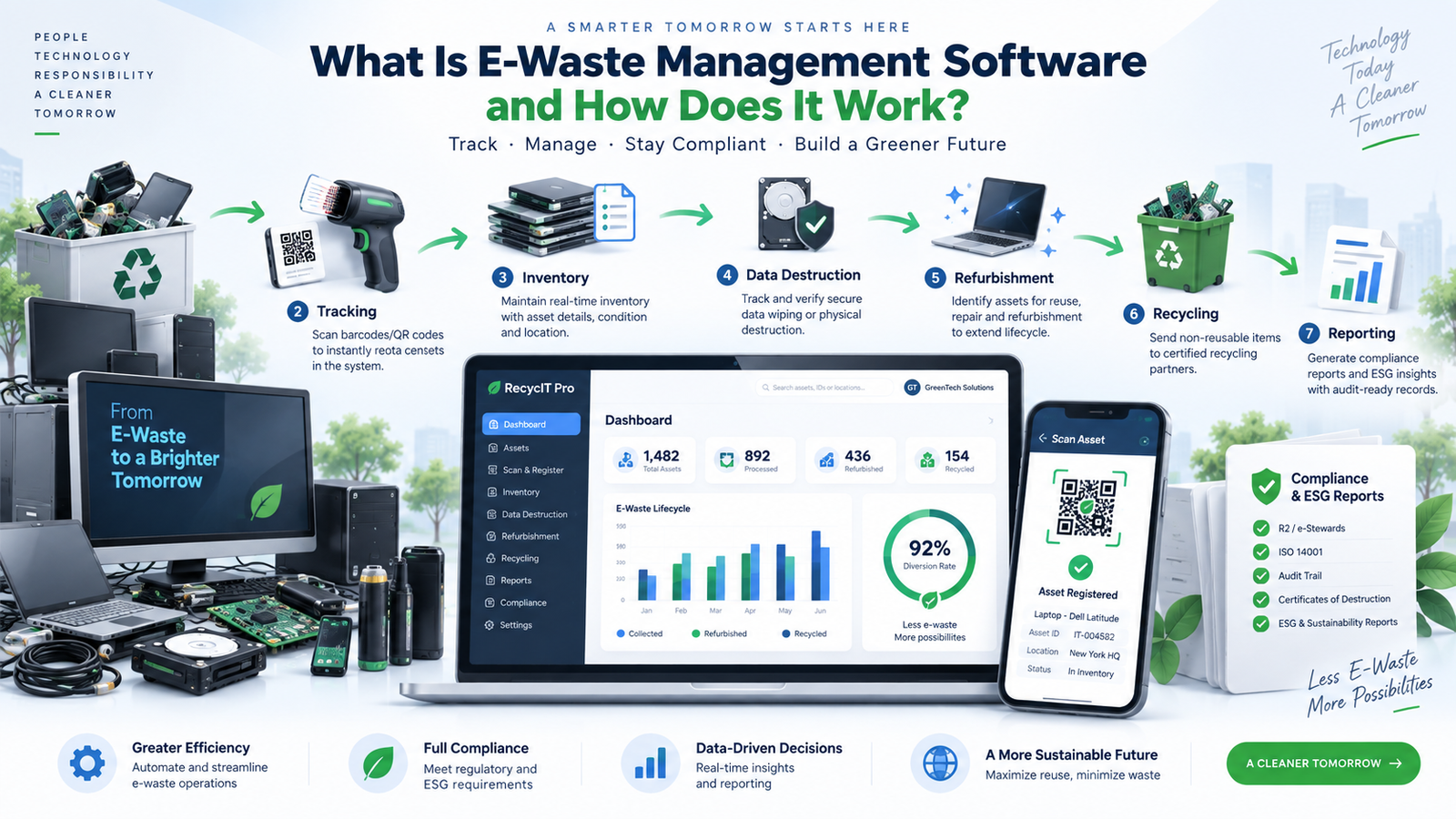
What Is E-Waste Management Software and How Does It Work?
Managing retired electronics becomes difficult when pickup records, asset lists, weight slips, certificates and compliance data are scattered across spreadsheets, emails, paper files and different teams. e-waste management software is a digital platform that connects these activities in one traceable workflow, from collection and asset registration through processing, recovery, documentation and reporting.
What Is an E-Waste Management Platform?
Electronic waste management software is a specialized system for recording, coordinating and reporting the movement and processing of end-of-life electrical and electronic equipment. It can centralize collection requests, asset or batch identification, weights, inventory, logistics, processing status, downstream vendors, certificates, audit trails and management reports.
Unlike basic inventory software, an e-waste management system can follow devices and material through multiple operational stages. An IT asset disposition (ITAD) provider may track a laptop by serial number because it needs data-destruction and disposition evidence. A recycler may track mixed material by batch, category and weight. Many operations need both models.
Why Is Dedicated E-Waste Software Needed?
Common manual problems include missing serial numbers, duplicate entries, inconsistent weights, delayed pickup updates, inventory discrepancies and certificates stored in separate folders. E-waste tracking software and e-waste reporting software become more useful as facilities, customers and downstream vendors increase.
The purpose is not simply to replace an Excel file with another screen. A properly configured platform connects operational records so collection teams, facility staff, managers and compliance teams can work from the same underlying information.
How Does E-Waste Management Software Work?
e-waste management software creates a digital record for each collection, asset, batch or material stream and updates that record as it moves through logistics, receiving, inventory, data handling, refurbishment, dismantling, recycling and final documentation. Each stage adds status, evidence and responsibility to one connected workflow.
1. Collection and Pickup Request
A customer, branch, producer or enterprise location raises a collection request. The system can record the source, contact details, material type, estimated quantity, pickup date and handling instructions.
E-waste collection software may then assign the job to an internal team, vehicle, collector or logistics partner and record proof that the collection occurred.
2. Asset Registration, Classification and Weighing
At collection or receiving, staff create an asset or batch record with fields such as:
- electronic equipment category
- make and model
- serial number
- corporate asset tag
- condition
- quantity
- weight
- originating customer or location
Barcode or QR scanning can reduce repeated entry, while weights remain tied to the relevant job or batch for reconciliation.
This creates an important relationship between the physical material and its digital record.
3. Transportation and Reverse Logistics
Reverse logistics moves electronic products from the user back into reuse, refurbishment, recovery or recycling channels.
The platform can connect pickup information, transportation records, chain-of-custody events and receiving confirmation. This helps close the common information gap between an item being marked “collected” and actually arriving at the destination facility.
4. Facility Receiving and Inventory
Receiving staff reconcile expected assets or weights against what physically arrives and record exceptions.
Inventory can then show which materials or devices are:
- awaiting inspection
- awaiting testing
- pending data destruction
- ready for refurbishment
- scheduled for dismantling
- awaiting recycling
- ready for downstream dispatch
Instead of maintaining different spreadsheets for every stage, the processing status remains connected to the original collection.
5. Sorting and Disposition Decision
Not every electronic device should follow the same route.
Depending on condition, customer requirements, technical viability and applicable rules, an item may be routed toward:
reuse → refurbishment → parts harvesting → dismantling → recycling → material recovery.
The workflow records that decision and preserves its link to the original asset or batch.
This distinction is important because a functional laptop with reuse potential is operationally different from a damaged electronic board entering a material-recovery process.
6. Data Destruction Where Required
Storage-bearing IT equipment may require a controlled data-destruction process before reuse, resale or recycling.
The system can record the selected method, date, operator, device identity, result and supporting evidence or certificate.
Software documents and manages the workflow. It does not replace the technical and physical controls required to sanitize or destroy data securely.
7. Refurbishment, Dismantling and Recycling
Reusable equipment can move into testing, repair and grading workflows. Devices that cannot be reused may be dismantled and separated into components or recyclable material fractions.
E-waste recycling software can connect incoming assets or batches with their processing stages and resulting outputs.
This allows the business to answer an important question:
What actually happened to the electronic material after it entered the facility?
8. Material Recovery and Downstream Vendors
Recovered fractions may need to move to specialized downstream processors.
Vendor records can preserve:
- who received the material
- what material was dispatched
- quantity or weight
- dispatch date
- related batch
- supporting documentation
This extends chain-of-custody visibility beyond the first recycling facility.
9. Certificates, Compliance Reports and Analytics
Operational records can feed customer certificates, recycling summaries, disposal documentation, audit trails, sustainability information and management dashboards.
A well-configured e-waste management software platform does not make data trustworthy automatically. Instead, it creates a structured evidence trail so reports can be generated from actual transactions rather than reconstructed later from emails, registers and spreadsheets.
Key Features of an E-Waste Management System
The value of a feature depends on which operational problem it solves.
Asset and batch tracking links serial numbers or material lots to locations and processing status.
Inventory management helps teams understand what material is physically present and which workflow stage it has reached.
Customer and vendor management connects collectors, transporters, corporate clients and downstream processors to relevant jobs.
Chain-of-custody records and audit trails preserve movement history and help users understand who completed an activity and when.
Barcode or QR tracking can speed identification where hundreds or thousands of individual devices pass through operations.
Workflow automation can trigger tasks, approvals, reminders or exception alerts rather than relying entirely on email or verbal follow-up.
Data-destruction records, recycling certificates and compliance documentation connect operational work with the evidence required by customers or internal teams.
Dashboards can highlight aging inventory, pending collections, unprocessed batches or incomplete documents.
For larger organizations, multi-location management, role-based permissions and integrations become increasingly important. An e-waste ERP software deployment may also connect with finance systems, weighbridges, barcode scanners, customer portals, logistics applications or other enterprise systems.
E-Waste Software vs Spreadsheets and Manual Tracking
| Area | Spreadsheets / Manual Tracking | Dedicated E-Waste Platform |
| Data accuracy | Relies heavily on manual entry and file control | Shared records and validation can reduce inconsistencies |
| Real-time visibility | Usually limited | Status can update across teams and locations |
| Scalability | Harder as transactions increase | Designed around repeatable workflows |
| Asset traceability | Possible but labour-intensive | Asset or batch histories remain linked |
| Reporting | Requires manual consolidation | Uses structured operational data |
| Audit preparation | Often involves reconciliation | Central records can improve readiness |
| Documentation | Frequently stored separately | Documents can remain attached to jobs or assets |
| Multi-site management | Different files and processes | Common workflows can span locations |
| Automation | Limited | Tasks, alerts and approvals can be automated |
| Access control | Mainly file-level permission | Role-based access can be more granular |
Spreadsheets are not automatically a bad option.
A very small, single-location operation with low transaction volume and a simple process may manage adequately with disciplined spreadsheets.
Dedicated software becomes more appropriate when asset traceability, multi-location operations, customer documentation, inventory complexity, recycling workflow automation or recurring reporting exceed what manual systems can reliably control.
Who Uses E-Waste Platforms?
E-waste recyclers can use digital systems for receiving, inventory, sorting, processing and recycling documentation.
ITAD companies often require serial-level tracking, data-destruction records and reuse or resale workflows.
Manufacturers and producers may need visibility into collection, recycling and Extended Producer Responsibility (EPR) information.
Enterprises retiring large IT fleets can follow assets from office locations through collection and final disposition.
Collection agencies benefit from pickup scheduling and movement records, while refurbishers and dismantlers may require device grading, inventory and outbound tracking.
Compliance teams can use centralized records to reconcile operational activity with reporting and documentation requirements.
E-Waste Software and Regulatory Compliance in India
Digital systems can help organizations capture, organize and report compliance information, but using software does not automatically make an organization compliant.
Compliance still depends on real-world activities, accurate records, correct regulatory classification, required registrations, applicable responsibilities, timely submissions and adherence to current rules.
In India, the E-Waste (Management) Rules, 2022 were notified by the Ministry of Environment, Forest and Climate Change and came into force on 1 April 2023. CPCB describes an Extended Producer Responsibility framework covering relevant producers, recycling through registered recyclers, EPR certificates, refurbishing certificates, returns and stakeholder audits.
CPCB also provides specific frameworks and guidance around EPR certificate generation and transfer.
Organizations implementing e-waste compliance software or EPR compliance software should therefore verify current CPCB procedures, E-Waste Rules and subsequent amendments when configuring workflows.
The distinction is important:
Software can help manage compliance information. Software cannot guarantee compliance.
How Software Improves E-Waste Traceability
Traceability means being able to reconstruct where an asset or material batch originated, who handled it, where it moved, what processing occurred and what its final disposition was.
An electronic waste tracking system can connect:
collection → asset identification → transportation → receiving → processing → downstream movement → certificates → final disposition.
Imagine 500 retired laptops collected from a corporate office.
Each serial number can be associated with the collection job, facility receiving scan, data-destruction result, testing outcome and final route.
Some devices might be refurbished. Others might be dismantled, with recovered materials moving to downstream processing.
Instead of different teams manually combining spreadsheets at the end, the reporting history can be built from connected records created throughout the lifecycle.
E-Waste Platforms vs General Waste Management Software
General recycling management software commonly focuses on activities such as route scheduling, containers, weights, billing and commodity movement.
Electronic waste can require much deeper asset-level information.
A laptop, server or storage device may have:
- a serial number
- corporate asset tag
- data-bearing components
- reuse potential
- refurbishment value
- parts-recovery potential
- device-specific disposition evidence
- data-destruction records
A bulk recycling facility may mainly require batch and weight controls.
An ITAD business, by comparison, may require detailed electronic asset tracking, device histories, refurbishment or resale workflows and data-destruction documentation.
The correct platform should reflect the operational model instead of assuming that every waste stream follows the same process.
Business Benefits of an E-Waste Management System
The practical benefits include better operational visibility, less repetitive administration, stronger traceability and more usable documentation.
Centralized records reduce the need to switch repeatedly between spreadsheets, paper registers, emails and disconnected applications.
Workflow automation can move tasks to the correct user and highlight exceptions earlier.
Structured records can make customer and regulatory reporting easier because documentation remains linked to operational transactions.
Multi-location controls can help standardize processes across facilities, while dashboards may highlight pending collections, processing backlogs, aging inventory, incomplete documents or vendor activity.
These benefits still depend on disciplined implementation. Poorly designed processes can simply digitize existing confusion.
How to Choose the Right Platform
When evaluating a dedicated e-waste platform, start with your workflow rather than a long vendor feature list.
Ask:
- What categories of electronic waste do we handle?
- Do we require asset-level tracking, batch-level tracking or both?
- How many facilities and collection locations are involved?
- Do we manage collection and reverse logistics?
- Do we provide data-destruction services?
- Do we refurbish or resell usable equipment?
- Which recycling certificates or customer reports are required?
- Do customers require portal access?
- Which compliance records must be maintained?
- Do we need weighbridge, finance, ERP, barcode or logistics integrations?
- What role-based access controls are available?
- Does the system maintain audit logs?
- Can data be exported if required?
- How are backups handled?
- Can workflows change as the operation grows?
When evaluating e-waste management software, ask the vendor to demonstrate one realistic job from collection through final documentation.
That normally reveals more about operational suitability than a dashboard presentation alone.
How to Implement an E-Waste Management System
Start with a current-workflow audit.
Map existing handoffs, spreadsheets, paper forms, approvals, exceptions and reports. Then identify which information needs to exist at asset, batch, collection, vendor and processing levels.
Next:
- define the required data structure;
- clean existing master data;
- select and configure the platform;
- migrate only useful historical information;
- connect required integrations;
- configure user roles and permissions;
- train teams according to their responsibilities;
- run a controlled pilot;
- compare digital records with physical operations;
- correct workflow gaps before full rollout.
Common implementation mistakes include migrating poor-quality data, copying inefficient manual processes directly into software, creating too many workflow statuses, failing to assign process owners and automating reports before underlying data is reliable.
How Can E-Waste Software Support Sustainability and the Circular Economy?
Better information can support reuse, refurbishment, resale, recycling and material recovery by preserving the history, condition and processing outcome of electronic assets.
Working equipment identified early may be routed toward reuse or refurbishment rather than automatically entering dismantling.
For material that cannot be reused, structured records can connect recycling and recovery outcomes with downstream movement.
Organizations may also use verified operational information for sustainability reporting, waste-diversion measurement and internal circular-economy initiatives.
Software should support measurement and evidence rather than manufacture environmental claims. Any public sustainability claim should be based on an appropriate methodology and reliable underlying data.
From Retired Device to Final Recovery: A Practical Example
The following example is an illustrative scenario, not an Infozion customer case study.
A company replaces 500 laptops across four offices.
The IT team marks the equipment for decommissioning and creates four collection jobs.
At pickup, each laptop is scanned by serial number and linked to its original office.
When the devices reach the processing facility, receiving staff reconcile what was expected against what physically arrived.
Each device then enters a controlled data-destruction workflow.
After testing:
- 180 laptops are suitable for refurbishment;
- 40 devices are suitable for parts recovery;
- 280 devices are routed toward dismantling and recycling.
The electronic records preserve the connection between each serial number and its final disposition.
Recovered material fractions from dismantled equipment can then be assigned to processing batches and downstream movements.
Documents and certificates remain linked to relevant records.
The corporate customer receives a consolidated report covering collection, data handling and disposition, while authorized users can still drill down to an individual device when required.
This is where lifecycle tracking becomes practically valuable: one chain of information follows the equipment instead of separate departments rebuilding its history later.
Which KPIs Can an E-Waste Platform Track?
Depending on the workflow, organizations may monitor:
- collection volume
- number of assets received
- processing turnaround time
- inventory aging
- pending collections
- assets awaiting processing
- reuse or refurbishment rate
- recycling volume
- material recovery outputs
- downstream vendor activity
- documentation completion
- certificate status
- processing exceptions
- vendor turnaround time
- progress against applicable internal or regulatory targets
These metrics should reflect the organization’s actual operational data. Generic industry benchmarks should not be inserted into reporting unless they come from a credible and relevant source.
Common Misconceptions
“E-waste software is only for large recyclers.”
Smaller operators may also benefit where traceability, customer documentation or multi-stage processing is complex. Very simple operations may still function effectively with disciplined spreadsheets.
“Software automatically guarantees regulatory compliance.”
It does not. Software organizes information and workflows; compliance depends on actual operations and current legal obligations.
“It is simply inventory software.”
Inventory is one component. Collection, transportation, chain of custody, processing, downstream vendors, certificates and reporting may also be involved.
“Every electronic device follows the same workflow.”
Reuse, refurbishment, parts recovery, dismantling and recycling require different disposition paths.
“Software eliminates the need for physical operational controls.”
It records and coordinates activity. It does not replace secure storage, safe handling, trained employees or verified processing procedures.
Frequently Asked Questions
1. What does electronic waste management software track?
It can track collection jobs, source locations, assets or batches, serial numbers, weights, inventory status, processing stages, downstream vendors, supporting documents, certificates and final disposition. The appropriate data model depends on whether the business processes serialized IT assets, bulk electronic material or a combination of both.
2. How does e-waste software work in a recycling facility?
The platform creates a digital record when material is collected or received and updates that record as material is weighed, classified, stored, sorted, processed and dispatched. Staff can scan assets or batches, attach documentation and update workflow status so operations, management and compliance teams share the same processing history.
3. Can e-waste software track individual electronic assets?
Yes. Asset-level tracking can use manufacturer serial numbers, corporate asset tags, barcodes or QR codes. It is particularly useful for laptops, servers, storage devices and similar equipment where organizations may need a history of receiving, data destruction, testing, refurbishment or final disposition.
4. Who needs an electronic waste tracking system?
Recyclers, ITAD providers, refurbishers, enterprises retiring large IT fleets, producers, manufacturers, collection networks and compliance teams may use one. The business case becomes stronger when an organization manages higher transaction volumes, multiple locations, individual asset histories, several downstream vendors or recurring customer and regulatory reporting.
5. Can e-waste management software help with EPR compliance in India?
It can support EPR-related record keeping, target monitoring, recycling documentation and reporting workflows, but it does not guarantee compliance. Organizations should verify current E-Waste Rules, amendments and Central Pollution Control Board procedures for their specific regulatory role before configuring the system.
6. How much does e-waste software cost?
Pricing depends on factors such as users, facilities, transaction volumes, customization, mobile functionality, integrations, customer portals, compliance modules and implementation requirements. Buyers should compare the total cost of ownership—including configuration, migration, training, support and future changes—rather than evaluating only the licence or subscription fee.
7. How long does implementation take?
There is no universal implementation timeline. A focused single-site system with standardized workflows is generally less complex than a multi-location deployment involving legacy data, weighbridges, financial systems, customer portals and custom compliance processes. A controlled pilot is useful for discovering operational gaps before the system is expanded across the organization.
8. What reporting should an e-waste system provide?
Useful reports can cover collection volumes, inventory status, processing outcomes, refurbishment or recycling volumes, asset disposition, downstream movements, certificate status, customer documentation and audit trails. Regulatory reports should always be configured against verified requirements rather than assumptions about what a regulator requires.